


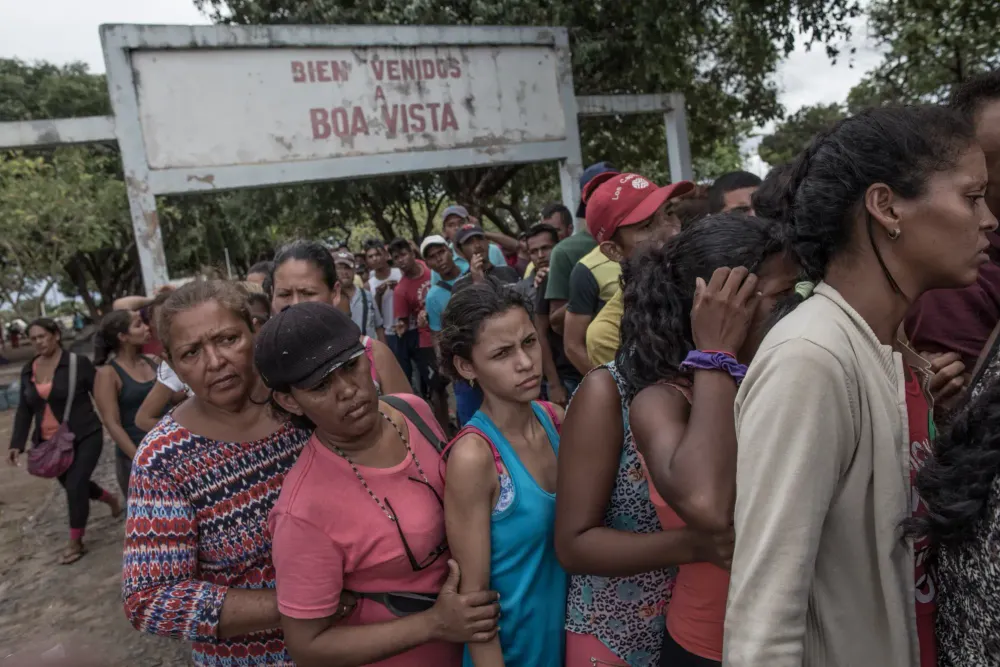
MIAMI — For decades, Cubans looking to leave the island had one destination fixed firmly in mind: the United States. That calculus has shifted dramatically over the past two years, and the numbers now make the new pattern unmistakable — Brazil has become the top destination for Cuban asylum seekers anywhere in the world, surpassing even Venezuelans as the largest nationality requesting refuge in the South American country.
Cubans filed 13,414 asylum applications in Brazil during just the first four months of 2026, according to Radio Martí’s reporting on Brazilian migration data.
Over the full first half of the year, Cuban applications reached 20,372 — 59.31% of all 34,346 asylum petitions filed nationally in Brazil during that period, according to the Observatory of International Migrations (OBMIGRA). That volume nearly quadrupled the 5,853 applications filed by Venezuelans, the second-largest group, and dwarfed the 138 filed by migrants from the Democratic Republic of Congo, the third-largest nationality on the list.
The pattern is not new for 2026 specifically — Cubans have led Brazil’s asylum rankings since the second half of 2025 — but the scale has continued growing.
Brazil recorded more than 41,000 Cuban asylum applications in all of 2025, itself a record at the time. Looking back further, Cuban asylum applications in Brazil totaled 114,779 between January 2015 and June 2026, according to the Cuba Capacity Building Project at Columbia University.
Why Brazil? Why Now?
The shift traces directly to the closure of pathways to the United States. The Trump administration’s tightening of the U.S. southern border and reduction of legal migration options for Cubans has pushed migrants toward alternative routes, with Brazil emerging as the primary beneficiary.
The migration path itself represents a striking reversal of a well-worn corridor. For years, migrants trying to reach the United States moved north through the Amazon region toward Central America and Mexico. Now, some of that same geography is being traveled in the opposite direction: Cuban migrants often first travel to Guyana, which does not require a visa, before continuing into Brazil through the Amazon.
Most enter through Brazil’s northern region, particularly the state of Roraima, which borders Venezuela, according to OBMIGRA data — while São Paulo remains one of the primary declared destinations for those seeking protection once inside the country.
What Asylum Status Actually Provides
Cuban migrants have gravitated toward Brazil’s asylum process specifically because it offers immediate, practical benefits while a case is pending. Applicants receive a provisional foreign identity document, a taxpayer registration number (CPF), and immediate work authorization — along with equal access to Brazil’s public health system (SUS) and municipal public services.
That immediate documentation and work access stands in contrast to the increasingly difficult odds of the asylum claims themselves actually being approved: official data shows approvals for Cuban asylum seekers have declined sharply in recent years, with only a small number of claims granted between 2023 and June 2026, even as application volume has surged.
A Community Reaching Historic Scale
The cumulative effect of this migration wave has made Cubans one of Brazil’s most significant immigrant communities. As of 2025, an estimated 103,427 Cubans were formally registered in Brazil, with total estimates — including undocumented migrants and pending asylum requestees — ranging from 100,000 to more than 150,000. That figure makes Brazil home to the third-largest Cuban community in the world, trailing only Spain and the United States.
Cuban communities have concentrated particularly in São Paulo, Santa Catarina, Paraná, Rio Grande do Sul, the Federal District, Roraima, and Minas Gerais. The scale of the shift becomes clearer set against recent history: between 2020 and 2021, only about 3,500 Cubans were registered in Brazil in total — meaning the community has grown roughly thirtyfold in under five years.
The Human Stakes Behind the Statistics
For many Cubans considering the journey, the decision is inseparable from Cuba’s deepening internal crisis, including for families of political prisoners.
Speaking from Güines, in Mayabeque province, Maibol González García — wife of imprisoned political dissident Noslen Ayala García — described her situation starkly: “Mi esposo está preso y yo estoy prácticamente presa también” — “My husband is imprisoned, and I am practically imprisoned too” — saying she intends to emigrate specifically to help support her family. She was equally clear that her preference would be to stay in Cuba under different political conditions: If the country’s regime changed, she said, she would never leave.”
Brazil’s Own Policy Response Remains Unsettled
The scale of arrivals has sparked debate within Brazil over how to handle the influx longer-term. Migrant advocacy organizations have called for Brazil to consider a broader residency authorization for Cubans, similar to one previously extended to Venezuelan citizens during an earlier wave of migration from that country.
At the same time, Brazil has tightened certain controls: since 2024, individuals arriving at São Paulo’s international airport have been barred from filing asylum applications directly at the airport itself, a measure authorities have justified as part of efforts to combat human trafficking.
With the Trump administration continuing to expand economic sanctions against Havana throughout 2026 and Trump himself insisting “there will be many changes” on the island in the coming months, coupled with a current regime in Havana committed to its relentless course of socialist resistance, the underlying pressures driving Cuban emigration show no sign of easing.
For now, that pressure continues translating into steadily rising numbers heading toward Brazil rather than the United States — a migratory shift analysts expect to continue as long as U.S. pathways remain closed and conditions on the island remain unchanged.