

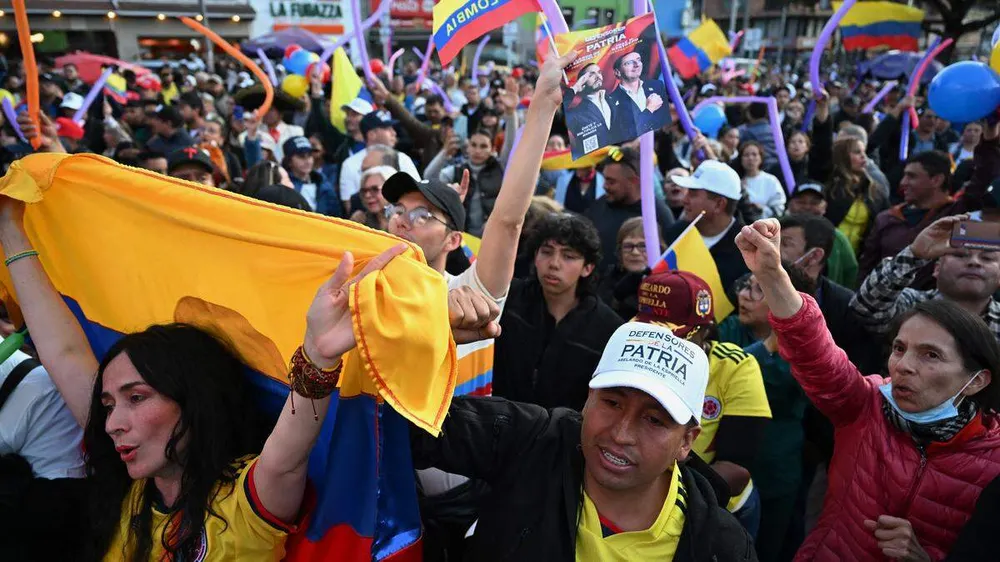
Colombia goes to the polls on Sunday in the most security-intensive election the country has ever held. The government’s plan to protect the May 31 first round election will deploy 248,000 uniformed personnel across the country — soldiers, police, and specialized electoral security units — in a mobilization designed to confront what authorities have described as the proliferation of armed groups and their intent to influence the process by coercing voters in several regions of the country.
The sheer number reflects a specific threat assessment: that the security crisis that has defined this campaign — 35 massacres in the first quarter, a senator’s convoy ambushed in Cauca, a soldier killed by a drone, campaign staffers murdered in Meta — will not end on Saturday because armed groups have agreed to stop fighting. Some of them have not.
The ELN’s Ceasefire — and Its Limits
Colombia’s National Liberation Army declared a unilateral ceasefire that will run from midnight on May 30 to midnight on June 2, covering Colombia’s first round of presidential voting on May 31.
The group says the move is intended to respect citizens’ right to vote.
The ELN ceasefire is real and historically consistent — the group has declared electoral ceasefires before every major Colombian vote in recent years, including the 2022 presidential election. Its stated logic is straightforward: the ELN wants to see who wins, and it prefers to negotiate with a new government from a position of demonstrated restraint rather than as an organization that disrupted an election.
The announcement comes amid fresh allegations from former President Álvaro Uribe Vélez, who claims that armed groups are pressuring voters in parts of Cauca to support candidate Iván Cepeda. The ceasefire and the accusations have intensified concerns over whether the 2026 election can be held under conditions that fully guarantee freedom of choice.
Uribe’s allegations — that armed groups are conducting voter coercion in Cauca in favor of Cepeda — are political denunciations that would require investigation and corroboration by relevant authorities. They have not been independently verified. What is documented, by civil society organizations, the Colombian ombudsman, and the United Nations, is that Cauca is one of Colombia’s most complex security environments, where communities have repeatedly reported confrontations, forced displacement, and attempts by illegal actors to influence daily life and governance.
Whether the specific coercion Uribe describes is occurring is a separate question from whether the conditions for such coercion exist. They do.
The Splintered Factions Problem
The ELN’s ceasefire does not bind the Estado Mayor Central’s splinter factions — the groups responsible for the most significant violence of this campaign. The April 25 bombing that killed 21 civilians on the Pan-American Highway, the senator convoy ambush, and the drone strike that killed Sub-Lieutenant Bedoya Rivero were all attributed to the Jaime Martínez front of the EMC. That front is not party to any ceasefire arrangement.
Despite the ELN and EMC agreeing to a ceasefire, splintered factions are likely to carry out attacks. Election-related gatherings are likely to cause travel disruptions.
Colombia’s security planners understand this. The 248,000 security personnel deployment is calibrated not to a scenario where all armed groups respect a ceasefire, but to a scenario where disciplined organizations like the ELN stand down while fringe factions, criminal enterprises, and territorial micro-organizations — the groups that do not negotiate and do not respect electoral protocols — continue to operate. That is the scenario most likely to materialize on Sunday.
What the Deployment Actually Looks Like
The 248,000 figure encompasses multiple security forces operating under a unified electoral security command. Military units will secure transportation corridors in conflict-affected departments — the Pan-American Highway in Cauca and Valle del Cauca, the border regions of Nariño and Putumayo, and the Bajo Cauca corridor in Antioquia. Police will cover urban and peri-urban polling stations. Specialized anti-explosive units will screen venues in departments with documented bombing history. Intelligence units will monitor social media for coercion reports and attempt real-time intervention where possible.
The Registraduría Nacional — Colombia’s electoral authority — has documented specific threat assessments for 427 municipalities, which it has shared with military and police commanders. In each of those municipalities, a security force commander has been assigned direct accountability for electoral protection. This is a more operationally specific deployment than previous elections.
The government’s public posture is one of confidence. Interior Minister Juan Fernando Cristo said the security deployment was “the largest in Colombia’s electoral history” and that the state was “fully prepared to guarantee Colombians’ right to vote.”
That language is both accurate — the numbers are real — and deliberately calibrated to project institutional strength in the days before the vote.
The Voter Intimidation Question
The hardest security challenge Sunday is not a single coordinated attack — it is the diffuse, low-visibility coercion that armed groups exercise in territories where they govern more effectively than the state.
In the mountainous municipalities of Cauca, the coca-growing regions of Nariño, and the river corridors of the Chocó, the question is not whether voters will be physically blocked from reaching polling stations. It is whether the daily presence of armed groups — their control of local economies, their relationships with community leaders, their capacity for retribution — shapes how people vote before they ever leave their houses.
That form of coercion is what Uribe is alleging in Cauca. It is also what the Colombian ombudsman, the UN Office for the Coordination of Humanitarian Affairs, and multiple civil society organizations have documented across Colombia’s conflict-affected regions throughout this campaign. It is not measurable in the same way that a bombing or an ambush is. It is also not preventable by deploying 248,000 uniformed personnel.
What Happens After Sunday
If Sunday’s vote produces a credible result — one that international observers, including the EU monitoring mission and the OAS Electoral Observation Mission currently deployed in Colombia, are willing to validate — it will do so despite, not because of, the security environment. The country will then have three weeks before the June 21 runoff, in which the same armed groups that have defined this campaign’s violence will continue to operate in the same territories under the same conditions.
The ELN ceasefire ends June 2. The splintered factions’ attacks never had a ceasefire to end. The 248,000 security personnel will begin standing down after the vote is counted. And Colombia’s next president — whoever emerges from the runoff on June 21 — will inherit the security architecture, the peace negotiation frameworks, and the territorial reality that has produced this campaign’s violence.
Sunday is not the end of Colombia’s security crisis. It is a day when 39 million Colombians are asked to exercise their democratic right in the middle of one.
Sociedad Media will continue to cover Colombia’s May 31 first round and the June 21 runoff. Tips and feedback welcome at info@sociedadmedia.com