

CATALONIA, SPAIN — Spain’s National Police announced on Wednesday that a joint operation with France’s anti-narcotics office had dismantled a cell of the Cartel de Jalisco Nueva Generación (CJNG) operating in Catalonia, seizing roughly 2.5 tons of methamphetamine in what authorities describe as one of the largest interdictions of its kind ever recorded in Spain or Europe.
Hidden in Vanilla
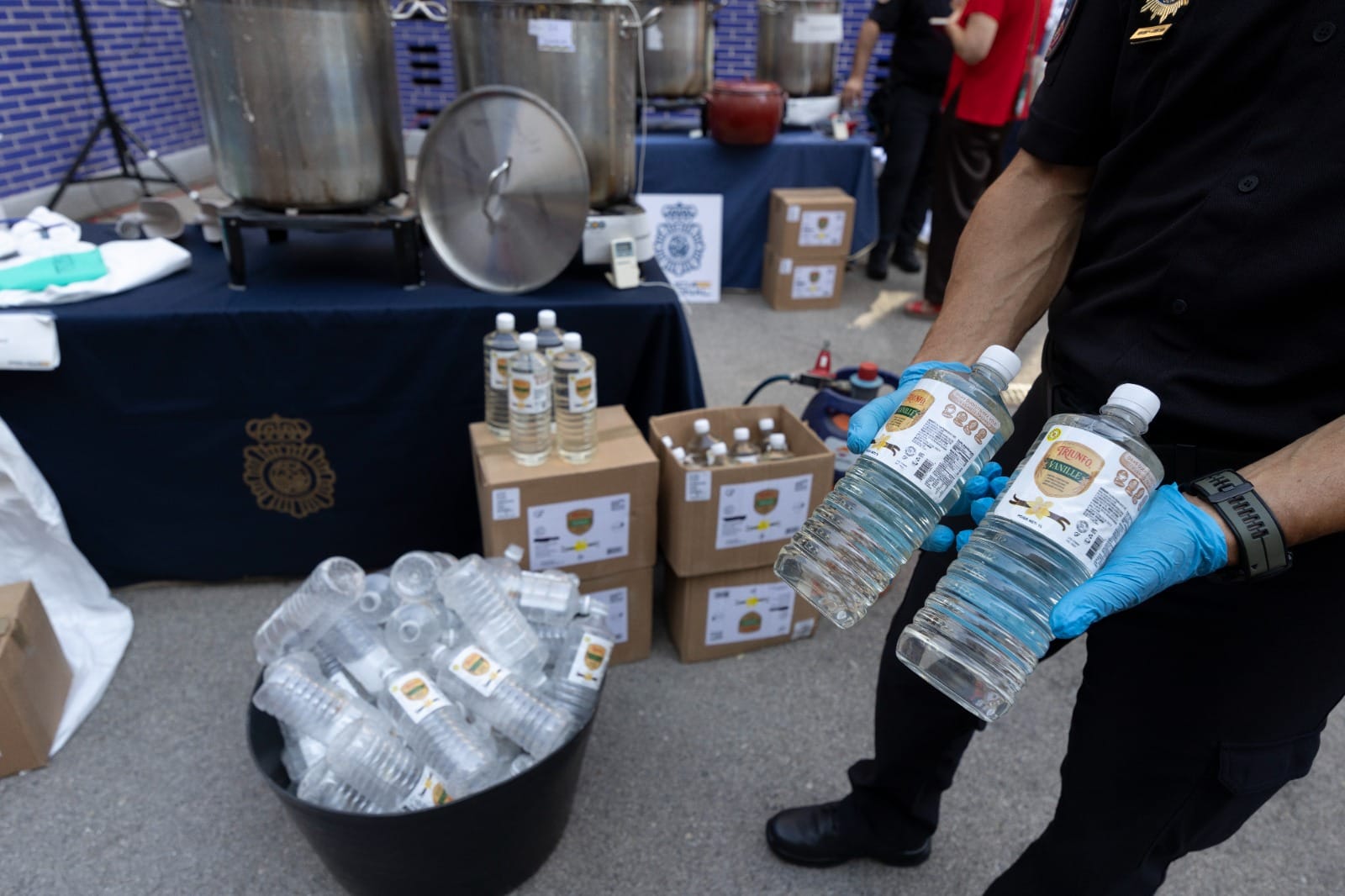
The organization’s method of concealment was, according to Spanish and Mexican outlets covering the case, deliberately engineered to defeat standard port inspections: more than 2.5 tons of methamphetamine dissolved into roughly 12 tons of liquid vanilla flavoring, shipped by sea from Mexico in containers destined for Spanish ports.
Once the shipment arrived, the plan called for extracting and re-crystallizing the drug at a clandestine laboratory the cartel had established on a rural property in Almenar, a town in Catalonia’s Lleida province — a location police say was chosen deliberately for its proximity to France and its extensive road and communications network.
How the Investigation Unfolded
French intelligence services first flagged the operation in early June, after intercepting a suspicious maritime container originating in Mexico and bound for Spanish ports.
Spanish and French authorities then tracked the shipment through to its final destination, monitoring the property in Almenar until investigators confirmed the group had begun the chemical process of recovering the methamphetamine from the vanilla liquid.
Video of arrests by Spain’s National Police, working jointly with France’s OFAST (Office Anti-Stupéfiants) in Catalonia, detaining 13 cartel affiliates with Mexican, Colombian, and Spanish nationalities. Credit: Spain National Police
At that point, on July 10, police launched a coordinated operation across seven simultaneous searches in Barcelona, Lleida, and Tarragona, arresting the organization’s key operators and dismantling the full logistics infrastructure used to receive, store, transport, and chemically process the drug.
Spanish authorities did not make the operation public until this Wednesday, nearly a month after the arrests took place.
Who Was Arrested
Thirteen people were detained: seven Mexican nationals — five from the Guadalajara metropolitan area in Jalisco, CJNG’s principal stronghold and base of operations, and two from Sinaloa — along with Spanish and Colombian nationals rounding out the rest of the group.
A judge ordered twelve of the thirteen held in pretrial detention. Police described the network as an itinerant cell with no apparent intention of establishing permanent roots in Spain, consistent with a logistics-and-processing operation designed to move product through rather than build lasting local infrastructure.
Part of a Broader Pattern
This is not CJNG’s first documented attempt to establish a foothold in Europe. Last November, a separate joint operation involving Spanish police, the U.S. DEA, and Dutch authorities — dubbed Operación Oyamel — dismantled what officials called a CJNG “office” in Spain, arresting 20 people, including members of Italy’s Camorra crime network and two individuals identified as priority DEA targets.
That earlier operation seized 1,870 kilograms of cocaine, 375 kilograms of methamphetamine, €275,000 in cash, and roughly $15,000 in cryptocurrency, with authorities noting the group had smuggled cocaine into Spain concealed inside heavy industrial machinery.
Taken together, the two operations — an office-style logistics network last November, and now a dedicated processing laboratory this summer — suggest CJNG has been actively working to build out direct refining and distribution infrastructure inside European territory, rather than simply exporting finished product from Mexico.
Spain’s Interior Ministry noted that the discovery of the Almenar processing site specifically reflects the cartel's attempt to establish refinement and logistics-intermediary hubs directly on European soil.
European Cells
The bust adds to a growing body of evidence that Mexican cartels, and CJNG in particular, are treating the European market as more than a simple export destination — investing in the kind of embedded local infrastructure, multinational personnel networks, and industrial-scale concealment methods previously associated mainly with cartel operations closer to the U.S. border.
The case also reflects deepening European counter-narcotics cooperation, with French intelligence services initiating the tip that ultimately led Spanish police to the lab, and follows a broader pattern of transatlantic law enforcement partnerships increasingly targeting Mexican cartel infrastructure well beyond North America.
Spanish authorities have not indicated whether additional arrests are expected or whether the investigation has identified further cartel infrastructure elsewhere in Europe.
The case is being handled by Spain’s judicial authorities, with twelve of the thirteen detained individuals currently held in pretrial detention as the investigation into the network’s broader European operations continues.
🚨🇪🇸🇲🇽 | ALERTA/SECURITY/MEXICO: Spain's National Police announced Wednesday that a joint operation with France's anti-narcotics office had dismantled a cell of the Cartel de Jalisco Nueva Generación (CJNG) operating in Catalonia, seizing roughly 2.5 tons of methamphetamine in… https://t.co/KY5En3NXUx
— Sociedad Media (@sociedadmedia) August 5, 2026


