

SAN DIEGO — The store was called Buy 4 Less. It sold nothing. Customers rarely walked in. A small group of supposed employees came and went. And underneath the storage room floor, behind a hydraulic lift concealed in the concrete, a nearly 2,000-foot tunnel bored through the earth toward Tijuana — engineered to move cocaine by the ton into the United States.
Federal authorities dismantled the operation on May 29, seizing more than 2,269 pounds of cocaine valued at approximately $45 million and charging four men with federal drug distribution offenses. The bust, announced by the U.S. Department of Justice on June 1, exposed one of the most sophisticated drug smuggling tunnels discovered along the U.S.-Mexico border in years — and confirmed it as the work of the Jalisco New Generation Cartel, the most aggressive criminal organization in Mexico.
Six Months Underground
The investigation began not with a tip, but with a storefront that didn’t add up.
Authorities say HSI’s Tunnel Task Force began watching the Buy 4 Less storefront in December 2025 after identifying suspicious activity — a supposed discount store near one of the busiest border crossings in North America that showed minimal foot traffic from actual customers. For six months, investigators surveilled the location before intercepting what prosecutors describe as the suspects’ first attempted cocaine shipment into the United States on May 29.
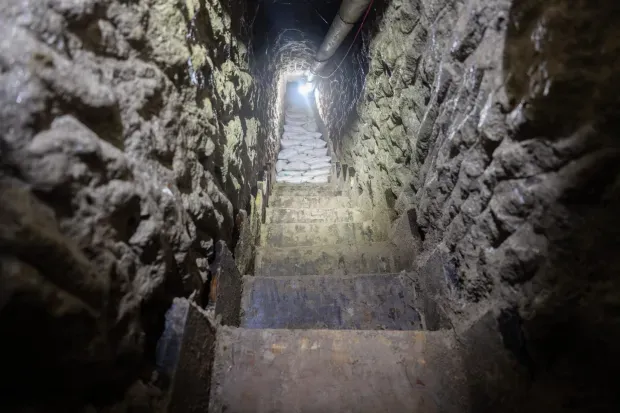
Traffic stops and K9 alerts on May 29 led investigators to the tunnel’s exit concealed beneath the Buy 4 Less storage room floor. Behind a hydraulic lift, agents found the entrance to a passage that dropped 55 feet underground and extended nearly 2,000 feet toward Tijuana. Three vehicles pulled over that day yielded 851 packages of suspected cocaine — 1,029 kilograms in total.
The four defendants charged are Gregorio Hernandez, 29, and Jose Jimenez, 32, both of San Diego, and Mexican nationals Antonio Cortez, 18, and Brandon Escalante, 26. All four face conspiracy to distribute cocaine charges carrying a maximum sentence of life imprisonment and fines of up to $10 million. Hernandez faces additional charges of conspiracy to use a border tunnel and conspiracy to import controlled substances.
The Engineering of Impunity
The tunnel was not a crude hole in the ground. The 1,933-foot passage drops 55 feet below the surface and features reinforced walls, sections up to 4.5 feet high, lighting, a ventilation system, an electric rail system for transporting large drug loads, and multiple staircases. The level of construction required serious money and serious planning.
“Yesterday, following a months-long investigation by the Homeland Security Task Force, authorities discovered a sophisticated cross-border tunnel connecting Tijuana, Mexico, to a building posing as a retail store in Otay Mesa, California,” said Acting Attorney General Todd Blanche. “This case reflects our unwavering commitment to dismantling cartels, stopping the flow of dangerous drugs into our communities, and keeping American families safe.”
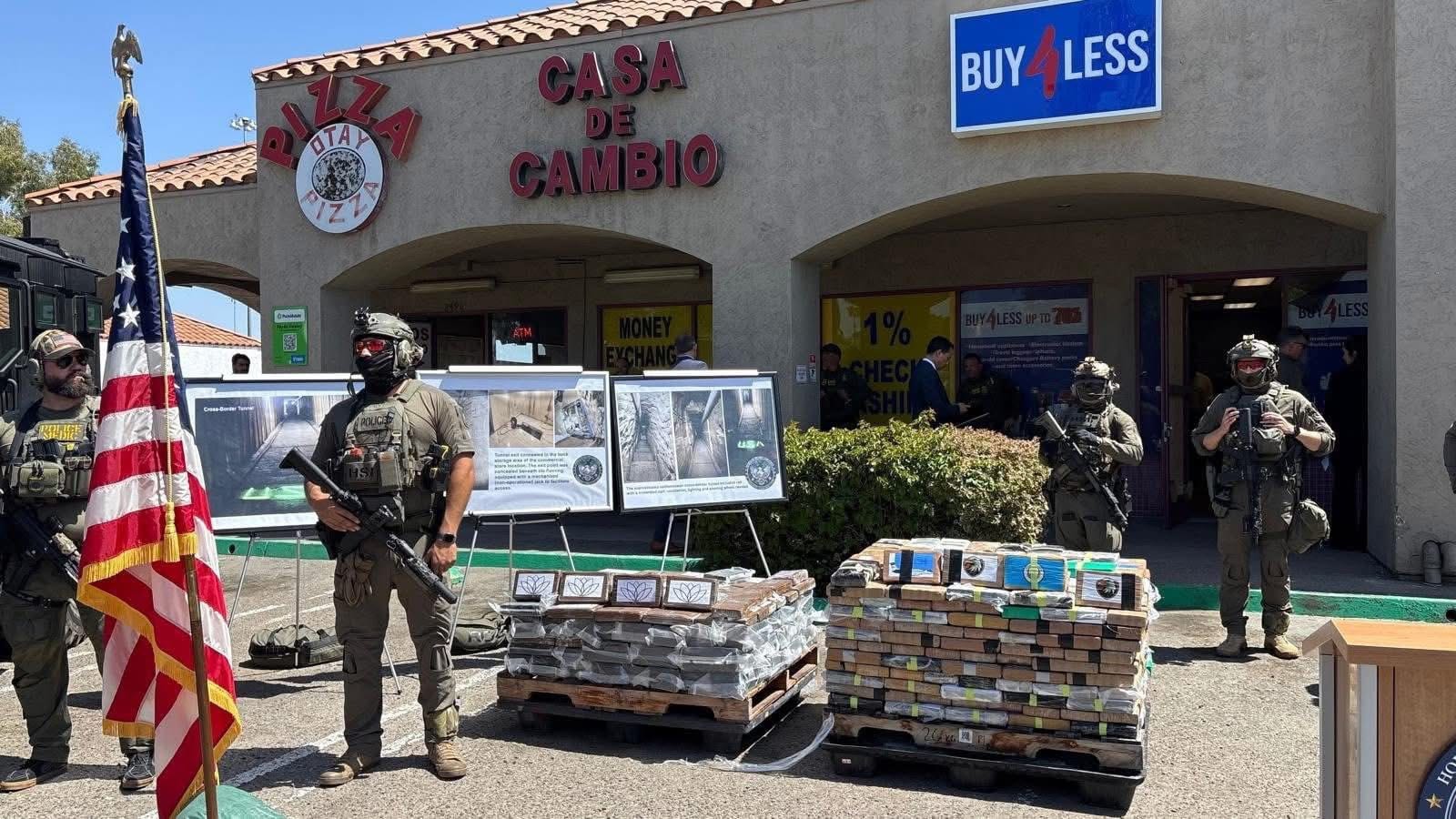
U.S. Attorney Adam Gordon offered the prosecution’s verdict in a single line: “For these defendants, it wasn’t a light at the end of the tunnel. It was lights and sirens.” He added: “Cocaine is now the lifeblood of the cartels — and what you see here today is a cardiac arrest for their system.”
It was the first operational tunnel found in the jurisdiction of the U.S. District Court for the Southern District of California since 2022.
CJNG in Sinaloa’s Backyard
The cartel attribution carries significance that extends beyond the seizure itself.
Authorities confirmed the tunnel was built and operated by the Jalisco New Generation Cartel — an organization that has expanded its reach across the United States in recent years and increasingly turned to cocaine as its primary revenue stream. HSI Acting Special Agent in Charge Kevin Murphy called the seizure a “significant blow” to the CJNG.
Otay Mesa has historically been a Sinaloa Cartel corridor. The discovery of a CJNG-operated tunnel in this district — engineered at enormous cost and sophistication — signals an aggressive territorial push by the Jalisco cartel into infrastructure that its rivals have dominated for decades. The timing is not incidental. The death of CJNG founder Nemesio Oseguera Cervantes, known as “El Mencho,” earlier this year left the organization’s future leadership uncertain — yet the Otay Mesa tunnel suggests the cartel’s operational capacity remains fully intact, even as its rivals may have assumed otherwise.
The Sinaloa Cartel, meanwhile, has been in internal disarray since the 2024 arrest of Ismael “El Mayo” Zambada and the factional war that followed. A weakened Sinaloa at Otay Mesa creates an opening — and the CJNG, whatever its leadership questions, appears to have moved to fill it.
The Wall Has Never Stopped a Tunnel
The Otay Mesa industrial zone has been a tunnel corridor for three decades. There have been 90 subterranean passageways discovered in the Southern District of California since 1993, 27 of which are considered sophisticated. The clay-like soil of the Otay Mesa industrial zone makes digging easier, and the warehouses and commercial buildings above provide ideal cover. Cartels have used tunnels as a trafficking method since the early 1990s.
🎥 Footage of discovery of Buy 4 Less drug tunnel ⬇⬇
Source: X
The location is, by any measure, one of the most fortified stretches of the U.S.-Mexico border — layers of fencing, surveillance technology, and patrol infrastructure designed to stop exactly the kind of trafficking the Buy 4 Less operation represents. None of it reached underground.
The Trump administration’s border security agenda, centered on wall construction and military deployments, confronts the same structural limitation every administration has faced: walls stop what moves above ground. They have never stopped what moves beneath it.
The 90 tunnels discovered since 1993 represent only what was found. Authorities have consistently acknowledged they cannot determine how long any tunnel operated before detection — or what moved through it undetected.
The Broader Counter-Narcotics Picture
The bust arrives as the Trump administration has escalated its counter-narcotics campaign across the hemisphere. The U.S. designation of the CJNG as a foreign terrorist organization — part of a sweeping round of FTO designations that also included the Sinaloa Cartel, Venezuela’s Cartel de los Soles, and last week Brazil’s PCC and Comando Vermelho — provides federal prosecutors with expanded legal tools to pursue cartel networks operating on U.S. soil.
The California National Guard Counter Drug Task Force supported the Otay Mesa operation, reflecting the increasingly militarized posture of U.S. counter-narcotics enforcement along the border.
Governor Gavin Newsom confirmed the Guard’s involvement, calling the seizure a demonstration of cross-agency cooperation saving lives across California.
Whether the Buy 4 Less tunnel was the CJNG’s first foray into Otay Mesa or the first one caught remains an open question.
Federal authorities say the investigation is ongoing.


