

MIAMI — On the morning of May 1, thousands of Cubans marched through Havana’s waterfront under the hot Caribbean sun, past the U.S. Embassy, and into the José Martí Anti-Imperialist Square. The slogan on the banners read:
“The Homeland is Defended.”
The message was not directed at the marchers, but at the North Americans in Washington.
At the front of the procession, in military uniform, walked 94-year-old former leader Raúl Castro — his most visible public appearance in months. He was accompanied by President Miguel Díaz-Canel and other officials waving flags. At one point during the ceremony, Raúl had to sit down suddenly, which stirred speculation into possible growing weakness at the top.
In Washington, as the march proceeded, White House officials were briefing reporters on a new executive order.
On Friday, President Trump signed the implementation of broadening U.S. sanctions against Cuba’s government to target people, entities, and affiliates that support its security apparatus, those complicit in corruption or serious human rights violations, and agents, officials, or supporters of the Cuban government. The order can apply to “any foreign person” operating in the energy, defense, metals and mining, financial services, or security sector of the Cuban economy — or any other sector.
Jeremy Paner, a former sanctions investigator at the U.S. Treasury’s Office of Foreign Assets Control, called the move “the most significant one for non-American companies since the U.S. embargo against Cuba began decades ago.”
Oil and gas companies, mining companies, and banks that had carefully segregated their Cuba operations from the United States are no longer protected.
The timing was deliberate. Trump signed the order as tens of thousands of Cubans marched during the international May Day demonstrations, in what has been adopted as the global rallying cry for socialist-like politics.
Havana called the new batch of U.S. sanctions collective punishment. Washington called it pressure. Both descriptions are accurate.
What the Blockade Has Done
To understand the May Day exchange — the march, the sanctions, the speeches — you need to understand what five months of blockade have done to Cuba’s physical reality.
Executive Order 14380, signed on January 29, declared Cuba an “unusual and extraordinary threat” and imposed an energy embargo that reduced Cuban oil imports by 80% to 90%, causing power outages of up to 25 hours a day in more than 55% of the country's territory.
According to the United Nations Human Rights Office, the blockade and ensuing fuel shortage have threatened Cuba’s food supply and disrupted the country’s water systems and hospitals. Only 44 of Havana’s 106 garbage trucks are operational. Canadian mining company Sherritt paused operations at its Moa facility. Foreign airlines have suspended flights. A Russian oil tanker carrying 100,000 tonnes of crude — enough to cover approximately 12 days of Cuban energy demand — arrived in Havana in late March, providing temporary relief that did not address the structural shortage.
The new sanctions do not increase the fuel blockade — they expand its reach to any foreign company operating in any sector of the Cuban economy. The intent is to remove the remaining financial oxygen from an economy already struggling to breathe.
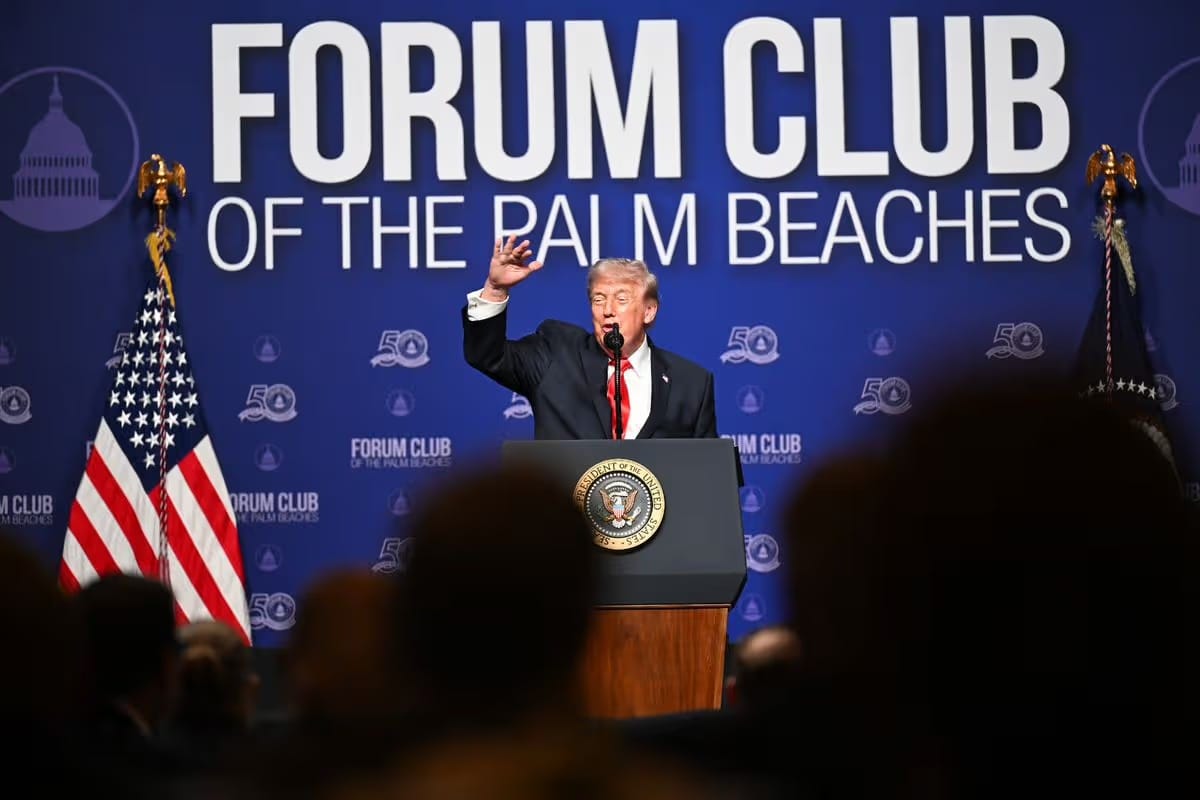
On the same evening Trump signed his May 1 executive order, he delivered remarks at a private dinner at the Forum Club in West Palm Beach that removed any ambiguity about the military option’s proximity.
“On our way back from Iran, we’ll have one of our great ships — maybe the USS Abraham Lincoln, the biggest in the world — come and stop about 100 yards off the coast, and they’ll say: ‘Thank you very much, we surrender,’” Trump told the audience, adding that the United States would be “taking over” Cuba “almost immediately” after concluding operations in the Middle East.
“I like to finish a job first,” he said. Cuba’s Foreign Minister Rodríguez Parrilla responded with sarcasm the following day: “What will we do with that huge chunk of metal?”
The USS Abraham Lincoln is currently deployed in the Arabian Sea as part of Operation Epic Fury against Iran. Its home port is San Diego — on the Pacific Coast. Routing it to Cuba would require circumnavigating the continent. Whether Trump’s remarks represent a genuine operational plan or political theater directed at the Forum Club’s Cuban-born guests, the message was clear enough for Díaz-Canel to incorporate it into his War of All the People address the same day.
Díaz-Canel’s Response: War of All the People
Díaz-Canel did not respond to Trump’s executive order with diplomatic language. He responded with a doctrine.
“We are not afraid of war, and there will be neither surprise nor defeat here,” Díaz-Canel told the May Day crowd. He invoked the “War of All the People” — a defensive military doctrine developed by Fidel Castro during the Reagan administration’s invasion threats in the 1980s, when the Soviet Union could not guarantee direct military intervention on Cuba's behalf.
“Under this defensive doctrine, every Cuban has a rifle. Every Cuban has a position in defense and a mission to fulfill in defense of the homeland, the revolution, and socialism,” Díaz-Canel said.
To illustrate Cuba’s capacity for resistance, he referenced the 32 Cuban escorts killed during the U.S. operation that captured Nicolás Maduro on January 3. “Imagine what could happen if Cuba faces a military invasion, where the example of those 32 would be multiplied by millions of Cubans,” he said.
Foreign Minister Bruno Rodríguez Parrilla reinforced the message: “The Homeland, the Revolution, and Socialism are defended with ideas and with arms. We will not be intimidated.”
The invoking of the War of All the People doctrine is not new — Díaz-Canel has referenced it before. What is new is the context in which it is being invoked. In the 1980s, the doctrine was a deterrent against a threat that never materialized. In 2026, it is being invoked against an administration that captured Venezuela’s president four months ago, has cleared the Senate’s war powers pathway for Cuba, and is now signing executive orders targeting any foreign company that does business on the island. The threat is not rhetorical. The doctrine’s invocation is a response to a real and documented escalation.
Raúl Castro’s Appearance — and What it Signals
Raúl Castro's presence at the May Day march — walking in military uniform, sitting down suddenly during the ceremony, visibly tired under the warm, humid air — was simultaneously a show of unity and an acknowledgment of fragility. A 94-year-old man who has not been seen regularly in public, appearing at the most politically charged event of the Cuban calendar, is not a routine appearance.
The signal it sends is specific: the Castro family is still present, still visible, still aligned with the government’s posture in its moment of maximum external pressure. Whether that alignment represents genuine institutional coherence or a managed performance of unity is a question that analysts of Cuban politics have been debating for months.
Under Cuba’s 2019 constitution, Díaz-Canel can be replaced if he resigns, is removed, dies, or is deemed unable to continue. Vice President Salvador Valdés Mesa would take over temporarily, and the National Assembly would appoint a new president.
The conventional institutional successor, identified by most analysts, is Roberto Morales Ojeda, secretary of organization of the Central Committee of the Communist Party, a former public health minister who served under both Raúl Castro and Díaz-Canel.
The succession question is not academic. Washington’s stated goal is regime change in Cuba by the end of 2026. The question it has not answered publicly — and which POLITICO reported this week is being actively debated internally, is whether that means the removal of the entire revolutionary system or a more targeted removal of specific officials, followed by economic reform and a negotiated transition. Those are not the same thing, and the difference matters enormously for the 11 million Cubans living under the system being targeted.
The Diplomacy Track — and its Limits
Behind the martial rhetoric, the sanctions announcements, and the May Day marches, a separate conversation has been running — intermittently, quietly, and with very limited results.
On March 13, Díaz-Canel publicly confirmed for the first time that his government was engaged in diplomatic talks with the United States. Cuba agreed in March to release 51 political prisoners, and on April 3, released more than 2,000 prisoners — a concession significant enough to acknowledge publicly, but insufficient to satisfy Washington’s core demands of economic liberalization.
POLITICO reported this week that the United States is considering a military option in Cuba aimed at regime change, but for now prefers diplomatic pressure. Washington may delay a full leadership overhaul, instead pushing for the removal of certain officials and urging Havana to implement economic reforms.
The diplomatic track and the military option are not mutually exclusive in Washington’s current framework. They are sequential — diplomacy is the preferred instrument as long as it produces movement, and the military option remains available as the alternative if it does not. The new May 1 executive order is best understood as a pressure instrument within the diplomatic track rather than a departure from it — tightening the economic vise to create incentives for Havana to move faster on the demands Washington has laid out.
Those demands — economic liberalization, release of political prisoners, free and fair elections, compensation for confiscated U.S. assets — have not changed since January. Cuba’s response — partial prisoner releases, confirmed negotiations, no concessions on the political system itself — has not been sufficient to satisfy them. Cuba has stated consistently that its form of socialist government is not up for negotiation, while Washington has stated consistently that regime change is the goal by the end of 2026.
Those two positions have not been reconciled. The gap between them is where the crisis lives.
A Hot Summer?
The Cuba crisis is now defined by a structural contradiction that neither side has found a way to resolve: Washington wants a political outcome that Cuba’s government cannot accept without ceasing to be Cuba’s government, and Cuba’s government cannot survive economically without a deal that Washington will only offer in exchange for political concessions it cannot make.
That contradiction does not have a diplomatic solution in the conventional sense. It has two possible resolutions: a managed transition in which enough of the existing power structure survives to make the concessions politically viable for those making them, or a collapse — either economic or military — that removes the need for negotiations entirely.
The United Nations has warned of possible humanitarian “collapse” in Cuba as a result of the fuel shortages. The infant mortality rate is rising. The hospitals are struggling. The garbage is piling up, and bacteria are spreading on the streets of Havana.
Raúl Castro sat down suddenly during the May Day ceremony. Díaz-Canel invoked a war doctrine designed for an invasion from the North. Trump signed an executive order targeting any foreign company that does business in Cuba. And somewhere in Washington, officials are still debating whether the military option is even necessary — or whether the economic pressure will be enough.
The answer to that question will define not just Cuba’s future but the limits of the Donroe Doctrine’s reach. Venezuela fell in January. Cuba has not fallen. Whether that changes before the end of 2026 is one of the most consequential open questions in the Western Hemisphere.
Sociedad Media is monitoring the Cuba crisis and U.S.-Latin America relations. This is a developing story. For tips and reporting, contact info@sociedadmedia.com


