

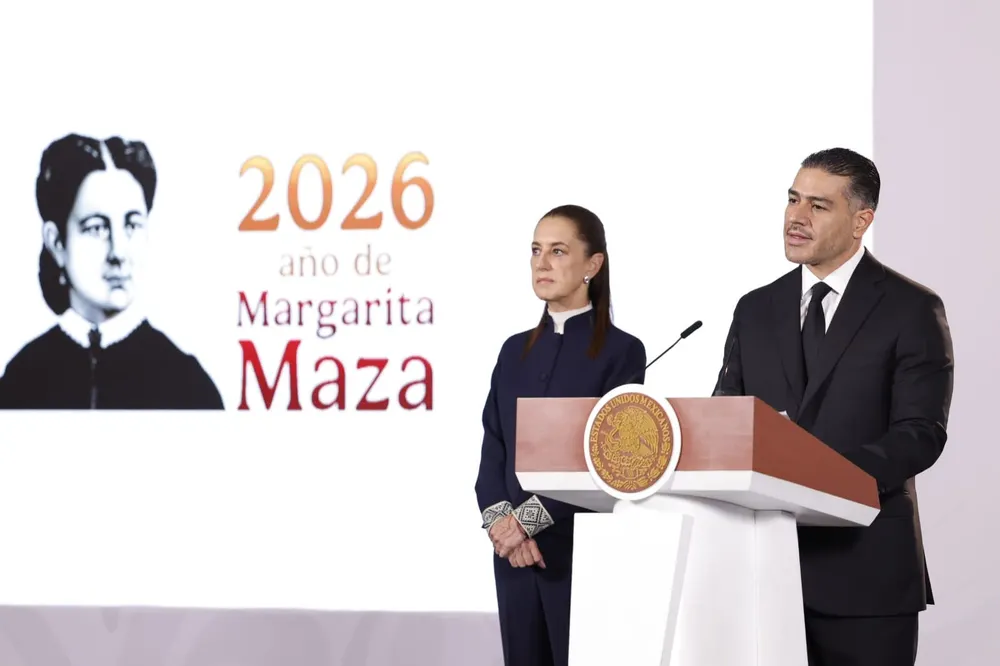
MEXICO CITY — Mexico’s security secretary said on Monday that criminal groups in Sinaloa operated with impunity for years because some authorities were corrupted and others did nothing. The statement came three days after federal forces captured Fausto Isidro Meza Flores, known as “El Chapo Isidro.” Omar García Harfuch spoke at President Claudia Sheinbaum’s morning press conference at the National Palace on November 23.
Although Harfuch did not name any officials, the remarks were a stark contrast to years of concerted silence on the pervasiveness of cartel-linked public corruption inside of the Mexican government.
“They were able to act with impunity because there were authorities who allowed themselves to be corrupted and others who, simply through omission, allowed them to keep doing harm for many years,” Harfuch said.
Harfuch said the criminals sowed violence and recruited young people. He added that the lack of institutional action allowed the groups to accumulate weapons and build up their firepower over the years. On the weapons seized in the operation, he said “strong weaponry” was secured and that details would come later.
Asked about allegations against Sinaloa’s governor, Rubén Rocha Moya, Harfuch asked for patience until the federal Attorney General’s Office (FGR) finishes its investigations, to avoid speculation.
He described the federal strategy as aimed at reducing high-impact crime, arresting those who generate violence and weakening criminal organizations regardless of faction.
Meza Flores was arrested on November 20 in Guasave, Sinaloa. National Guard and Army special forces carried out the operation, coordinated with U.S. intelligence agencies.
Defense Secretary Ricardo Trevilla Trejo confirmed at the same press conference that U.S. intelligence supported the capture.
The arrest triggered clashes, blockades and burned vehicles, with at least 11 dead and eight detained, according to one report. Mexican authorities identify Meza Flores as the head of a Beltrán Leyva organization, and he is on the FBI’s Ten Most Wanted list.
A federal judge ordered preventive detention at the Altiplano prison for Meza Flores, his cousin Germán “N” (alias "Serafín," described as his second in command) and José “N,” his brother-in-law and alleged financial operator. They face charges of carrying a weapon for exclusive Army use and crimes against public health. At the defense’s request the legal deadline was doubled, and the hearing to decide whether they will stand trial resumes Saturday at 9:00 a.m.
U.S. Indictments
Harfuch’s remarks land against a U.S. case that has already put Sinaloa’s leadership under scrutiny. On April 29, the U.S. attorney for the Southern District of New York, Jay Clayton, and DEA Administrator Terrance Cole announced charges against Rocha Moya and nine other current and former officials for drug trafficking and weapons offenses.
Prosecutors allege the defendants associated with the Sinaloa Cartel to distribute large quantities of narcotics in the United States. The indictment says the Chapitos faction helped Rocha Moya win the governorship and that he promised them protection in return, before and after taking office.
It also alleges that Sinaloa’s deputy attorney general received about US$11,000 a month for tipping off the Chapitos to U.S.-backed operations.
Omar García Harfuch at President Claudia Sheinbaum’s morning press conference at the National Palace on Monday, November 23, Mexico City, Mexico
Rocha Moya “categorically and absolutely” rejected the charges, saying they lack truth and foundation. He took leave in May. He briefly resumed the post and then requested a new indefinite leave, and on August 25 the state Congress named Graciela Domínguez Nava interim governor by 31 votes to 6.
Two former Sinaloa officials close to Rocha turned themselves in to U.S. authorities in May. Harfuch said at the time that of the ten people named, only one, Morena Senator Enrique Inzunza, still holds constitutional immunity.
However, Harfuch’s earlier statements were different. In May he said there was never any indication of links between Rocha Moya and the Sinaloa Cartel, and that federal forces found no visible resistance from the state government. I
n August 2025, after “El Mayo” Zambada’s statements, he said there were no formal accusations against officials or military personnel over ties to cartels. Zambada said in his guilty plea that he promoted the corruption of police, soldiers and politicians in Mexico.
The November 23 comments are a more general acknowledgment, though they do not identify anyone and do not retract those earlier positions.
Warning From the DEA
Hours after Harfuch spoke, DEA head Terry Cole posted on X that the agency would keep sharing intelligence with trusted partners and would expose corrupt officials who conspire with designated international organizations. He said justice would be applied “one way or another.”
Harfuch announced more federal presence in the state. Between October 1, 2024, and November 15, 2026, nearly 4,200 people were arrested in Sinaloa, according to the figures he presented.
Authorities seized more than 150 tons of drugs, 7,400 firearms and about 1.6 million cartridges. State and municipal forces will receive more than 150 vehicles, and 240 monitoring points with 720 cameras and 30 license-plate readers will go up on the Culiacán–Mazatlán and Mazatlán–Durango highways.
Harfuch will travel to Culiacán on Tuesday with the Security Cabinet to supervise operations, deliver equipment and meet state authorities.
mayacomunicacion
Mexico’s attorney general has opened inquiries into alleged ties between Sinaloa officials and criminal groups, including Zambada’s capture and the murder of Héctor Melesio Cuén Ojeda.
Meanwhile, Domínguez Nava is to govern until a successor is chosen in the June 2027 elections. The “Chapo Isidro” case will test whether the federal government’s new language extends to action against officials, or stays at the level of the capture of a cartel leader.