


MIAMI — Colombia’s presidential election arrives Sunday with the race fundamentally changed from where it stood two weeks ago, the sitting president under a new criminal investigation for alleged electoral interference, and the Colombian diaspora in South Florida already casting ballots in what organizers are calling the most politically engaged overseas vote in the country’s history.
Five days before the May 31 first round, everything is still open.
Aragon Avenue: Miami Votes First
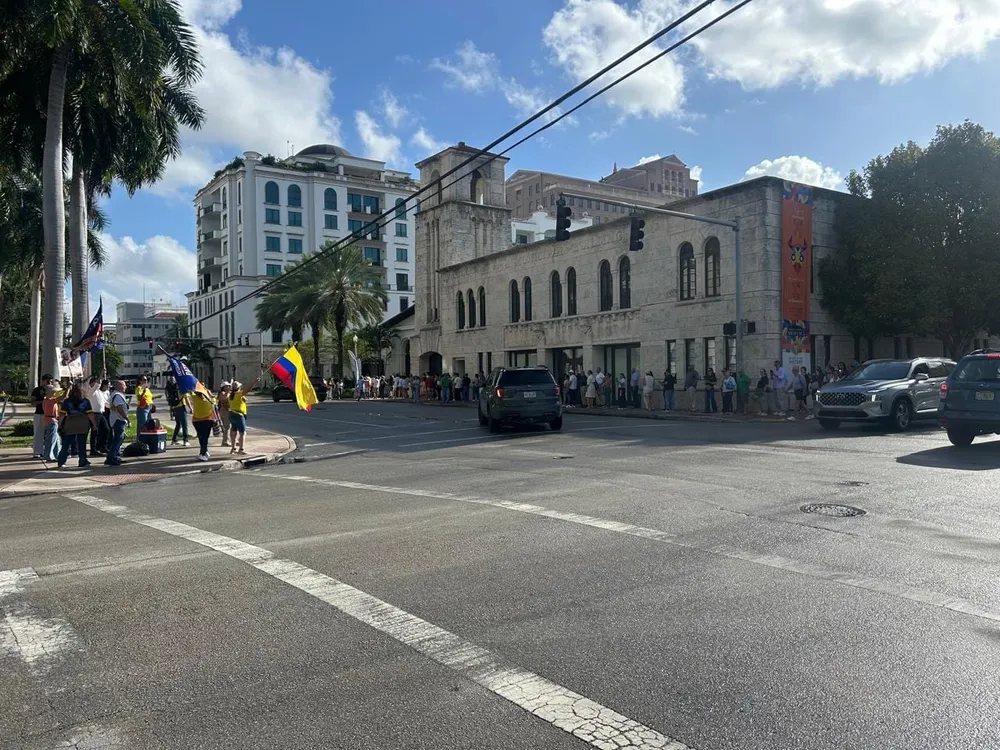
Since Monday, Colombians registered in Florida have been casting ballots at the Coral Gables Museum at 285 Aragon Ave. — early voting runs 8 a.m. to 4 p.m. Monday through Saturday. On Sunday, Colombia’s actual election day, the Colombian consulate at 280 Aragon Ave. and five other assigned precincts will be open across South Florida.
Police officers expect traffic and deep political divisions. The registrar of Colombia’s National Civil Registry confirmed on Monday that there was high attendance at the first day of overseas voting — attributed in part to the U.S. Memorial Day holiday giving registered voters a day off to exercise their franchise.
The turnout reflects a diaspora that is more politically mobilized than at any previous election.
For the 2026 elections, the overseas electoral roll increased by 45.42% compared to the 2022 presidential elections, Colombia’s Foreign Minister Rosa Villavicencio confirmed at the opening of overseas voting. The surge reflects years of sustained Colombian emigration — to the United States, Spain, and across Latin America — and a diaspora that has watched this campaign's violence, its legal confrontations, and its polling volatility with the intensity of people who still have family in the middle of it.
In a close election, overseas votes can matter. In 2022, Gustavo Petro won the presidency by a margin that the diaspora’s organizing effort contributed to. Both the Cepeda campaign and the De la Espriella campaign have devoted significant effort to mobilizing Colombians abroad in the final weeks, aware that in a near-tied race, every constituency is decisive.
The Race That Flipped
When Sociedad Media last reported on the Colombia race on May 25, De la Espriella had surged into a near-tie with Cepeda in the last authorized poll. The AtlasIntel survey released Saturday put Cepeda at 38.7% and De la Espriella at 37.3% — within the margin of error — with the poll projecting De la Espriella would defeat Cepeda in a runoff.
That represents a dramatic reversal. Two weeks ago, Paloma Valencia was in second place and consolidating the conservative vote. De la Espriella was running third. The shift has produced a race in which the conventional wisdom about a Cepeda-Valencia runoff has been replaced by genuine uncertainty about which conservative will advance — and whether the conservative who does advance can close a gap with Cepeda that is narrower than anyone anticipated when the campaign began.
De la Espriella models himself explicitly after Néstor Bukele and Javier Milei — a far-right lawyer pitching himself as an outsider who will break the political establishment. His surge in the final weeks is consistent with the pattern those candidacies followed: late-breaking momentum from younger, male, digitally engaged voters who don’t show up in traditional polling samples until the final days of a campaign.
U.S. Senator Bernie Moreno warned at an Atlantic Council event on May 20 that Washington may not recognize Colombia’s election results if voter intimidation affects ballot outcomes in insecure regions. His remarks were interpreted by Colombian political sectors as international pressure on the electoral process. Petro responded through social media defending Colombia’s institutions. The exchange added a Washington dimension to an already charged final week.
Announcement of Petro Probe
The most significant development in the elections emerged on Tuesday — and the one that will define the final five days of campaigning.
The Investigation and Accusation Commission of the Colombian House of Representatives formally opened a criminal investigation against President Gustavo Petro for alleged improper involvement in the electoral process.
The commission — the constitutional body that handles criminal proceedings against sitting presidents in Colombia and the only body authorized to investigate the head of state — opened the inquiry on the basis of allegations that Petro used the machinery of the state to influence the outcome of the May 31 vote in favor of his preferred candidate, Iván Cepeda.
The investigation is the second domestic legal proceeding touching Petro as Colombia heads to the polls. Former Bogotá mayor Claudia López — herself a presidential candidate earlier in the cycle — denounced Petro before the Inter-American Commission on Human Rights for alleged campaign interference, requesting urgent measures ahead of the vote.
The second is the campaign financing case. Colombia’s Constitutional Court ruled in June 2025 that only the House of Representatives can investigate Petro over alleged irregularities in the financing of his 2022 campaign, effectively ending the electoral court’s proceedings and transferring jurisdiction to the same commission that opened today's inquiry. That case found that Petro’s 2022 campaign exceeded legal financing limits by approximately 6 billion pesos and accepted contributions from sources not legally permitted.
Petro has consistently denied all allegations, characterizing each investigation as a politically motivated attempt to destabilize his government and prevent the implementation of his reform agenda. “An administrative body brings charges against the president of the republic. It is an open constitutional breach,” he said when the CNE investigation was announced in 2024.
His government has not yet commented on today’s House commission inquiry.
What Petro’s Legal Exposure Means for Cepeda
The timing of the House investigation’s opening — five days before the vote, with overseas ballots already being cast — places Cepeda in a direct political bind.
Cepeda has run as the continuation of Petro’s Pacto Histórico project — explicitly defending the government’s legacy on inequality, labor reform, and the total peace framework. That alignment has been the foundation of his coalition and the source of his polling lead throughout the campaign. It is also the thing his opponents are now using against him.
De la Espriella and Valencia have spent the final weeks framing the choice as one between continuity with the current government or a break with an administration whose legal troubles are now a matter of constitutional record. A vote for Cepeda, in their framing, is a vote to extend the reach of a presidency that Colombia’s own House of Representatives is investigating for electoral interference.
Whether that framing moves votes in the final days — including among the Colombians standing in line on Aragon Avenue in Coral Gables this week — is the question Sunday will answer.
Colombia’s first round is on May 31. Every available poll considers a runoff on June 21 inevitable — no candidate is close to the 50% plus one required for a first-round victory. The new president takes office August 7.
The mandatory campaign silence period is now in effect. No advertising, no events, no new polling. The candidates have made their final arguments. The country votes in silence — except for the Colombians in South Florida who are already making their choice, one ballot at a time, on a street in Coral Gables.
Sociedad Media will continue to cover Colombia’s presidential election through the May 31 first round and the June 21 runoff. Tips and feedback welcome at info@sociedadmedia.com