


SANTO DOMINGO — Rosa Ng Báez is the daughter of a Chinese immigrant who died in 1978. Decades later, she championed the creation of Santo Domingo’s Barrio Chino, a district of restaurants, shops and weekend fairs that Chinese state media says began with about ten businesses and now has roughly one hundred.
It is a small neighborhood with a large symbolic job. It tells Dominicans, and the world, that the Chinese presence in the country is not a story that began with Beijing’s diplomats or a wave of new retail chains. It is a story that goes back more than 160 years.
The first documented mention of a Chinese person in the Dominican Republic dates to 1864, during the Restoration War against Spain, when a man known as “Pancho el Chino” appears in the record. Soon afterward, according to reference accounts of the community’s history, an entrepreneur named Gregorio Riva brought Chinese workers from Cuba to make bricks and lime in the Cibao region. Those settlers went on to set up warehouses in Samaná, Yuna and Moca, and are credited with building Moca’s cemetery by 1870.
The Dominican Center for Chinese Studies (CENDOESCH), which published a study on Chinese migrants in 2021, also places the first arrivals in the 1860s and says most of the community traces its roots to Enping, in China’s Guangdong province.
More arrivals followed in waves in later decades. Chinese migrants came during the U.S. occupation of 1916 to 1924, and again in 1937 as the Sino-Japanese War pushed people out of China.
By the 1950s, Chinese-Dominican merchants had established businesses in Santo Domingo’s Duarte district. Migration slowed in the 1960s and 1970s, then picked up again from the late 1980s and early 1990s, this time largely from Hong Kong and Taiwan.
Family Business
Commerce has been the thread through all of it. CENDOESCH found that the great majority of Chinese migrants work in trade and retail, and a 2023 report in El Dinero described a community running supermarkets, hardware stores, restaurants, beauty salons, motels and the fast-food chicken shops Dominicans call “pica pollo.”
The family stories are consistent. Miguel Feng arrived in 1984 at age 11. His family went from farming vegetables to running supermarkets and then four motels, each employing between 10 and 25 Dominicans, El Dinero reported.
Cheung Ka Lok’s father came from Hong Kong in 1979 and built a supermarket chain. “The opportunities are there, you just have to take advantage of them,” Chinese migrants told the outlet about the Dominican business climate.
Most of the Chinese community lives in the capital region, El Dinero reported.
Chinese Population
Estimates of the community’s size vary so widely that they describe different things. The 2010 census counted 1,406 Chinese-born residents, and a count cited in reference accounts for 2012 recorded more than 3,600.
By February 2021, 8,872 Chinese nationals held residency permits, according to CENDOESCH. Another analysis puts the ethnic Chinese population at about 20,000.
Some estimates of people of Chinese descent run as high as 60,000, though that figure is loosely sourced.
The gap reflects who is being counted. Official numbers capture foreign-born people with papers. They miss Dominicans of Chinese ancestry, who are many, and people whose status is irregular.
Chinatown D.R.
The Barrio Chino opened in the mid-2000s. Sources date its inauguration to 2006 or to April 2008, with the Flor Para Todos foundation behind it and the government of President Leonel Fernández supporting it. It has a temple, a Chinese-language school, supermarkets stocked with Chinese products, and fairs where Dominicans come for the food and the festivals.
Zhang Yuehui of the Chinese Colony Center told Xinhua that “ties between the two peoples have deepened in culture, gastronomy and customs” since it was created.
But the district has had its troubles. In January 2023, ahead of Lunar New Year, Ng Báez described it to El Día as being in “a state of deterioration and slum conditions and insanitary surroundings,” with electrical infrastructure stolen, street furniture destroyed and Chinese statues removed. She led cleanup and lighting repairs.
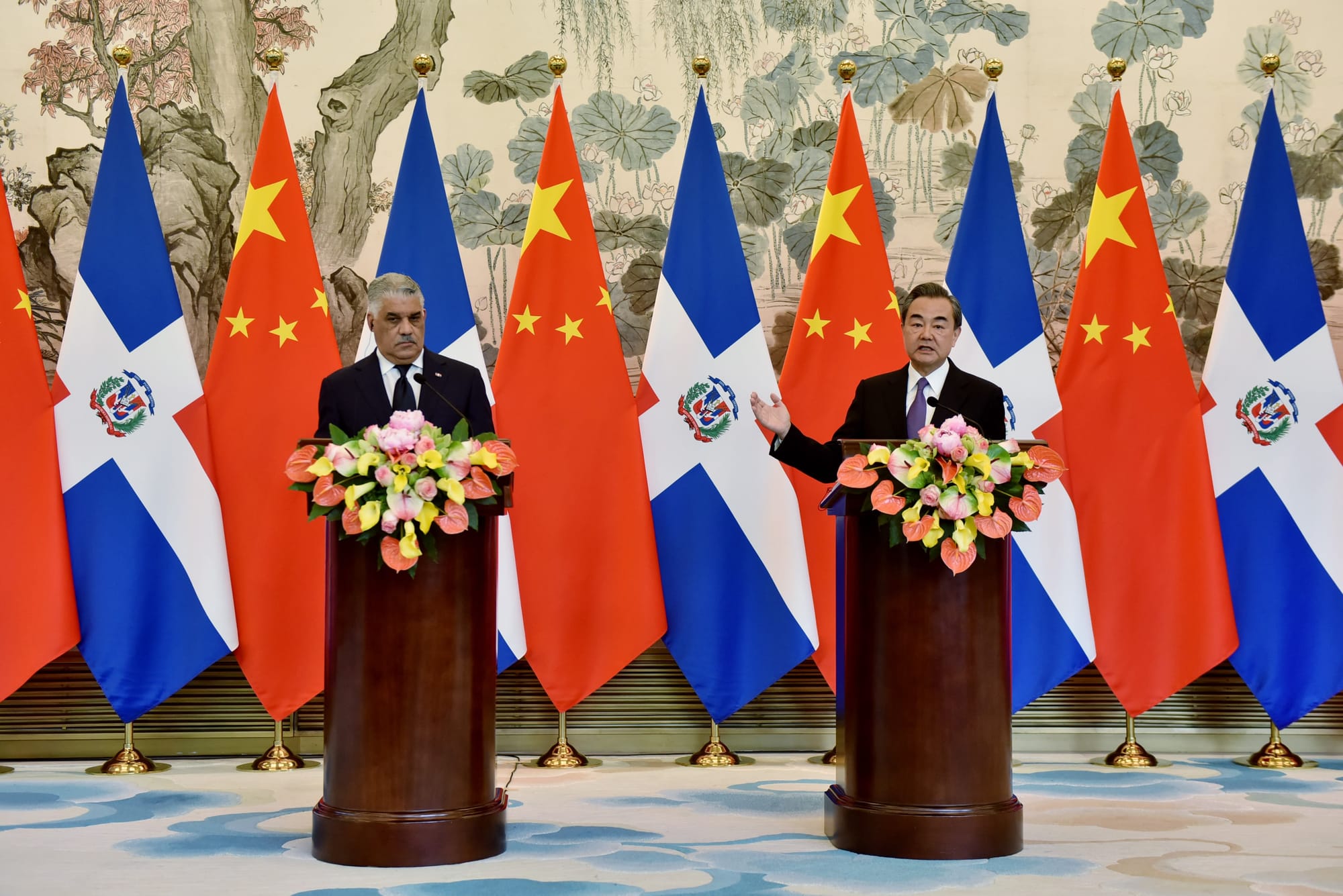
The Chinese community now sits closer to national politics than it did a decade ago. The Dominican Republic switched its diplomatic recognition from Taiwan to the People’s Republic of China in 2018, drawing suspicions from Washington.
Since then the ambassador, Chen Luning, has been a visible presence, signing a $40 million grant and 450 scholarships for Dominican officials in September 2025.
At the same time, the Dominican state has been tightening its oversight of Chinese-owned retail. In 2025, authorities notified 40 companies of hiring violations under the law that caps foreign staff at 20 percent. At least a dozen large Chinese stores in Santo Domingo and Santiago were shut for roughly nine months over structural, tax, customs and labor problems, Infobae reported in May 2026, putting between 2,000 and 3,000 people out of work.
Rosa Ng, identified as the Chinese community’s president, said “there is no explanation for why companies that already complied remain closed.”
Then, in August 2026, geopolitics arrived in the community’s lap. The U.S. Embassy in Santo Domingo shared a Washington warning naming Huawei, ZTE, Hikvision and other Chinese tech firms as security risks.
Chen called the claims “pure invention” while the Dominican government has not publicly taken a side.
Neutrality or Alliance?
The Dominican Republic has never declared formal neutrality, but its government has practiced balance, and that room is narrowing as Washington presses Caribbean governments to cut ties with Chinese technology and investment.
President Luis Abinader said in 2020 that “we are not distancing ourselves from China” while barring Chinese firms from ports, telecoms and airports and adopting the U.S. “Clean Network” for 5G.
The Dominican government has not publicly taken a side. The pressure fits a wider U.S. push after Trump’s March 2026 Shield of the Americas summit, where he opposed “hostile foreign influence” in the hemisphere, and Washington is leaning on Uruguay and Mexico over Chinese trade, per CFR.
The costs of choosing are lopsided. China is the DR’s second-largest trading partner, according to its own ambassador, and has offered grants and training, including the $40 million grant and 450 scholarships mentioned earlier.
The U.S. remains the DR’s largest partner in security and remittances.
Santo Domingo’s most likely path is to keep trading with China while quietly restricting Chinese tech in sensitive sectors, a course that risks irritating Beijing and may not satisfy Washington.
The recent inspections of Chinese retail point the same way, since they are framed as domestic compliance and not as a geopolitical move.
As international politics continue to heat up between the ever increasing competition for influence in the Caribbean between the United States and China, the Dominican Republic and its government will continue to find itself in the uncomfortable position of having to pick a side, and if not, draw derisions from both superpowers for sitting on the fence.