


Jorge Nieto has faded to fourth at 11.2% and Ricardo Belmont sits fifth at approximately 10%. The remaining uncounted tallies come disproportionately from southern highlands and rural areas where Sánchez is strongest.
Full official results are not expected until Wednesday April 15 at the earliest. The June 7 runoff is confirmed — who Fujimori faces is not.
Sociedad Media is monitoring.
Updated information below:
The Count Shifts South — and the Runoff is No Longer Settled
What looked like a confirmed Fujimori versus López Aliaga runoff on Sunday night has become one of the most suspenseful vote counts in recent Peruvian history.
López Aliaga started at nearly 14% in early urban-heavy returns but has slid to approximately 12% as the count has moved into rural and southern regions.
Roberto Sánchez of Juntos por el Perú climbed from 8.5% to 11.7%, overtaking Jorge Nieto in the process. The gap between López Aliaga and Sánchez has narrowed to under one percentage point, and the remaining uncounted tallies come disproportionately from the southern highlands and rural areas where Sánchez is strongest.
The trajectory is not accidental. Lima’s urban precincts — the first to report — heavily favor right-wing candidates. López Aliaga was mayor of Lima and his base is concentrated in the capital’s wealthier districts. As the count moves outward into Andean and Amazonian regions, the political geography of Peru reasserts itself — left-leaning rural communities, indigenous voters, and the working poor of Peru’s interior have historically backed candidates like Sánchez and, before him, Pedro Castillo.
The same pattern played out in 2021 when Castillo — dismissed as a fringe candidate with single-digit urban support — pulled ahead of Fujimori on the strength of rural votes that arrived late in the count.
Fujimori’s own running mate, Luis Galarreta, told the media that Fuerza Popular would prefer to face López Aliaga in the runoff — an implicit acknowledgment that a Sánchez matchup would be a harder fight. That preference is grounded in recent history. In 2021, Fujimori lost to Castillo — Sánchez’s political predecessor and the candidate who endorsed him in this election by 44,000 votes out of 18 million cast. A Fujimori-Sánchez runoff on June 7 would be a direct rematch of that polarization, with every scar of the past five years of Peruvian political conflict reopened.
A Fujimori-López Aliaga runoff would pit two right-wing candidates against each other in a competitive but ideologically narrow contest, potentially alienating the entire left-of-center electorate. A Fujimori-Sánchez runoff would recreate the left-versus-right dynamic of 2021 and reactivate the polarization that defined Peruvian politics for the past five years.
The stakes of who places second are therefore not merely numerical. They define the character of the June 7 election entirely — and with it, what kind of Peru emerges from its most chaotic first-round vote in modern history.
The Criminal Charges — A Story Within the Story
The vote count is not the only legal drama unfolding in Lima this week.
The National Elections Jury filed a criminal complaint against ONPE chief Piero Corvetto for alleged offenses against the right to vote, delay of official functions, and obstruction of the electoral process. The complaint extends to three other officials and the legal representative of contractor Servicios Generales Galaga, responsible for distributing electoral materials that failed to arrive on time.
ONPE’s Electoral Management director, José Samané Blas, was detained by the National Police on suspicion of collusion in the hiring of the contractor.
The detention of an ONPE director during an active vote count is without precedent in Peru’s recent democratic history. It compounds the institutional damage from an election day already defined by police raids on the electoral authority, a two-day voting extension, fraud allegations from multiple candidates, and a logistics failure that left 52,000 Lima residents unable to vote on Sunday.
Investigative outlet Convoca reported that the logistics company responsible for the material distribution failure — Servicios Generales Galaga — had been a supplier to Lima’s municipality during López Aliaga’s own tenure as mayor, directly undermining his claims of electoral fraud directed against him.
Whether the criminal proceedings against ONPE leadership affect public confidence in the final result — and whether any candidate uses that uncertainty to challenge the outcome — will shape Peru’s political stability through the June 7 runoff and beyond.
LIMA — On Sunday morning, police raided the offices of ONPE — Peru’s national electoral authority — as 27 million Peruvians were in the middle of voting for their country’s next president. The raid, confirmed by AFP, disrupted operations and contributed to delays severe enough that electoral authorities extended voting until Monday at 7 a.m. local time in Lima and at two polling stations in the United States.
Election day was marred by delays and irregularities that sparked accusations of foul play and cast a shadow over the results.
It was, by any measure, a fitting prologue for a country that has had nine presidents in less than a decade.
By Sunday night, early official results from ONPE showed right-wing businessman Rafael López Aliaga leading the presidential race with 23.4% of the vote, according to Reuters. The figure comes from approximately 5% of ballots counted — enough to signal momentum but far too early to determine the final result. Exit polls from Ipsos and Datum had placed Keiko Fujimori in front with 16.6%, followed by a statistical four-way tie for second place.
The gap between those exit poll numbers and the early official count reflects the volatility that has defined Peruvian elections for a decade.
What is not in dispute is that a runoff will happen. No candidate was anywhere near the 50% threshold required to win outright in the first round. The runoff is scheduled for June 7, 2026. What remains unresolved — and will likely remain unresolved until ONPE completes its count on Monday — is who López Aliaga or Fujimori will face on that date.
Who is López Aliaga
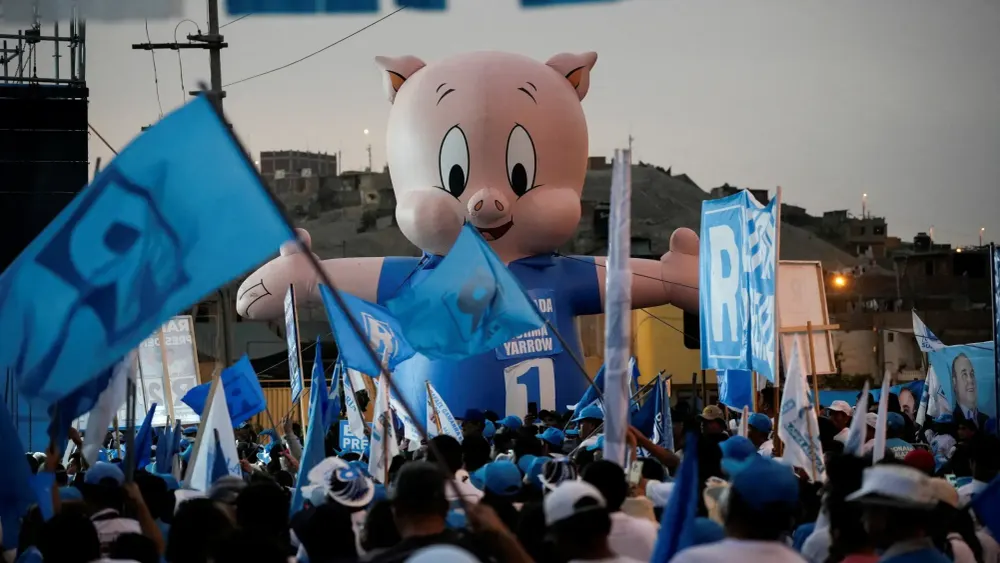
Rafael López Aliaga, 65, is a railway and luxury hotel magnate who won the Lima mayoralty in 2022 with 26.4% of the vote and resigned in late 2025 to run for president. A member of the conservative Catholic organization Opus Dei, he has run a right-wing campaign centered on crime, anti-corruption, and traditional Catholic values. He is known by the nickname “Porky” — a reference to the cartoon character — which he has embraced as a deliberate brand identity.
He has pledged to slash government ministries, align himself closely with U.S. President Donald Trump and Argentina’s Javier Milei, deploy troops to Peru’s borders, and use military courts for civilian prosecutions. He has also expressed admiration for El Salvador’s Nayib Bukele and proposed inviting U.S. intelligence to operate inside Peru to capture gang leaders.
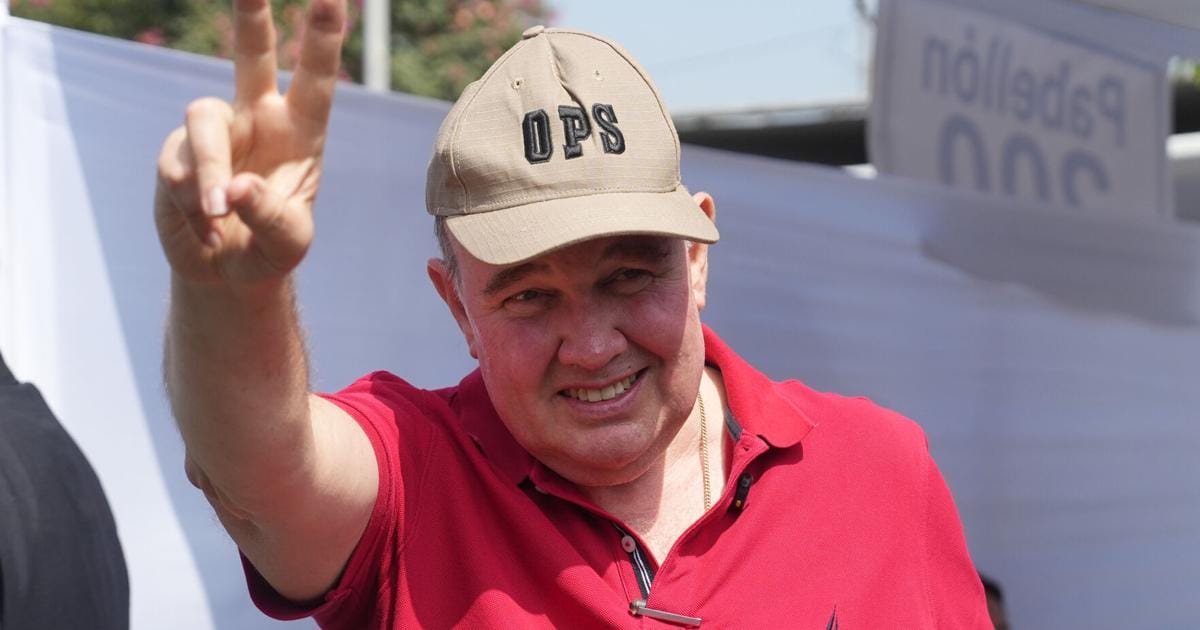
Aliaga’s surge in the official count was unexpected. Pre-election polls had shown him sliding — he had fallen to just 7 percent of voter intent in the final Ipsos poll released a week before the vote, with Fujimori overtaking him by eight points.
The divergence between those polls and the early ONPE count is either a sign of a significant late surge among Lima’s urban right-wing voters — his strongest base — or an artifact of which precincts have reported first.
The Fujimori Question
Keiko Fujimori, 50, is poised to advance to her fourth consecutive presidential runoff — having run in 2011, 2016, and 2021 without winning the presidency.
One recent survey found that 54% of Peruvians said they would not vote for her under any circumstances. She, too, leads a right-wing congressional bloc and remains the most organizationally sophisticated candidate in the race despite her persistent ceiling in public support.
The scenario emerging from Sunday’s count — a López Aliaga versus Fujimori runoff — would pit two right-wing candidates against each other for the presidency, potentially alienating Peru’s left entirely and producing one of the more unusual electoral matchups in the country’s recent history.
The Country They Would Govern
Whoever wins on June 7 inherits a country in measurable decline on the issues that dominated the campaign. The primary concerns among voters were corruption and crime, with extortion and homicides increasing greatly since the previous election. Security became the central concern for voters.
Peru’s homicide rate has doubled in the past decade, while reported extortion cases jumped from 3,200 to 26,500 per year.
They also inherit the institutional wreckage of a system that has consumed nine presidents in ten years. The last president, José Jerí, was removed from office in February 2026 by Congress for holding undisclosed meetings with a Chinese businessman under government scrutiny, making him Peru’s ninth head of state in less than a decade.
Congress warned observers of its attempt to build what the Council on Foreign Relations described as a “mafia state” in the run-up to the election.
The new bicameral legislature — Peru’s Congress returns to a bicameral structure for the first time since the 1990s, with a 60-seat Senate and 130-seat Chamber of Deputies — adds a new variable to the institutional equation. Whether it produces greater stability or simply more vectors for presidential removal remains to be seen.
The count continues Monday morning. The runoff is on June 7. The chaos is, for Peru, entirely familiar.
The Count Shifts — and So Does the Story
As the night progressed and ONPE’s official tally moved beyond the urban precincts of Lima that reported first, the picture changed significantly from the early returns that had showed López Aliaga leading with 23.4%.
With 30% of tallies processed, López Aliaga stood at 18% and Fujimori at 17% on early Monday morning. At 10% processed, López Aliaga had held 22% to Fujimori’s 16%.
The pattern is consistent with what analysts expected — Lima’s urban conservative base reports early and over-represents right-wing candidates before regional and rural votes arrive.
Datum’s rapid count, based on approximately 300,000 voting tallies collected nationally, placed Fujimori in first and López Aliaga in second. Datum CEO Urpi Torrado said the 52,000 votes still to be cast Monday would not alter the direction of the result. “They will vary by tenths of a percentage, but I don’t think it will change the direction of the results. Whoever is in fifth or sixth place will not move to second. Each tenth of a percent represents approximately 20,000 votes,” she told América TV.
If the Datum rapid count holds — and wire services confirm what Peruvian outlets are reporting — the June 7 runoff will pit Fujimori against López Aliaga in a contest between two candidates of the right. That matchup would be the first all-right-wing presidential runoff in Peru’s modern democratic history, and it would effectively leave the left without a candidate in the decisive round for the first time since the political crisis cycle began in 2016.
The Datum count still awaits confirmation from ONPE’s official tally, which authorities said could take until Wednesday to reach 100% given the distance of some voting locations and the verification of disputed tallies.
This article has been updated to reflect Datum’s rapid count results and the evolving official ONPE tally. The runoff pairing has not yet been confirmed by wire services. Full official results are expected by Wednesday April 15. Sociedad Media will continue to monitor Peru’s electoral process through the June 7 runoff. For stories & inquiries, contact us at info@sociedadmedia.com