

BOGOTÁ — Two weeks after Donald Trump gathered twelve right-leaning Latin American leaders at his Doral golf resort to launch the Shield of the Americas, a different group of leaders gathered in Bogotá on Saturday—and they had a very different message for Washington.
The 10th Summit of the Community of Latin American and Caribbean States (CELAC) opened at the Agora Convention Center in Colombia’s capital on March 21, concluding a week-long high-level forum that paired CELAC’s heads of state with delegates from across the African continent. The event—billed as a milestone in South-South cooperation—served as the clearest possible illustration of how deeply Latin America is divided over its relationship with the United States, and how actively the hemisphere’s left-leaning bloc is working to build an alternative international architecture outside Washington’s orbit.
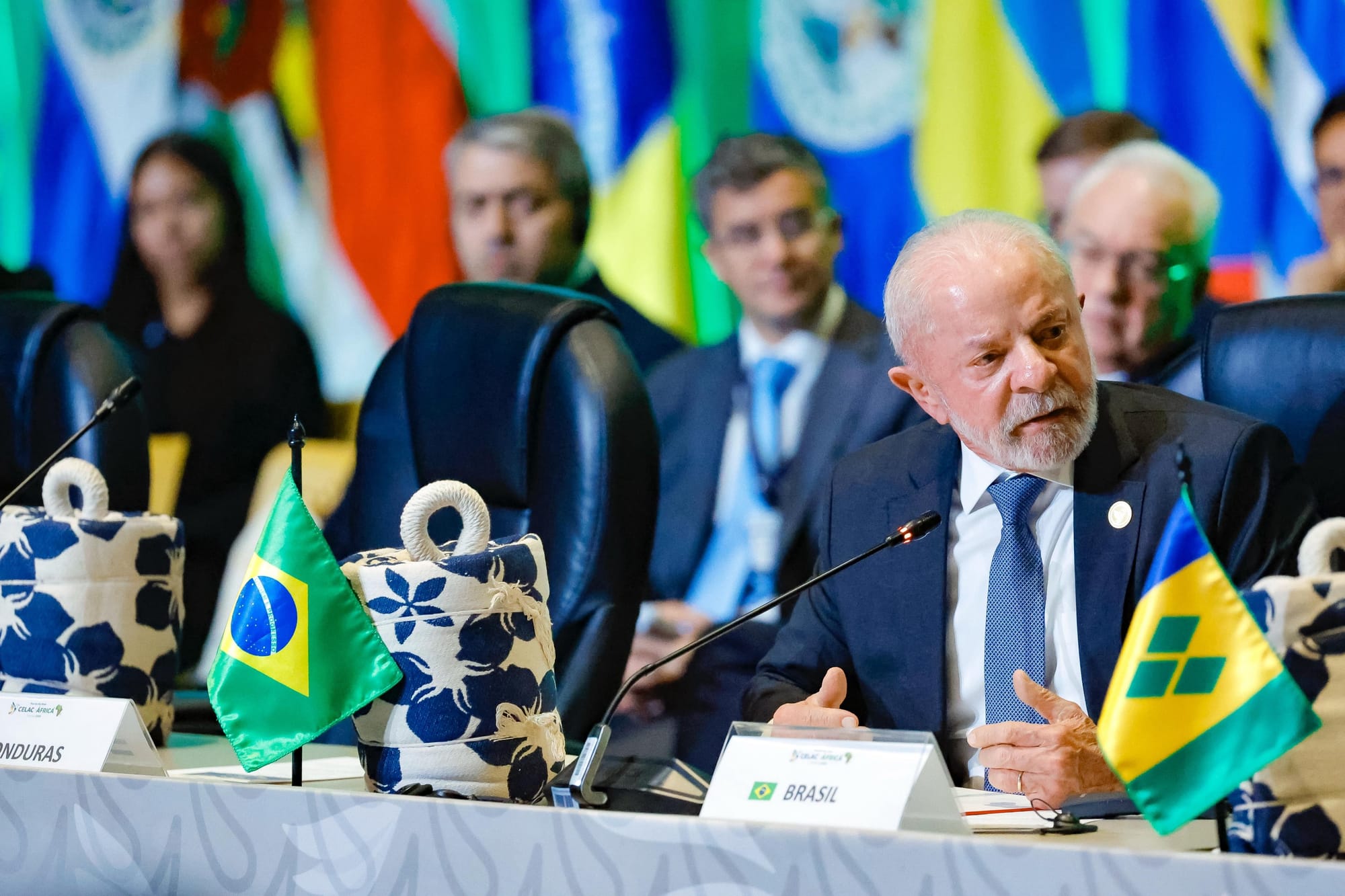
Brazilian President Luiz Inácio Lula da Silva delivered the summit’s most striking remarks, criticizing what he called the return of a colonial approach toward developing nations—gesturing without naming at actions undertaken by the Trump administration, including the January 3 capture of Venezuelan leader Nicolás Maduro and the fuel blockade in Cuba.
“It’s not possible for someone to think that they own other countries,” Lula said. “What are they doing with Cuba now? What did they do with Venezuela? Is that democratic?”
Colombian President Gustavo Petro—himself under active DOJ investigation, as reported Friday by Sociedad Media—used the summit to deliver one of the day’s sharpest critiques of Washington’s regional posture, warning that U.S. Secretary of State Marco Rubio’s approach “could escalate conflicts in different regions of the world.” Calling for a new multilateralism, Petro said:
“The new multilateralism is a meeting of humanity and of the diverse peoples of humanity, seeking common solutions to humanity’s problems through dialogue among civilizations.”
A Summit Built on South-South Ambition
The event ran from March 18 to 21, marking a deliberate effort to institutionalize long-term cooperation between Latin America, the Caribbean, and Africa. The forum rested on three core pillars: development cooperation, trade and investment promotion, and ethnic-racial justice with historical reparations. Leaders praised the initiative for addressing shared legacies of colonialism, slavery, and exclusion.
Colombia's Vice President Francia Márquez—the first Black woman to hold that office in the country’s history—drove the forum from its opening session, framing the gathering as fulfillment of Colombia’s Africa 2022-2026 strategy and as a step toward historical reparation. “It is an act of justice with our ancestors,” Márquez said, opening the forum’s agenda on ethnic-racial reparation.
Burundi’s President Évariste Ndayishimiye attended in his capacity as pro tempore president of the African Union—a presence that underscored one of the summit’s strategic pillars. He highlighted the importance of building stronger alliances between Latin America and Africa, two regions that share historical and structural challenges.
Colombia signed a key maritime cooperation agreement with Ghana on the summit’s sidelines—one of several bilateral agreements that gave the forum concrete outputs beyond its political declarations. More than 130 businesses—Colombian exporters and African buyers—participated in a business roundtable that preceded the summit, with participating African nations including Senegal, Nigeria, Ghana, South Africa, Côte d’Ivoire, and Egypt. ProColombia is actively preparing more than 200 Colombian companies to increase their presence in African markets.
China’s Shadow—and Xi’s Message
The geopolitical subtext of the Bogotá summit was impossible to ignore. Two weeks after Trump signed the Doral Charter explicitly targeting Chinese influence in the Western Hemisphere, Beijing sent its own signal.
Chinese President Xi Jinping sent a congratulatory message to the 10th CELAC summit, saying that since its establishment, CELAC has been committed to promoting peace, stability, development, and prosperity in the Latin American and Caribbean region. The message was diplomatic in language and strategic in timing—a reminder that China views CELAC as a multilateral framework it can work with, at the precise moment Washington is trying to pull the region’s governments away from Beijing.
The Absences That Spoke Loudest
The summit was marked by the notable absence of several heads of state and government—yet another episode highlighting the deep ideological divisions among Latin American and Caribbean governments that hinder efforts toward continental unity.
The governments that attended Trump’s Doral summit—Argentina, Chile, Ecuador, Bolivia, Paraguay, and others—sent no heads of state to Bogotá. The photograph from the Agora Convention Center tells the story of a hemisphere in which the same thirty-three countries technically belong to the same regional organization while inhabiting entirely different geopolitical universes.
Petro himself—the summit’s host—did not attend the forum’s opening, causing controversy that overshadowed the early stages of the event. Instead, Vice President Márquez led in his place. Whether his absence reflected scheduling, the distraction of the DOJ investigation news breaking the same week, or deliberate optics management is unclear.
The Handover and What Comes Next
One of the summit’s central moments was the handover of CELAC’s pro tempore presidency from Colombia to Uruguay, led by incoming Uruguayan President Yamandú Orsi.
Uruguay—a small, stable, center-left democracy—inherits a CELAC that is simultaneously more geopolitically relevant and more internally fractured than at any point since its founding.
The summit left an ambivalent picture. On one hand, it reaffirmed the political will to keep the project of regional integration alive and to project it toward other parts of the world. On the other it exposed CELAC’s internal difficulties—from the low participation of leaders to the lack of effective mechanisms to implement decisions.
The Bogotá summit did not resolve those tensions. What it did—unmistakably—was demonstrate that two parallel Latin Americas now exist simultaneously: one gathered at a golf resort in Doral to fight cartels and Chinese influence alongside Washington, and one gathered in a Bogotá convention center to warn that the world’s most powerful country is trying to colonize them again.
Both groups share the same hemisphere. But they do not share the same world.


