

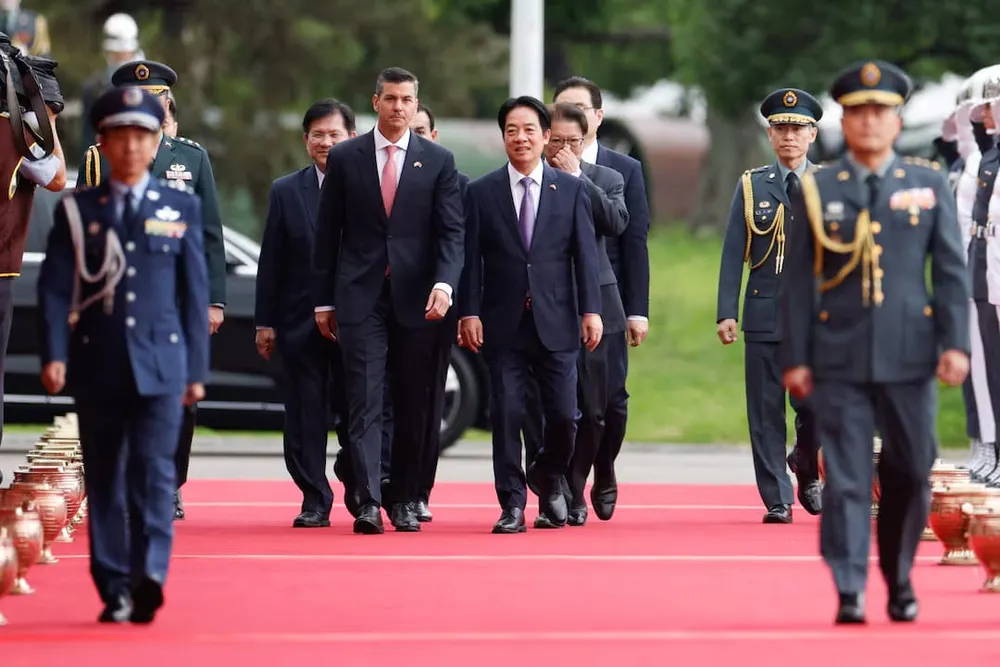
ASUNCIÓN — When Paraguayan President Santiago Peña arrived in Taipei on May 7 at the head of a delegation of more than 40 business leaders, the official visit was expected to produce the usual diplomatic pageantry — trade agreements, ceremonial photographs, warm words about six decades of friendship between two small countries that the rest of the world rarely discusses in the same sentence.
What it produced was something considerably more consequential.
“Between two giants, we are beginning the path to create the world’s largest artificial intelligence hub: Taiwanese technology powered by Paraguayan energy,” Peña said as he concluded his four-day state visit on May 10.
The announcement was not rhetorical. Taiwan’s Ministry of Foreign Affairs confirmed the signing of a Memorandum of Understanding on the Paraguay–Taiwan Sovereign AI Computing Center Investment Project, witnessed jointly by presidents Peña and William Lai and signed by the foreign ministers of both countries. The project is structured as a 50/50 joint venture — equal government ownership, equal financing, equal governance — managed through a newly created “Binational Digital Entity” that will answer to both states simultaneously.
The deal is one of the most ambitious technological cooperation agreements signed between any two countries in the region in decades. It is also, explicitly, a geopolitical alliance.
Why Paraguay? Why Taiwan?
The logic of the partnership is straightforward once you understand what each side brings.
“Artificial intelligence needs two critical elements. One is electrical energy — it consumes enormous amounts of electricity. The other is semiconductors, the microchips and circuit boards necessary to process that massive amount of data at scale. And that is where we are uniting two countries that are world powers,” Peña said.
Taiwan is responsible for producing approximately 90% of the world’s advanced semiconductors — the chips that power everything from smartphones to the servers running the world’s AI models.
TSMC, Taiwan Semiconductor Manufacturing Company, manufactures chips for Apple, Nvidia, AMD, and every other company at the frontier of AI development. Taiwan’s dominance in semiconductor fabrication is not a market coincidence; it is the result of decades of deliberate industrial policy and technical accumulation that no country has been able to replicate at comparable scale.
Paraguay brings the other half of the equation. The country is one of South America’s leading exporters of clean energy, with enormous surplus hydroelectric generation from the binational Itaipú and Yacyretá dams shared with Brazil and Argentina.
AI data centers are among the most energy-intensive infrastructure in the world — the computing requirements of training and running large language models and AI systems consume power at a scale that is straining grids from Virginia to Singapore. Paraguay’s surplus clean energy, available at competitive costs, is precisely what large-scale data center infrastructure requires.
Paraguay’s competitive advantages also include consistent macroeconomic stability and a policy of international openness that creates a secure and welcoming environment for major long-term investments. For a project measured in decades and requiring the kind of regulatory certainty that volatile political environments cannot provide, those attributes are not incidental.
The Three-Phase Plan
The first phase of the project envisions building a 10-megabyte data center. The second phase aims to reach 100 megabytes. In a third phase, the goal is to reach 1 gigabyte — which would make it the world's largest artificial intelligence data center.
Peña compared the initiative’s ambition directly to the Itaipú Dam — the binational hydroelectric project that, when completed in 1984, was the largest power station in the world and transformed Paraguay’s energy position permanently. Whether the AI center comparison holds will depend on execution, financing, and the pace of global AI demand — all uncertain variables. But the structural logic of the comparison is real: Itaipú converted Paraguay’s geographic position on the Paraná River into an energy asset of global significance. The AI center is attempting to convert that energy asset, combined with Taiwan’s technological capacity, into a computing infrastructure asset of equivalent scale.
The project also includes a planned Taiwan-Paraguay University of Technology — a permanent institutional anchor for the technological partnership — alongside the agreements on cybersecurity cooperation and mutual legal assistance in criminal matters that were signed during the same visit.
The Geopolitical Dimension
The Paraguay-Taiwan AI deal cannot be understood outside its diplomatic context.
Taiwan now has 12 official diplomatic partners globally, 7 of them in Latin America and the Caribbean. Paraguay remains the only South American country that maintains official diplomatic recognition of Taipei. That relationship — maintained continuously since 1957 despite enormous economic pressure from Beijing — has come at a cost.
China, which considers Taiwan a province rather than a sovereign state, has consistently offered economic incentives to Paraguay’s neighbors to switch recognition to Beijing. Every other South American country now maintains official relations with China rather than Taiwan.
During the signing ceremony, Peña condemned China’s “increasing military exercises” and growing “economic pressure” against Taiwan, and criticized what he described as economic coercion by Beijing aimed at disrupting Taiwanese President Lai’s planned overseas visits to diplomatic allies.
Peña called for international recognition of the Taiwanese people’s right to self-determination and supported Taiwan’s participation in international organizations.
Taiwanese President Lai framed the cooperation directly in terms of democratic alignment: “Facing the expansion of authoritarianism, both countries — of the global democratic value chain — should continue strengthening cooperation and promote democracy, peace, and prosperity as a path connecting the world.”
The AI center, in that framing, is not just an infrastructure project. It is a demonstration that democratic alignment with Taiwan carries concrete economic and technological benefits — a counter-narrative to Beijing’s argument that recognizing the People’s Republic is the only rational choice for developing nations seeking economic partnership.
What Came With the Deal
The AI center was the headline, but it was one of seven instruments signed during Peña’s four-day visit — a package that signals how seriously both governments are treating the relationship as a comprehensive partnership rather than a narrow diplomatic arrangement.
Taiwan officially authorized Paraguayan chicken meat exports, opening a market currently worth $350 million in annual imports to the island. The first shipments are expected within weeks. Carbon credit agreements were finalized — Taiwan’s carbon emissions tax creates a direct market for Paraguay’s forest carbon credits, with a potential market of more than 5 million tonnes.
A Paraguay-Taiwan Chamber of Commerce, Industry and Culture was established. And Peña received an honorary doctorate from the National Taiwan University of Science and Technology.
Lai also announced that Taiwan would open its market to Paraguayan poultry imports — Taiwan is already a major market for Paraguayan beef and pork — in a concrete trade concession that gives Asunción tangible economic returns for its diplomatic loyalty.
Bigger Picture
For Latin America, the Paraguay-Taiwan AI deal arrives in the middle of the region’s critical minerals competition with China and the United States — a context that makes it legible as part of a broader pattern rather than an isolated bilateral event.
The hemisphere is living through a moment in which its natural assets — lithium, copper, rare earths, hydroelectric energy, agricultural land — are being recognized simultaneously by multiple great powers as strategic resources rather than simply commodities. Paraguay’s hydroelectric surplus, which was for decades an underutilized asset in a landlocked country with limited industrial capacity, is now precisely the resource that global AI infrastructure development requires most urgently.
Whether Paraguay can convert this moment into lasting technological and economic transformation is the question that its government and its citizens will be living with for the next decade. The history of resource booms in Latin America — from silver to rubber to oil to soybeans — is not uniformly encouraging. But the structural difference with this arrangement is the technology transfer dimension: if the AI center is built and operated as a genuine binational entity, Paraguay ends up with not just the energy revenues but the technical capacity, the workforce development, and the institutional knowledge of operating world-class computing infrastructure.
That is a different proposition from selling hydroelectric power at wholesale rates.
Whether the MOU becomes that reality depends on what happens next.
Sociedad Media will continue to cover Latin America’s position in the global technology and AI economy. Tips, sources, and feedback welcome at info@sociedadmedia.com