

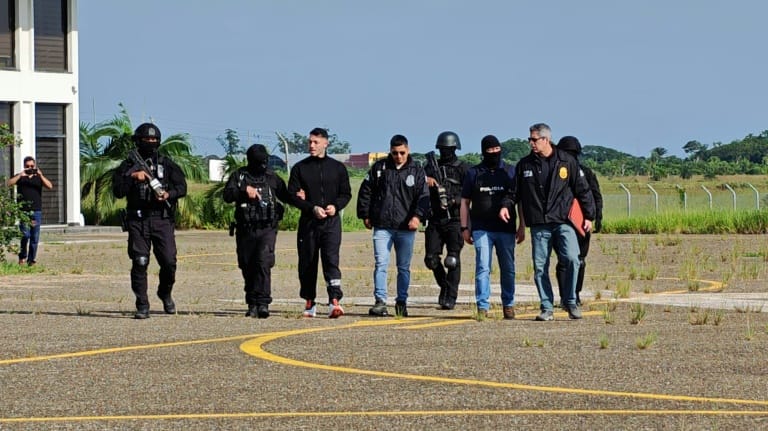
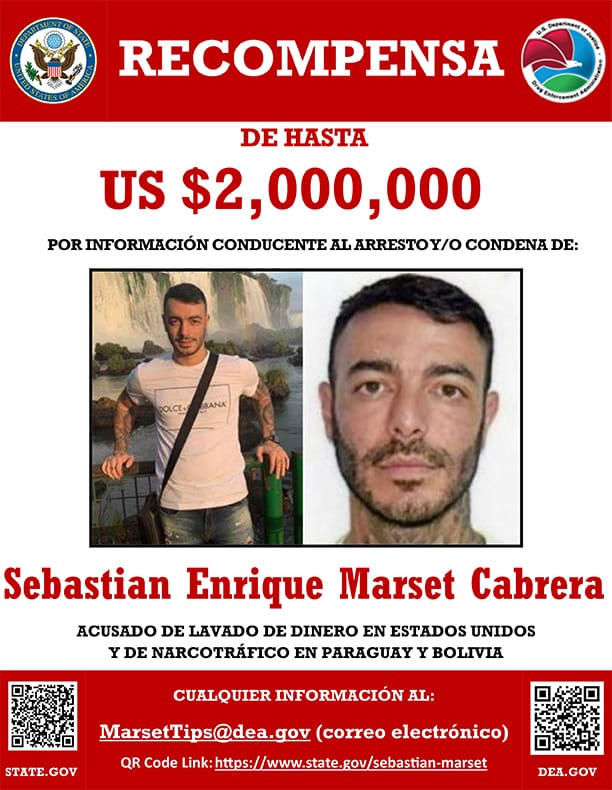
MIAMI — On the morning of March 13, hundreds of Bolivian special forces converged before dawn on a residential neighborhood in Santa Cruz de la Sierra, surrounding two properties in a coordinated sweep that ended one of the Southern Cone’s longest and most consequential manhunts. Within hours of the operation, Sebastián Marset—a 34-year-old Uruguayan drug lord wanted by Washington for laundering millions in illicit drug proceeds—was on a DEA plane, extradited to the United States to face federal charges.
For regional security analysts, Marset’s capture was not simply the takedown of another criminal. It was a window into how South America’s narco-trafficking architecture has quietly evolved—moving away from the hierarchical, territorial cartels familiar in Mexico and Colombia and toward something more diffuse, more globalized, fractionalized, and in many ways more difficult to dismantle.
A Network Without Borders
Marset led an international cocaine trafficking and money laundering network known as the Primer Cartel Uruguayo, or First Uruguayan Cartel (PCU), with believed links to Paraguay’s Insfrán Clan, Brazil’s First Capital Command (PCC), and Italy’s mafia, the ‘Ndrangheta. Rather than commanding territory through sheer force—as Mexican cartels like CJNG have done Marset operated as a logistics coordinator, connecting cocaine producers in Bolivia and Paraguay with distribution networks in Europe.
His organization coordinated cocaine shipments departing from Bolivia, moving through Paraguay and onward to South America’s Atlantic ports, where the PCC and ‘Ndrangheta controlled shipping and European distribution.
The scale was significant: the PCU was linked to seizures of more than 16 tons of cocaine in Europe, primarily at ports in Belgium, the Netherlands, and Portugal. From 2020 to 2023, more than 50 tons of cocaine concealed in merchandise shipped from Paraguayan ports were seized in Belgium, Germany, and the Netherlands—and experts estimate that what authorities intercept represents roughly 10% of the total cargo sent to Europe.
Marset himself became a symbol of the new narco archetype: a logistics broker, not a warlord. He stamped his drug shipments with the label “The King of the South,” gave orders for cocaine to be hidden in cookie and soybean shipments, and paid $10,000 in cash to wear a number 10 jersey during amateur fútbol matches.
Marset invested in lower-league soccer clubs, operated as a concert promoter, and ran shell companies—all while coordinating intercontinental drug flows worth tens of millions of dollars.
A Career Built in the Cracks Between States
Marset’s earliest known ties to the drug trade stretch back to 2012, when he received a large marijuana shipment flown to Uruguay from Paraguay, sent by Juan Domingo Viveros Cartes—the uncle of former Paraguayan President Horacio Cartes. He was arrested in 2013, served five years in Uruguay’s Libertad prison, and emerged in 2018 with something more valuable than the drugs he had transported: a continent-spanning network of criminal contacts cultivated behind bars, including alleged connections to Brazil’s PCC.
His rise thereafter was built on exploiting institutional weakness across multiple countries simultaneously. In 2021, Marset was arrested in Dubai while carrying a fake Paraguayan passport, but while in detention, he then applied for and received a legitimate Uruguayan passport—a procedural failure that triggered a political crisis in Montevideo and led to the resignations of several senior Uruguayan officials.
The ‘King of the South’ was not cornered after Dubai—he was freed by his own government’s bureaucracy. By 2022, he was living openly in Santa Cruz under a Brazilian false identity, running a fútbol club and evading Interpol’s red notice across 190 countries.
The Murder That Defined a Region
In May 2022, Paraguayan prosecutor Marcelo Pecci was shot dead by hitmen on a beach in Cartagena, Colombia, while on his honeymoon. Pecci was, until the day of his death, the most important prosecutor in Paraguay’s fight against organized crime and drug trafficking—the lead investigator in Operation A Ultranza PY, which had just months earlier dismantled much of the PCU’s financial network in Paraguay.
Marset is accused of being the mastermind behind Pecci’s murder, which occurred just days after the prosecutor had requested an arrest warrant for five members of the Insfrán crime family. Colombian President Gustavo Petro directly linked Marset to the assassination, though Marset has denied any involvement and has not been formally charged in that case.
The killing shocked the region and has become one of the starkest examples of organized crime’s willingness to directly target state institutions.
Both Marset and the Insfrán Clan’s Miguel Ángel Insfrán, alias “Tío Rico,” were identified as key suspects in Operation A Ultranza PY—a massive investigation into drug trafficking and money laundering that Pecci was actively pursuing at the time of his assassination.
Bolivia’s Shift and the DEA’s Return
Marset’s capture was not accidental. It was the direct product of a geopolitical realignment in Bolivia that has unfolded over the past several months. Bolivian President Rodrigo Paz, who took office in November after nearly two decades of socialist governance under the Movement for Socialism, or MAS under Evo Morales, reinstated ties with the DEA in late February—ending a rupture that had lasted 17 years.
Just days before the March 13 raid, Paz attended the Shield of the Americas Summit hosted by President Donald Trump in Florida, where Bolivia joined an anti-cartel military alliance alongside 16 other countries. Marset’s arrest, coming less than a week later, was a tangible early dividend of that diplomatic shift.
The operation began before dawn in Las Palmas, a neighborhood near Santa Cruz’s Abasto market in central Bolivia, northeast of the nation’s capital of Sucre, with authorities simultaneously raiding two properties—Marset’s primary residence and a separate safe house—without a single casualty among law enforcement, suspects, or civilians.
Among those arrested alongside Marset were two Venezuelans, a Colombian, and a relative named Tatiana Marset Alba.
On March 16, Marset made his first U.S. court appearance at a federal district court in Virginia. Bolivian authorities separately announced the seizure of approximately $15 million in assets linked to Marset, including 16 aircraft, five properties, and a cache of firearms.
What the Capture Reveals—and What it Doesn’t Solve
Security analysts have welcomed the arrest while cautioning against overstating its impact on the underlying criminal architecture. Marset’s PCU operated not as a vertically integrated organization with a traditional boss, or jefe, but as a coordination layer—connecting producers, transporters, and distributors across multiple sovereign jurisdictions. His removal disrupts that coordination function, but the supply chains, the port infrastructure, and the European demand that his network served remain intact.
Marset did not lead a structured group or control any territory. Despite managing intercontinental criminal networks, his power rested on relationships and logistics rather than coercive territorial control. That model, broker-based, rather than cartel-based, is harder to decapitate than a traditional hierarchy, because no single successor inherits the architecture wholesale.
There are also outstanding jurisdictional questions. Paraguay wants Marset on drug and money-laundering charges and has linked him to the Pecci assassination investigation. The United States has accused him of laundering drug proceeds through U.S. financial institutions. Bolivia had been pursuing him over his alleged criminal network in Santa Cruz.
How those competing claims are resolved in U.S. federal court will shape whether Marset’s capture leads to prosecutions that expose the political networks that enabled him, or simply removes one operator from a system that has already adapted around him.
For the diaspora communities of Miami and South Florida—many of whom maintain ties to countries along this cocaine corridor—the Marset case is a reminder that the drug trade threatening neighborhoods and institutions in Latin America is not a local problem. It is a transnational enterprise that runs through respectable-looking shell companies, fútbol clubs, and European ports, sustained by the same institutional weaknesses that allow prosecutors to be murdered on their honeymoons without anyone being held fully accountable.
Marset is in a Virginia federal courthouse. The network he built is still operational.
Sociedad Media will continue to cover developing events surrounding the prosecution of Sebastián Marset and regional security cooperation against transnational criminal organizations. For tips, corrections, or story leads, contact us at info@sociedadmedia.com


