

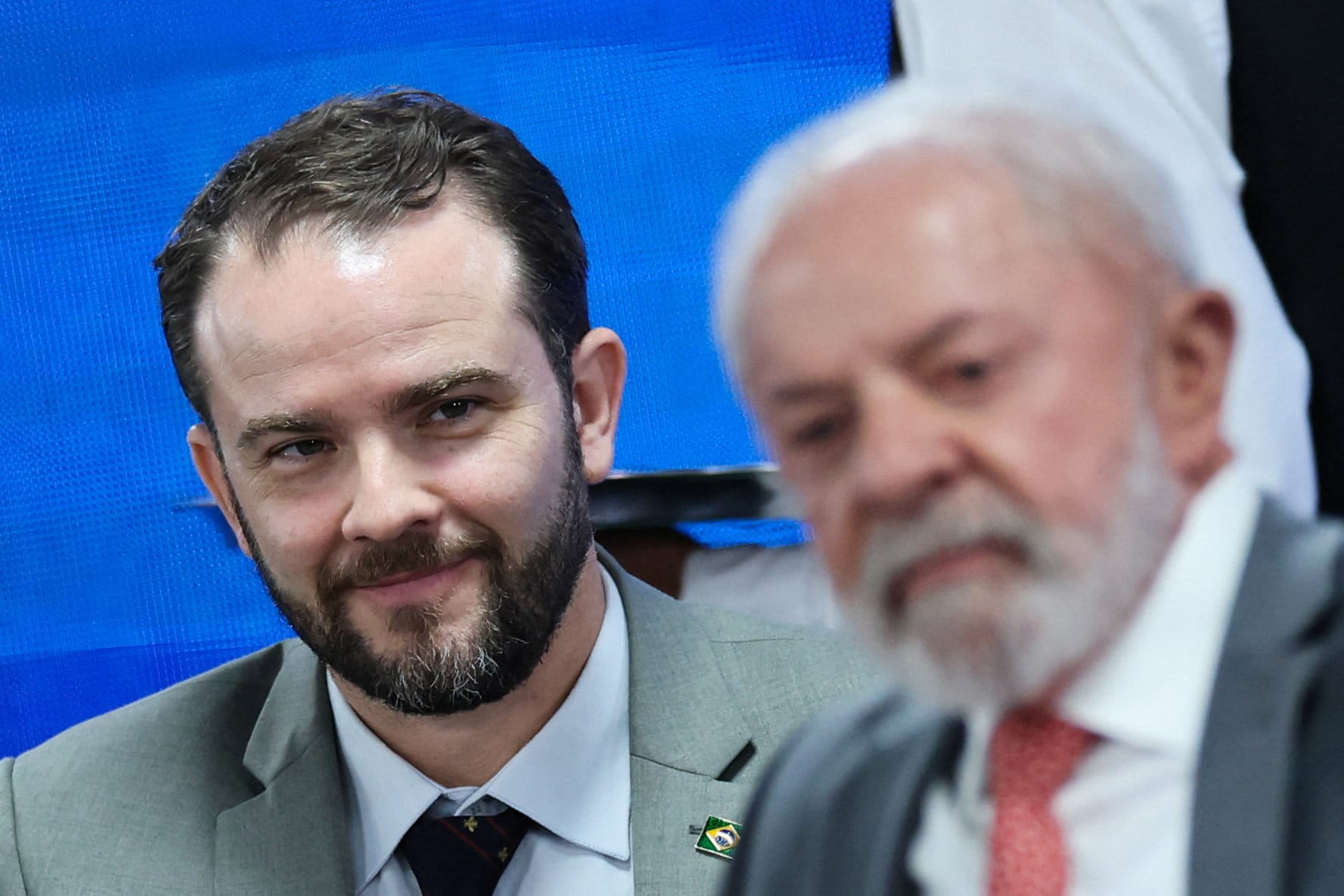
MIAMI — On a Friday afternoon in Brasília, Brazil’s Finance Minister Darío Durigan stood before reporters to announce something that would have been difficult to imagine twelve months ago: a formal security agreement between the government of Luiz Inácio Lula da Silva and the administration of Donald Trump.
The agreement between Brazil’s Federal Revenue Service and U.S. Customs and Border Protection will enable the exchange of cargo data, particularly on shipments leaving the United States for Brazil, with a focus on intercepting illegal weapons and illicit narcotics.
The initiative, described by Durigan as integrating intelligence and joint operations, is the most substantive bilateral security cooperation between the two governments since Lula returned to office in January 2023.
The numbers that prompted it tell their own story. Over the past twelve months, Brazilian and American authorities identified 35 incidents involving the seizure of 1,168 illegal weapons weighing approximately 550 kilograms, primarily shipped from Florida using fraudulent declarations and concealment techniques.
U.S.-provided intelligence helped uncover sophisticated smuggling methods, including rifle components hidden inside airsoft equipment and narcotics concealed in packages falsely labeled as pet food and other common goods sent through postal services.
The Florida Pipeline
U.S. intelligence services have identified Miami as a preferred location for PCC operations in the United States. The Primeiro Comando da Capital — the São Paulo-based organization that the U.S. government described in 2021 as the most powerful organized crime group in Brazil and among the most powerful in the world — has used South Florida as both a logistical hub for arms shipments to Brazil and as a financial base for money laundering operations.
C4ADS, a Washington-based security research organization, uncovered Florida-registered companies tied to three alleged PCC members and money launderers, exposing how even networks flagged by law enforcement continue to access the American financial system.
The pattern is not isolated. Intelligence reports indicate that PCC members have used South Florida and Texas as entry points for smuggling operations into the United States, leveraging ties with the Sinaloa Cartel and Jalisco New Generation Cartel to move narcotics into major American cities. Authorities have also identified suspected PCC operatives involved in money laundering schemes using American financial institutions to clean drug profits before transferring funds back to Brazil.
The Comando Vermelho — the Rio de Janeiro-based organization that, alongside the PCC, represents the most powerful criminal infrastructure in Brazil — operates a parallel network. The CV controls parts of Rio de Janeiro and has expanded into neighboring countries. It is estimated to have as many as 30,000 members and remains the second-largest criminal organization in Brazil behind the PCC.
Both organizations are now the subject of active Washington deliberations over whether to designate them as foreign terrorist organizations — a classification that Lula has publicly and directly opposed.
A Crime Wave That Has Defined Lula's Third Term
The agreement announced on Friday is a response to a security crisis that has deepened significantly during Lula’s time in office — and that has become one of the most damaging political liabilities of his presidency.
As of 2024, more than 80 organized criminal groups operate in Brazil. The PCC has approximately 100,000 lifetime members and associates operating in almost every Brazilian state as well as internationally, with its base in São Paulo. The CV has approximately 30,000 members, operating in about 20 Brazilian states and other Latin American countries. In 2023, Brazil recorded approximately 39,500 homicides.
Both organizations have expanded their territorial reach substantially during the Lula years. Data from the Grupo de Estudos dos Novos Ilegalismos and the Instituto Fogo Cruzado show that between 2008 and 2023, the CV grew its controlled territory in Rio de Janeiro by 89.2%, while militias grew by 204.6%. By 2024, armed groups directly controlled 14 percent of the urbanized area of the Rio metropolitan region.
In 2023, the homicide rate in northern Brazil was 41.5% higher than the national average. Six of the ten cities with the highest homicide rates in the country were in the northeastern state of Bahia, with the rise in violence driven directly by PCC and CV expansion into those regions. Between May 2022 and April 2025, more than 3,500 conflicts involving criminal networks occurred in Bahia alone, with research showing that each clash between rival criminal networks produced a 39% increase in homicides in the affected municipality in the following month.
The financial scale of the organizations involved is difficult to overstate. The PCC is estimated to have laundered approximately $10 billion between 2020 and 2024 using legitimate business structures, including fuel companies, real estate, and corporate bank accounts.
The São Paulo Public Prosecutor’s Office estimates the group makes around $2 billion a year solely from the sale of cocaine base paste purchased in Bolivia and resold on the European market.
The expansion has not been limited to Brazil’s borders. The CV maintains ties with Colombian guerrillas, including the ELN and FARC dissidents, as well as producers in Peru and Bolivia for cocaine supply, and Paraguay for marijuana and arms. The presence of CV and PCC networks at Brazilian ports reflects their ambition to establish themselves as transnational players in global drug trafficking.
The political consequences for Lula have been severe and escalating. In October 2025, a large-scale Rio de Janeiro state police operation targeting CV leadership in the northern favelas resulted in 132 casualties — the deadliest police operation in recent Brazilian history — including four police officers and more than 120 people whose identities and criminal affiliations remain disputed by local residents and civil society groups.
The operation, ordered by Rio’s state governor rather than the federal government, exposed the limits of Lula’s authority over a security crisis being managed by state-level actors with their own political agendas.
Experts also noted that the Lula administration has failed to devise a coherent federal strategy for addressing organized crime, which has typically been left to state authorities despite the national-level threat. While Lula has retightened firearm restrictions and deployed armed forces to key ports and airports, researchers have assessed that these measures address symptoms rather than the root causes driving PCC and CV expansion — including Brazil’s overcrowded prison system, where the PCC was born and from which it continues to be directed.
The international response has been unambiguous. In 2025, Argentina, under President Javier Milei, designated both the CV and PCC as narco-terrorist organizations. Paraguay subsequently made the same designation. Both countries reinforced their borders with Brazil in direct response to the activities of the two organizations. The United States has been pushing Brasília toward a similar designation — a pressure that Lula has consistently resisted, and that the Friday agreement is partly designed to deflect.
The contradiction at the heart of Lula’s security record is this: the president who has most aggressively resisted the international framing of Brazil’s criminal organizations as terrorist threats is also the president on whose watch those organizations have reached their greatest territorial and financial extent. The agreement with Washington does not resolve that contradiction. But with elections six months away and public safety consistently ranking as the top voter concern in Brazilian polling, it represents the most visible step Lula has taken to address it.
The Political Tightrope
The agreement announced Friday sits at the intersection of two governments that have spent the past year fighting over almost everything else.
Trump has been on a campaign to crack down on criminal networks throughout the Western Hemisphere, reaching out to regional right-wing governments to join his Shield of the Americas coalition. Left-wing leaders, on the other hand, like Brazil’s Lula, were conspicuously absent from a March summit kicking off that initiative.
The Trump administration has simultaneously been pressuring Brasília to take more aggressive action against organized crime, including through military deployments — an approach Lula has resisted on both practical and sovereignty grounds.
The terror designation question has been the sharpest point of friction. Reports have emerged that Trump is considering designating the PCC and Comando Vermelho as terrorist organizations. Brazil’s Foreign Minister Mauro Vieira said he conveyed Brasília’s opposition directly to Secretary of State Marco Rubio in a phone call.
“I spoke with Secretary Rubio and told him that the Brazilian government is against this classification,” Vieira said in an interview with G1 in March.
Against that backdrop, Friday’s intelligence-sharing agreement represents a pragmatic middle ground — a form of cooperation both governments can claim as a win without either side conceding on the designation question that has defined the relationship’s most contentious months.
For Lula, the agreement blunts the opposition narrative that his government is soft on crime — a vulnerability that polling consistently identifies as his weakest flank, with Brazil's presidential election six months away. For Trump, it demonstrates that his administration can extract security cooperation from a left-wing government that has resisted his harder-line approaches, and bolster Washington’s message to regional partners that the United States is still on the march to eradicate the criminal element in Latin America.
The December Phone Call
The initiative traces back to a 40-minute phone call between Lula and Trump in December 2025. During that conversation, Lula proposed cooperation on arresting Brazilian crime leaders living in Miami, emphasizing that the two countries needed “intelligence and smart tactics” rather than military force to combat trafficking.
That framing — Lula specifically naming Miami in the context of where Brazilian criminal leadership has taken up residence — is a notable admission from a president who has staked his relationship with Washington on resisting the most aggressive elements of Trump’s regional security posture.
Brazil’s finance ministry said consolidating cargo data into a structured database has already improved identification of patterns, links between senders and recipients, and recurring trafficking routes, strengthening information-sharing with U.S. authorities to support enforcement action at the source. The system can trace the origin of illicit goods and map the criminal networks involved in the international arms trade. Early results, officials said, are already benefiting both countries.
The Miami Connection
The practical test of the agreement will be whether it produces visible results — arrests, seizures, dismantled networks — before Brazil’s October presidential election. Research analysts have noted that cooperation and intelligence sharing remain critical to addressing the PCC’s transnational expansion, and that the issue provides an opportunity for the Brazilian government to engage in productive collaboration with the United States, particularly as the PCC endeavors to expand into areas where Brazilian intelligence operations are less robust.
The challenge is structural. The PCC has transformed over three decades from a prison gang founded in São Paulo into a transnational criminal organization with a presence throughout South America, Africa, and Europe. Its leadership operates from inside Brazilian prisons, directing international operations through encrypted communications and a franchise model that has proven resilient to previous enforcement efforts. The Comando Vermelho presents similar challenges, with deep roots in Rio de Janeiro’s favela communities and documented expansion into neighboring countries.
An intelligence-sharing arrangement between customs agencies addresses the logistics layer of that network — the shipments, the concealment methods, the cargo routes. It does not address the financial infrastructure, the political connections, or the organizational resilience that have made both groups resistant to decades of law enforcement pressure on both sides of the equator.
What it does address, specifically and concretely, is the arms pipeline running out of Florida. For the communities in São Paulo and Rio de Janeiro absorbing the violence that those weapons enable, that is not a small thing.
For Miami, whose Brazilian community is the largest in the United States south of the Northeast, and whose port and financial infrastructure have been identified as active nodes in the PCC’s international network, the agreement is not abstract foreign policy. It is a description of something happening here.
Sociedad Media will continue to monitor U.S.-Brazil security cooperation and developments related to transnational criminal organizations operating in South Florida. For questions and general inquiries, contact the outlet at info@sociedadmedia.com


