

Every night through March 31, residents of four Ecuadorian provinces go to bed knowing they cannot leave their homes until sunrise. The nightly curfew running from 11 p.m. to 5 a.m. in Guayas, El Oro, Los Ríos, and Santo Domingo de los Tsáchilas—Ecuador’s main drug trafficking corridors—is backed by 75,000 soldiers and police officers deployed as part of the country’s most aggressive security offensive to date. In the first hours alone, authorities reported 253 arrests for violating the measure.
“We’re at war,” Interior Minister John Reimberg said as the operation began, urging residents to stay indoors. “Don’t take any risks. Stay home,” he warned.
That declaration encapsulates where Ecuador finds itself in 2026—a country once considered one of Latin America’s most peaceful, now deploying the language and machinery of war against criminal networks that have infiltrated its prisons, ports, and provincial governments. The curfew, the U.S. military partnership, and a string of high-profile arrests this month are the most visible expressions yet of President Daniel Noboa’s iron-fisted strategy. Whether they represent a turning point or a temporary escalation is the central question now confronting policymakers across the Andes.
The Crackdown
The curfew covers Ecuador’s main drug trafficking routes along the Pacific coast, where rival gangs have fought for control of cocaine shipments bound for North America and Europe. Noboa framed the measure not as a last resort but as a deliberate escalation of a strategy he has pursued since taking office in 2023.
In a post on X, Noboa pledged that security forces would target areas linked to illegal mining and narcotics trafficking, writing:
“We will completely eliminate those who prefer anarchy and want a failed state instead of a country at peace.”
The offensive also rests on emergency powers that allow joint military-police patrols and warrantless home searches in affected zones. The strategy is coming under international scrutiny—on March 13, the U.N. Committee on Enforced Disappearances raised concerns over the repeated use of states of emergency, the prolonged role of the armed forces in domestic security, and allegations of abuses during operations.
For many Ecuadorians, the crackdown brings mixed feelings. Night-time workers say the curfew is hitting their incomes. Others worry about potential abuses by security forces, who were criticized by human rights groups during previous states of emergency. The human cost of the offensive is landing hardest on those least equipped to absorb it. Ecuador’s informal economy—which employs roughly half the working population—operates largely at night. Street vendors, taxi drivers, security guards, and restaurant workers have seen their incomes effectively cut off during curfew hours.
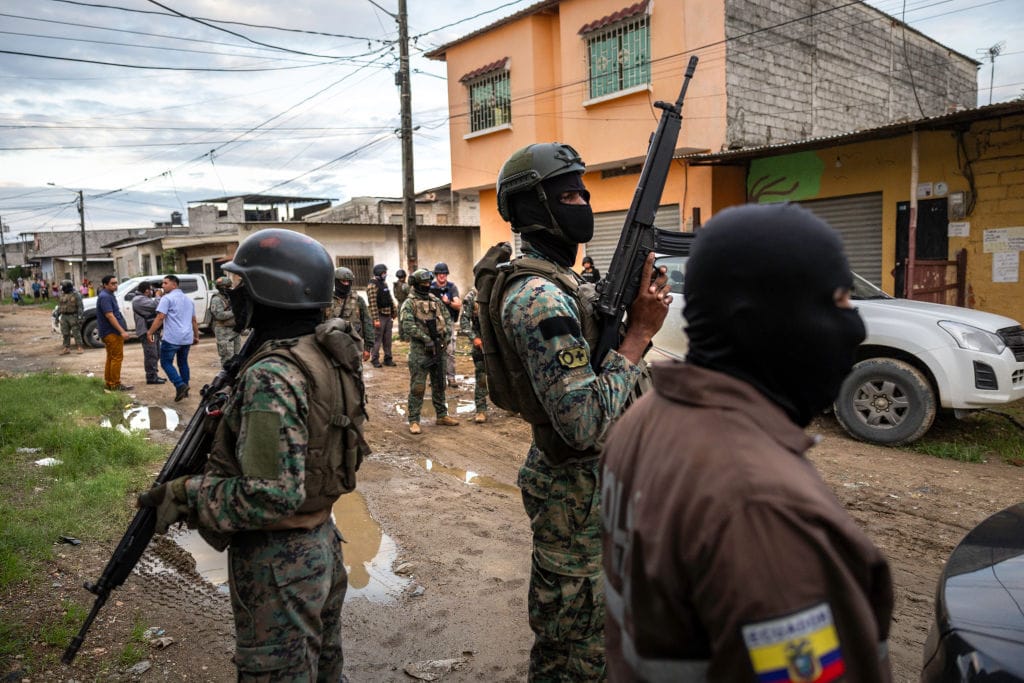
In Guayaquil, South America’s fourth-largest port city and the epicenter of gang activity, community organizations report that families in affected neighborhoods are navigating a dual fear: the gangs that have terrorized their streets for years, and the soldiers now patrolling them. Human rights organizations have called on the Noboa government to establish independent oversight mechanisms for the current operation.
For the millions of Ecuadorians caught between those two realities, the curfew is not a policy debate—it is the conditions of daily life.
The U.S. Alliance and the Shield of the Americas
Although challenged by civil liberties groups, the operations are a response to about 15 years of chronic and deadly gang violence that has catapulted Ecuador to the top echelons of the most violent states in the western hemisphere. It is also the domestic expression of a deepening security partnership with Washington that moved into operational territory earlier this month.
On March 3, the U.S. Southern Command announced that Ecuadorian and U.S. military forces had launched joint operations against designated terrorist organizations in Ecuador. General Francis Donovan described it as “a powerful example of the commitment of partners in Latin America and the Caribbean to combat the scourge of narco-terrorism.”
The Trump administration also announced it would open the first FBI field office in Ecuador, located inside the U.S. Embassy in the capital city of Quito—a significant institutional foothold that reflects Washington’s deeper operational interest in the country’s criminal networks.
The offensive is unfolding as Ecuador deepens its security partnership with Washington as part of a 17-country cartel-fighting alliance launched by U.S. President Donald Trump under the banner “Shield of the Americas.” President Noboa, one of Trump’s staunchest allies in the region, has pursued an iron-fisted security policy since taking office, largely inspired by the controversial achievements under the right-wing administration of Nayib Bukele in El Salvador.
The Doral summit, held at Trump’s own golf club in Miami—a detail not lost on South Florida observers—signaled the extent to which Latin American security policy is now being shaped by direct U.S. engagement at the highest level. Notably absent from the summit were the presidents of Colombia and Mexico, two countries traversed by major drug-trafficking routes that have confronted cartels for decades.
Their exclusion reflects the ideological dividing line now running through regional security cooperation.
Landmark Arrests and the Villavicencio Case
Against this backdrop of military escalation, a series of high-profile apprehensions this month has given Noboa’s government concrete wins to point to—none more significant than the capture of the man allegedly responsible for the assassination that shocked Ecuador’s democracy in 2023.
On Wednesday, March 18, law enforcement authorities from Mexico, Colombia, and Ecuador arrested Ángel Esteban Aguilar Morales, alias “Lobo Menor,” the leader of the Ecuadorian criminal group Los Lobos, at Mexico City’s international airport, where he attempted to enter the country under a false identity. He is suspected of masterminding the 2023 assassination of anticorruption presidential candidate Fernando Villavicencio, who was shot as he left a campaign rally near Quito.
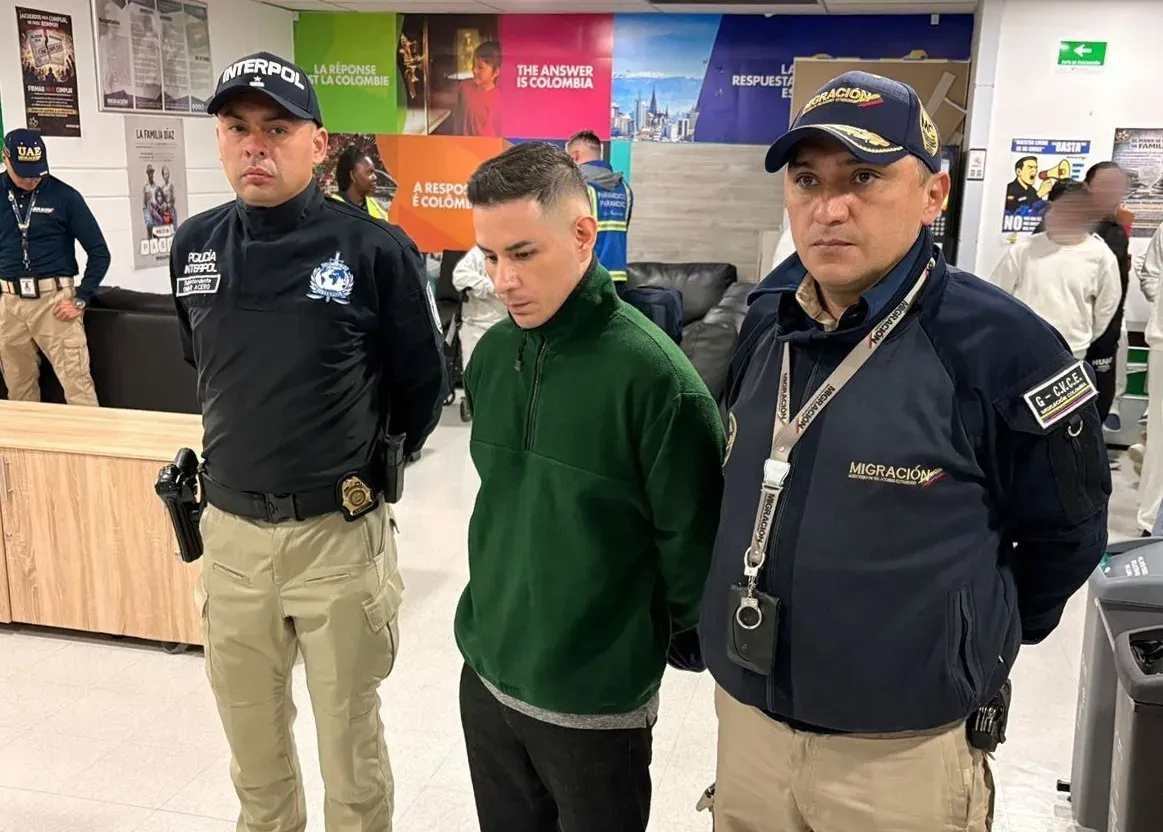
The arrest of Aguilar is a major blow to Los Lobos, which had already lost its leader in November 2025 when Spanish authorities arrested Wilmer Geovanny Chavarría Barré, alias “Pipo,” in a separate operation.
Los Lobos rose to prominence in 2020 after breaking away from rival gang Los Choneros, and forged a key alliance with Mexico’s New Generation Jalisco Cartel (CJNG), which supplied the group with weapons, training, and strategic support.
Interior Minister Reimberg celebrated Lobo Menor’s arrival at Ecuador’s maximum-security Cárcel del Encuentro (dubbed “The Encounter”, Ecuador’s flag-ship maximum security detention facility modeled after El Salvador’s CECOT) prison on March 20 with a pointed post on X showing the former cartel leader in an orange prison uniform with his head being shaved, writing:
“From ‘capo’ to inmate. Cell #1.”
In 2024, the United States had already declared Los Lobos to be the largest drug trafficking organization in Ecuador, with an estimated 8,000 members operating across 16 of the country’s 24 provinces, backed by the CJNG and Sinaloa cartels.
Can Military Force Solve What Institutions Failed to Build?
The arrests are genuine victories. The curfew is a tangible escalation. But analysts across the region are asking the harder question: does a military and enforcement-heavy strategy address the conditions that allowed Ecuador’s criminal networks to grow in the first place?
To understand why that question carries such weight, it helps to understand how quickly Ecuador fell. As recently as 2017, Ecuador recorded a homicide rate of just five per 100,000 inhabitants—among the lowest in Latin America—the legacy of a government social inclusion program that had successfully reduced gang violence over a decade. That program was dismantled through budget cuts after 2017, and the consequences were swift and catastrophic.
By 2023, Ecuador had become South America’s murder capital. The homicide rate had climbed to 46 per 100,000—a ninefold increase in six years—driven by the collapse of the prison system, the arrival of Mexican cartel networks seeking Pacific coast transit routes, and a generation of young men with no economic alternative to gang recruitment. What took a decade to build was undone in half that time.
What military force is now being asked to reverse took root in conditions—poverty, institutional decay, and geographic misfortune—that no curfew alone can address.
Like the Lernaean Hydra of Greek mythology, organized crime in Latin America has proven difficult to defeat with decapitation strategies. For every drug kingpin who falls, several others are willing to take his place. El Mencho’s death in Mexico last month sparked violent retaliation across the country, resulting in 60 deaths and raising the prospect of an accelerated CJNG power struggle—a cautionary parallel for Ecuador’s current straits.
Ecuador’s gang fragmentation, triggered by the capture and killing of leaders, has consistently fueled internal power struggles rather than reducing violence. Both inter- and intra-gang disputes often originate in prisons before spilling into the streets, a cycle that successive states of emergency have failed to break.
The broader political context matters too. Noboa’s crackdown is part of a wider realignment in Latin American governance—a turn toward tough-on-crime, U.S.-allied leadership that also includes El Salvador’s Nayib Bukele, Argentina’s Javier Milei, and Chile’s José Antonio Kast. Each has won elections on security platforms that prioritize enforcement over progressive social investment.
Florida International University’s Latin America Outlook for 2026 warns that the region is likely to experience expanding corruption and violence related to transnational organized crime throughout the year, with criminal groups that have diversified from drug trafficking into illegal gold mining, human trafficking, and extortion operations—activities that pure enforcement strategies could help reduce.
Ecuador’s war is real. The curfew is in force. The arrests are mounting. But the structural conditions—a shattered prison system, Mexican cartel influence, a cocaine transit geography that no single government can redraw, and youth unemployment that continues to feed gang recruitment—remain unchanged.
The curfew ends on March 31. What comes after it is the question Ecuador’s allies, neighbors, and 18 million citizens are waiting to answer.
Sociedad Media will continue to monitor Ecuador’s security crisis, the Shield of the Americas alliance, and organized crime developments across the Andes. Have a tip or a story connected to Ecuador’s diaspora community in the United States, or information related to relevant news events in the region? Reach out to our team at info@sociedadmedia.com—we want to hear from you.


