

WASHINGTON, D.C. – Leaders from around the world gathered on Thursday in Washington, D.C. to present the inaugural meeting of the newly unveiled Board of Peace.
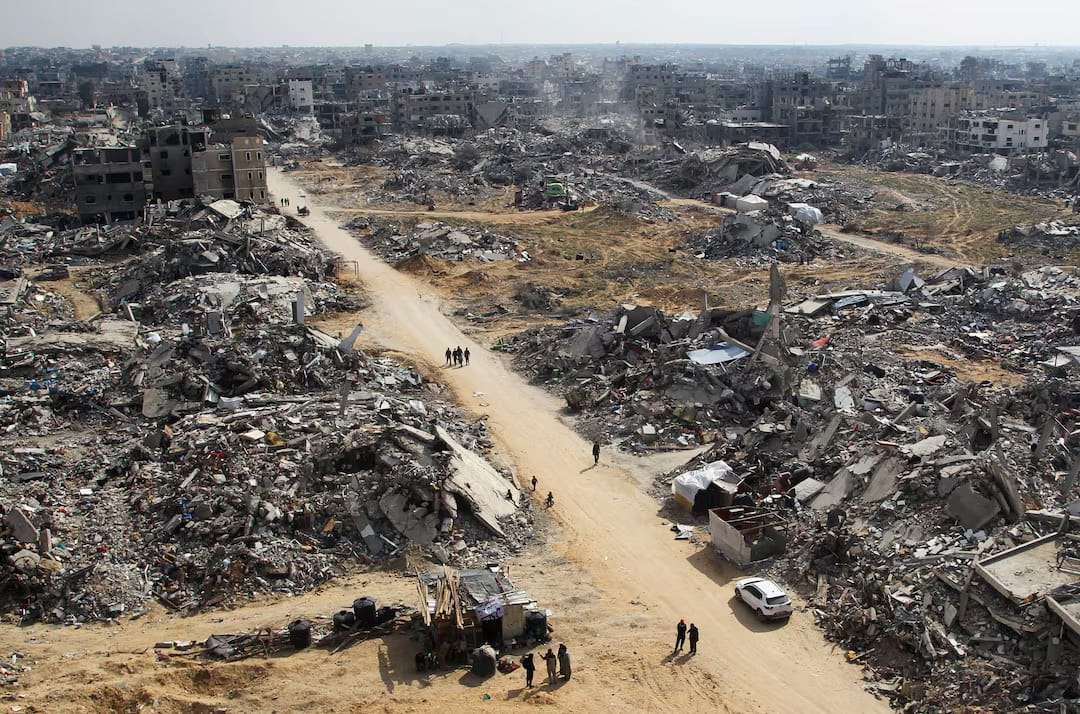
The international body, introduced by U.S. President Donald Trump, was established and endorsed by the United Nations in November 2025, with the aim of forming a multi-lateral task force to enforce security measures as part of a ceasefire plan in Gaza following the nearly three-year war with Israel, and to begin the redevelopment process of the battered territory.
Although offered as an internationally-led alternative to resolve a major international crisis, one in which the United Nations had ineffectively addressed, skeptics of the organization’s potentially expanding scope to manage future crises say the body’s charter could risk rivaling the United Nations itself.
President Trump announced during a speech on Thursday that the body’s member-states have pledged an initial $7 billion for reconstruction efforts in Gaza. Trump also stated that the United States will contribute $10 billion of its own to aid in the redevelopment process.
Gaza, a thin stretch of land that spans 140 square miles, with a population of two million people (making the area one of the most densely populated areas in the world), has been decimated due to heavy bombardment by the IDF after terrorists from Hamas launched a daring incursion into Israel on Oct. 7, 2023, killing more than 1,200 men, women, and children.
Representatives from 40 nations met at the U.S. Institute of Peace in the nation’s capital. Top diplomats from Argentina, Hungary, Azerbaijan, India, Pakistan, Indonesia, Morocco, Albania, Egypt, Jordan, among others, gathered for the Board’s first official meeting.
Critics of the new organization fear that the international body will legitimize autocratic governments and undermine the importance of international norms.
Analysts also stress concern over the entry of right-wing leaders like Viktor Orbán of Hungary, who critics say has launched a campaign to target liberal opposition groups in the eastern European country, and have accused Orbán of being closely aligned with Putin’s Russia.
Indonesia, Morocco, Kazakhstan, Kosovo and Albania have all committed to deploying troops to Gaza as part of the International Stabilization Force (ISF), according to the US Army Maj. Gen. Jasper Jeffers, who will be in command of the security deployment in Gaza.
Jeffers also added that Egypt and Jordan will train a Palestinian police force in their home countries to help bolster Palestinian civil units to ensure the internal stability of the Gaza Strip after the departure of international forces.
The international community is now watching developments in the Middle East in what could become a major international conflict, as Israeli intelligence reports indicate that a U.S. strike on Iran could be imminent.
The Pentagon has repositioned U.S. assets from Europe to the Middle East this week.
Flight logs reveal that the United States has deployed over “150 transport planes to supply weapons systems and equipment to the Middle East, giving rise to speculation of a broader military campaign against Iran,” as previously reported by Sociedad Media.
President Trump praised U.S. Special Envoy Steve Witkoff for his diplomatic efforts with Iranian counterparts in Geneva on Tuesday, but officials close to the administration say that negotiations have reached their natural end.
Trump warned at the Board of Peace conference on Thursday that “Iran is in a hot spot right now,” adding, “We have to make a meaningful deal, otherwise, bad things happen, but we have to make a meaningful deal,” Trump said.
“We do have some work to do with Iran. They can’t have a nuclear weapons. Very simple. You can’t have peace in the Middle East if they have a nuclear weapon.”


