

Iranian state security forces kill a total of 36 protesters as demonstrations against the ruling government enter their second week, stirring fears from government leaders over the regime’s potential demise.
On Tuesday, discontent over a struggling economy and spiraling hyperinflation sparked a mass sit-in at the Grand Bazaar in Tehran, a symbol of Persia’s cultural crossroads for centuries, where thousands of merchants and vendors assemble to present their goods to residents and tourists.
Authorities have deployed thousands of state security forces to stamp out the demonstrations that began in late December, eventually spreading throughout the country, resulting in the deaths of a total of 36 people and taking more than 1,200 into custody.
Tighter sanctions are largely the source of Iran’s economic strains, and a ruling government that refuses to adapt to the demands of a younger generation of residents calling for change, who have now rallied thousands into the streets to denounce the governing theocracy, led by the nation’s Supreme Leader, the Ayatollah Ali Khamenei, who has remained in power since 1989.
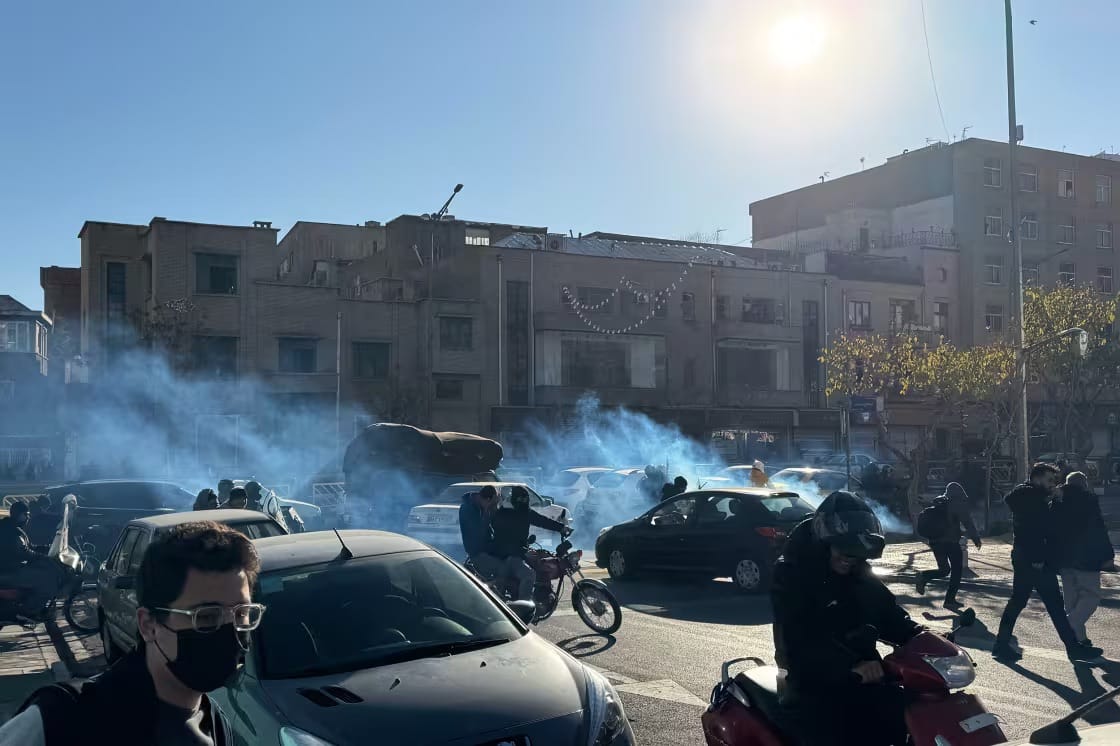
Following the 12-Day War with Israel in June of 2025, Iran’s economic woes worsened as the nation’s currency, the Iranian Rial, collapsed in December, reaching IR 1.4 million to $1.
In 1979, by the end of the Shah’s rule, when the Iranian Revolution swept the current government into power, the Iranian Rial was trading at 70 to $1, an elusive far cry from what the country’s current economic situation is today.
Government Fears
On Monday, the Iranian government announced a plan to provide citizens with a $7 monthly stipend in an effort to stem the growing discontent and spreading demonstrations from the country’s population.
Fatameh Mohajerani, a government spokesperson, said the move is aimed at “preserving households’ purchasing power, controlling inflation and ensuring food security.”
In the face of the most serious period of domestic upheaval since the 1979 Revolution, presenting the most vivid danger to the survival of the Islamic Republic, reports suggest that U.S. and British intelligence agencies believe that Khomeini has devised a plan for a possible escape route to Moscow if the situation on the ground proves untenable, according to sources for The Times.
Trump’s Iran Threat
Following a pre-dawn raid into a military compound in the middle of Caracas led by the U.S. elite special operations unit, Delta Force, that captured the de facto leader of the Venezuelan republic, Nicolás Maduro, President Trump warned the ruling Iranian government of any violent crackdown on protesters, stating that Iran would be “hit very hard” if it continued to use lethal force on demonstrators.
On Jan. 2, President Trump wrote on Truth Social that the United States will “come to their [protesters] rescue” and is “locked and loaded and ready to go.”
On June 21, 2025, the United States conducted precision strikes on multiple Iranian nuclear sites, crippling the nation’s nuclear development program.
Iranian Response
The Iranian regime, amid mounting pressure from domestic upheaval and widespread agitation, condemned the statements by the U.S. president, arguing that officials in Washington and Israel are plotting to stir unrest in Tehran.
Iranian Foreign Ministry spokesperson Esmaeil Baqaei accused the governments of the United States and Israel of “inciting” the protests as part of a concerted effort to manipulate events inside Iran and to take advantage of the current developments in an attempt to weaken the ruling government.
🚨🇮🇷 | WORLD: Day 5 of demonstrations in Iran as protestors take fire to a Shiite clerical seminary in Farsan, Chaharmahal, and Bakhtiari province during economic collapse and hyperinflation.pic.twitter.com/jQtEGtIMqG
— Sociedad Media (@sociedadmedia) January 2, 2026


