

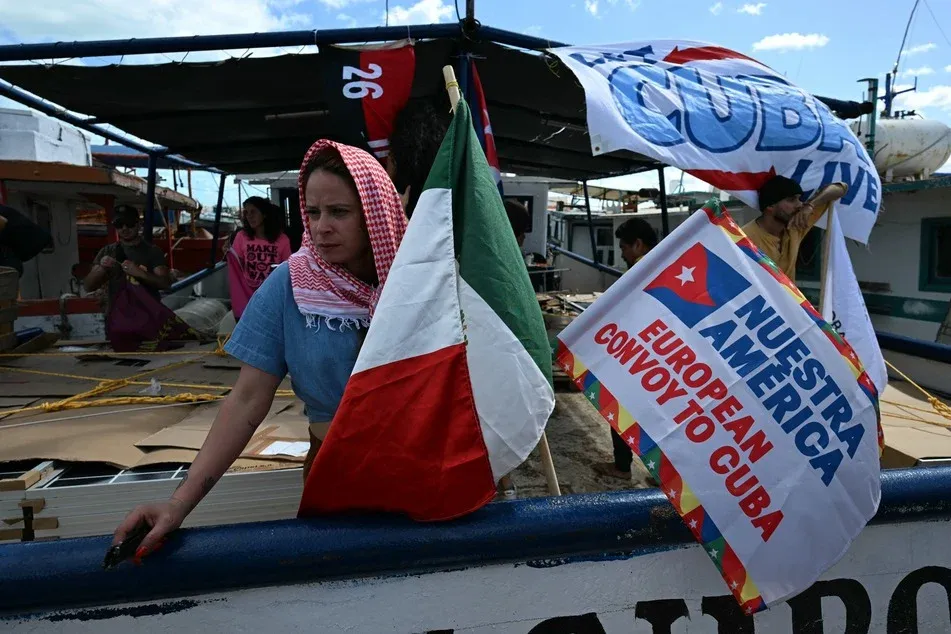
MIAMI — They came by air from Italy, Spain, France, and the United States. Three vessels are arriving by sea from Mexico today. And on the Malecón esplanade—the iconic seafront promenade where generations of Cubans have gathered to watch the waves and dream of leaving—650 delegates from 33 countries and 120 organizations are converging today in Havana to deliver 20 tons of humanitarian aid to an island that has not received an oil shipment in more than three months.
The Nuestra América Convoy to Cuba—named for José Martí’s 1891 essay envisioning a unified Latin American identity free from imperial domination—is the most visible international solidarity action in the hemisphere since the Gaza flotillas that inspired it. Whether it is a genuine humanitarian lifeline, a political statement dressed as a relief mission, or both simultaneously, depends almost entirely on who you ask—and where they stand in a Latin America more divided over Cuba than at any point since the Cold War.
What it is, What it Carries, and Who Organized it
The Nuestra América Convoy to Cuba is an international humanitarian movement that began as a maritime flotilla plan and expanded into a global coordinated mission delivering humanitarian supplies by air, land, and sea, converging in Havana on March 21, 2026.
It was publicly announced in early February 2026, “to bring food, medicine, and essential supplies to Cuba.” Inspired by the Global Sumud Flotilla that attempted to break Israel’s blockade on Gaza last year, the initiative is promoted by Progressive International—a movement that emerged in 2020 to unite left-wing activists around the world.
The convoy’s 650 delegates represent 120 organizations from 33 countries—including Morena, Mexico’s ruling party; the Workers’ Party of Brazil (PT); and the Broad Front of Uruguay. Prominent figures traveling with the convoy include British parliamentarian Jeremy Corbyn, Colombian Senator Clara López, former Spanish politician Pablo Iglesias, U.S. labor leader Chris Smalls, and Brazilian humanitarian activist Thiago Ávila.
The aid itself is tangible and urgently needed. The convoy is carrying more than 20 tonnes of food, medical supplies, and solar panel equipment. Participants were asked to bring dry goods, baby food, over-the-counter medicine, and batteries—the essential items of a population living through rolling blackouts and fuel-driven supply chain collapse.
The first shipment of international aid—five tons of medical supplies—arrived ON Wednesday in advance of the main convoy.
The plan is to converge all deliveries at the Malecón esplanade, where humanitarian aid and supplies will be stored and later distributed around the island. The Cuban government welcomed the convoy’s arrival—a stance that immediately raised questions from dissidents and exile organizations about the independence of the distribution process.
Organized by the Left—but Not by Havana
The question of who is really behind the convoy has been central to the debate surrounding it. The Cuban government did not organize it, but its fingerprints are visible in the network supporting it.
Progressive International’s Advisory Council includes Mariela Castro, a deputy in Cuba’s National Assembly and daughter of Raúl Castro. A member of the Cuban political apparatus is therefore part of the strategic leadership of the organizing body. Critics have seized on that connection to argue that the convoy, whatever its humanitarian intentions, is functionally providing political cover for the regime at its moment of maximum pressure.
Cuban art historian and activist Salomé García Bacallao, writing from exile, put it most pointedly: “If they can enter, so can we”—referring to the restrictions Cuba imposes on its own dissidents who attempt to return to the island while welcoming international solidarity delegations. The implicit argument is sharp: a government that imprisons political opponents and expels journalists cannot claim humanitarian beneficence for accepting foreign aid deliveries.
“In the end, we are dozens and dozens of delegates, and we represent millions of people in this convoy,” said David Adler, coordinator of Progressive International and the convoy’s lead organizer. “We cannot allow this collective punishment. We cannot normalize it.” Adler, who also coordinated the Gaza flotilla, frames the Cuba mission in identical terms—a government-imposed blockade producing civilian suffering that the international community has an obligation to confront regardless of political alignment.
A Divided Latin America
The convoy’s arrival today crystallizes a division in Latin America that has been building since January 3—the day U.S. forces captured Nicolás Maduro and severed Venezuela’s oil lifeline to Cuba. On one side stand the governments that attended Trump’s Shield of the Americas summit at Doral on March 7—Argentina, Ecuador, Chile, Bolivia, Paraguay, and others—who view Washington’s Cuba pressure campaign as legitimate and overdue.
On the other stand Brazil, Mexico, Colombia, and Uruguay—whose governments have sent aid and condemned the blockade, and in some cases actively participated in the convoy’s organizational network.
Mexican President Claudia Sheinbaum, who has not been shy in her defense of the Cuban government, has warned of a possible humanitarian crisis in Cuba. Mexico’s ruling Morena party sent representatives on the convoy—a gesture that carries its own geopolitical complexity, given that Mexico simultaneously faces the threat of U.S. tariffs if it resumes oil shipments to the island.
The European dimension adds an extra layer. The EU is weighing the suspension of its Political Dialogue and Cooperation Agreement with Cuba—a framework that has provided 94 million euros in humanitarian aid between 1993 and 2020 and set aside an additional 125 million euros for 2021–2027. Poland’s MEP Arkadiusz Mularczyk, who supports the suspension, told Al Jazeera that the EU should “not get in the US’s way.” But other European delegates joined the convoy in precisely the opposite spirit—saying their governments condemn the blockade at the UN every year and then do nothing.
Mexican geopolitical analyst Esteban Román Alonso called the convoy “theater” aimed at satisfying the leftist base—arguing that “the left is tied to the Cuban myth purely by propaganda.” That characterization will resonate in Miami’s Cuban exile community, where the arrival of Jeremy Corbyn and CodePink activists in Havana while Cubans are being shot during protests is received as a profound moral failure by the international left.
Russia’s Oil and Washington’s Talks
The convoy’s arrival today coincides with two other significant Cuba developments. Cuba is preparing to receive its first shipment of Russian oil this year—just days after the government announced it was operating on natural gas, solar power, and thermoelectric plants as severe power outages continue to hit the island.
The Russian shipment—modest in scale relative to Cuba’s needs—suggests Moscow is not entirely willing to abandon Havana even as its own economic pressures mount.
On the diplomatic front, the most explicit signal yet came from Cuba’s Deputy Foreign Minister Carlos Fernández de Cossío, speaking Friday on the same day the convoy delegates began arriving. “The Cuban political system is not up for negotiation, nor is the president, nor the position of any official in Cuba, subject to negotiation with the United States or with the government of any other country,” Fernández de Cossío said. He noted there are many areas of common interest on which dialogue with Washington is possible, as has been done in the past.
The statement directly contradicts the New York Times report that Washington has demanded Díaz-Canel’s departure as a condition of any deal, drawing a hard line that the convoy’s arrival today will only reinforce.
The Fundamental Question
Twenty tons of food, medicine, and solar panels is not nothing. For a hospital in Holguín running on generators, a pallet of medicine is the difference between surgery and sepsis. For a family in Havana living on R$13 per month on a state salary, a case of dry goods is a month’s nutrition.
But 20 tons is also not an oil shipment. “Cuba needs fuel,” one analyst told Al Jazeera. “We can take as much humanitarian aid as we can, but that is masking symptoms, not treating the cause.” The fundamental cause of Cuba’s crisis is not a shortage of dry goods or medical supplies. It is a shortage of oil, and 650 solidarity delegates arriving at the Malecón with suitcases of batteries and canned food cannot replace the Venezuelan crude that powered the island’s grid, hospitals, and agriculture for two decades.
No details have been announced about how the supplies will be distributed once they arrive on the island—and whether there will be independent oversight mechanisms to ensure that the aid reaches the population directly rather than being channeled through government distribution networks that have historically prioritized regime-aligned communities.
The convoy is here. The Russian oil is coming, perhaps. Washington and Havana are talking. And in the streets of Cuba’s cities, the pots are still banging. The island’s crisis has attracted the world’s attention. It has not yet found its resolution.


