

Two months after U.S. special forces captured Nicolás Maduro and his wife and alleged co-conspirator in a predawn raid on Caracas on Feb. 3, Venezuela is undergoing the most dramatic economic transformation it has seen since Hugo Chávez seized the presidency in 1999.
American oil executives are now swooping into the South American country, sanctions are being dismantled by its interim government, political prisoners are walking free after years in some of the region’s most feared detention facilities, and for the first time in nearly two decades, U.S. companies are sizing up one of the richest untapped markets, and the world’s largest reserves of oil, all at their fingertips.
The question is no longer whether Venezuela will reopen to American business. It already has. The question is how fast, how deep, and at what cost to the socialist regime in Caracas.
The Oil Prize
The numbers are staggering. Venezuela holds the world’s largest proven oil reserves at roughly 303 billion barrels, accounting for about 17 to 20 percent of global reserves—more than Saudi Arabia. Yet for years, that treasure sat largely inaccessible.
Production that once exceeded 3 million barrels per day in the early 2000s fell to around 840,000 to 900,000 barrels per day in 2025. Corruption, incompetence, and mismanagement squandered the Venezuelan oil boom of 2003-2008, turning what was once the nation’s greatest asset into its greatest liability as the regime under Chávez and Maduro redirected revenues from the state-run oil company into government funds to manage charitable social programs for the Venezuelan poor.
The state-owned oil conglomerate, P.D.V.S.A., says its pipelines haven’t been updated in half a century, and the cost to return to peak production levels would run as high as $58 billion.
The Trump administration did not flinch at the figure.
At a White House meeting with executives from approximately 20 major international oil companies in January, following the Maduro raid, President Trump’s goal was to secure billions of dollars in investments to help restore Venezuela’s failing oil infrastructure. He told the assembled executives that Big Oil would spend at least $100 billion in Venezuela.
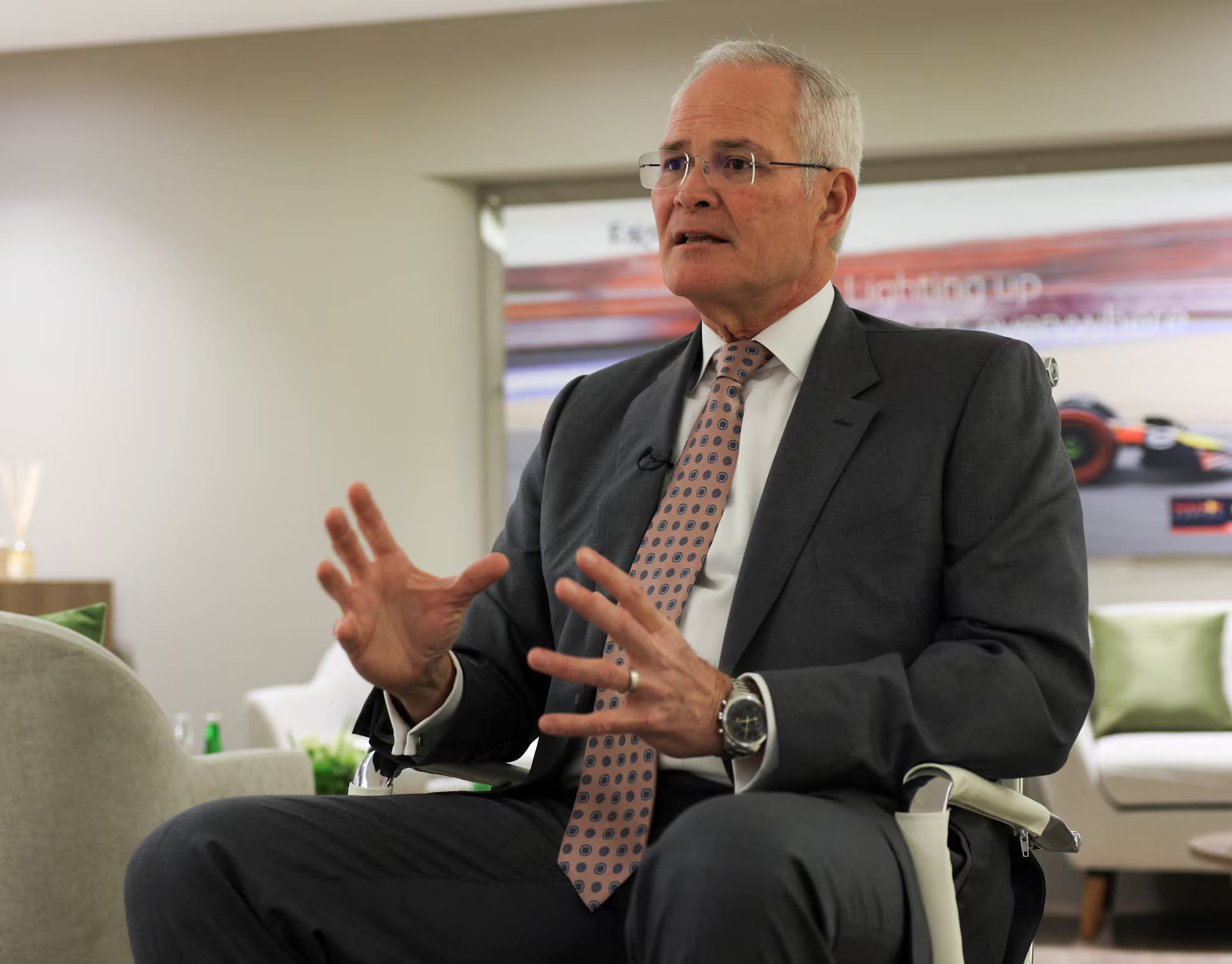
Not everyone in the room agreed, however. ExxonMobil CEO Darren Woods stated flatly that Venezuela is currently “uninvestable,” pointing to the significant changes needed to make the country more attractive for U.S. companies.
Two months after Maduro’s removal, a licensing framework is already in motion for the return of Big Oil. The Office of Foreign Assets Control (OFAC) issued two general licenses in early 2026, dismantling nearly a decade of restrictive measures while establishing new financial supervision protocols.
The licenses authorize the complete petroleum value chain: exploration, drilling, enhanced recovery, and infrastructure rehabilitation.
Chevron Leads, Others... Not so much
Of the major U.S. oil companies, Chevron is the best positioned to benefit–because it never left. Chevron is the only major American firm operating in Venezuela, producing and exporting heavy crude under a special U.S. Treasury license.
The company operates through long-standing joint ventures with the P.D.V.S.A. and is estimated to be involved in projects covering around 25% of Venezuela’s total oil reserves, primarily in the Orinoco Belt, according to Francisco J. Monaldi, director of the Latin America energy program at Rice University.
ExxonMobil and ConocoPhillips, by contrast, withdrew from Venezuela after refusing to accept new contract terms under Hugo Chávez’s nationalization campaign in 2006 and 2007.
Both subsequently secured international arbitration awards for their seized assets during Chávez’s expropriations.
ConocoPhillips alone holds outstanding claims totaling more than $10 billion. Any new investment framework will have to reconcile with this history.
Venezuela should be able to rapidly return to producing around one million barrels a day once the export blockade is lifted. Getting output back to 3 million barrels a day or more will take substantial time. This could be achievable over a ten-year horizon, but not four years, according to experts.
Energy analysts at Wood Mackenzie note that the reconstruction of Venezuela’s industry would be greatly helped if political and economic conditions stabilize enough to encourage skilled and experienced oil workers—many of whom have built careers and lives abroad and will be reluctant to return—to come back to Venezuela.
Beyond Oil: U.S. Brands Eye a New Market
The energy sector is the headline, but the commercial opportunity runs much wider.
Charles Myers, chairman of consulting firm Signum Global Advisors, called Venezuela “a major infrastructure play” that could be as big as $500 billion over the next 10 years, spanning construction, automotives, defense, chemicals, and consumer goods.
Myers organized a March investor trip to Caracas with multinationals and asset managers to begin scoping opportunities on the ground.
For U.S. beverage companies, Venezuela has historically been on the radar of Pepsi and Coca-Cola because the nation combines oil-driven income, a large urban consumer base, and very high soft-drink consumption compared to other Latin American countries, say company data analyses.
PepsiCo operates through a joint venture with Empresas Polar, while Coca-Cola works through a local bottler tied to Coca-Cola FEMSA—both ventures have substantially scaled back due to the high-risk operating environment under the regime.
Analysts at the U.S. State Department propose that if sanctions ease further and the currency stabilizes, both companies could find a window to modernize supply chains and reinvest in their Venezuelan strategies, posing tremendous opportunities for a Venezuelan return.
Economic forecasting firm Ecoanalítica projects 15% growth for the Venezuelan economy in 2026—the highest in 15 years—and a survey conducted by the firm found that 92% of Venezuelan companies expect a positive or very positive outlook for the year ahead.
Prisoners Walk Free—But Hundreds Remain
Washington made clear from the outset that oil access and political liberalization would go hand in hand. The U.S. Embassy in Caracas, closed since 2019, was reopened in February, and diplomatic relations between Washington and the interim government of Acting President Delcy Rodríguez were formally restarted.
The most visible sign of political opening has been the release of political prisoners. As of February 24, the number of confirmed releases since January 8 had reached 545 out of an estimated 800 or more political prisoners held before January, according to a Venezuela-based human rights organization, Foro Penal.
The releases came in stages. Among the first freed was Enrique Márquez, who attended President Trump’s State of the Union address, a former electoral authority who had run against Maduro in the contested 2024 presidential election. “It's all over now,” Márquez said in a video filmed outside a prison with his wife at his side.
Multiple U.S. citizens were also freed in mid-January, the first such releases since Maduro’s capture, confirmed by the State Department.
On February 19, Venezuela’s National Assembly unanimously adopted an amnesty law covering political detainees, with 379 prisoners formally granted amnesty in the immediate aftermath.
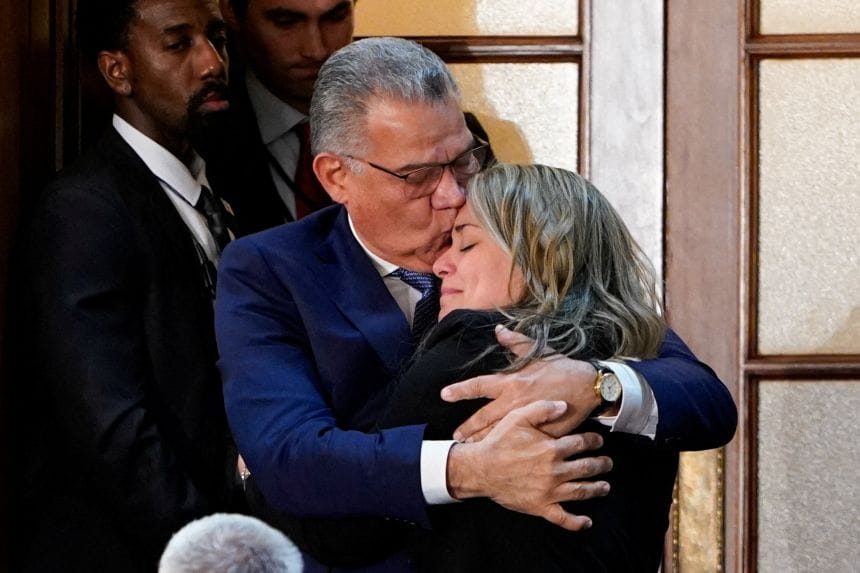
Trump celebrated the prisoner releases at his State of the Union address on Tuesday, inviting Márquez to sit in the gallery as a guest. “They've been great,” Trump said, referring to the transition government in Caracas. “Everything we’ve wanted, they've given us.”
Human rights advocates remain cautious, however.
Alfredo Romero, director of Foro Penal, urged Venezuelan lawmakers to pass a comprehensive amnesty law, noting that those released remain under legal restrictions, barred from speaking publicly, and are required to appear before a judge every 30 days.
“Most political prisoners are being tortured or subject to cruel treatment in some way or another,” Romero told NPR. “It's good news, but we are worried because this process has been so slow.”
A Fragile Opening
Laura Cristina Dib, director for Venezuela at the Washington Office on Latin America, stressed that long-term investment is not possible without clear rules and expressed concern about a reshuffling of the Chavista regime through ministerial changes that do not signal a genuine reopening to democracy.
“Oil companies make very costly investments and usually in difficult environments,” said Cynthia Arnson of the Johns Hopkins School of Advanced International Studies. “Until it’s clear which way this is going, and how much stability there is, the idea that the capture of Maduro will cause U.S. oil companies to jump into Venezuela is also a myth.”
For the millions of Venezuelans who lived through the Maduro years—and the hundreds of thousands in Miami who watched from across the water—the next chapter is being written in real time. The oil is there. The licenses are being issued. The prisoners, albeit slowly, are coming home.
But whether the country that emerges from all of this resembles a democracy or simply a more commercially convenient version of what came before remains the defining question of Venezuela’s fragile new opening.
Sociedad Media will continue to monitor developments in Venezuela amid the country’s ongoing political transformation following the ouster of Nicolás Maduro.


