

MIAMI — She didn’t make the trip to Miami in person. But on Wednesday, Venezuela’s acting President Delcy Rodríguez addressed a Saudi-backed investment summit in the city from Caracas—pitching a country that the world’s largest oil companies have already publicly called “uninvestable.”
Speaking at the Miami summit via remote presentation, Rodríguez touted Venezuela’s resource wealth and the sweeping reforms her government has enacted since Nicolás Maduro’s removal in January. She projected double-digit economic growth for Venezuela this year and the following two, and described a business environment now open to private capital, international arbitration, and the kind of investor protections the Maduro government spent 25 years systematically dismantling.
“When we consider a barrel of oil, its production cost, 64% of that barrel has room for negotiation with the investor regarding royalty reductions, income tax reductions, and most importantly, the dividends the investor receives,” she told the assembled investors. “If there is a large investment, obviously the return will be higher on that 64%.”
Notably absent from her presentation: any mention of Nicolás Maduro.
The Gap Between the Pitch and the Reality
The reforms Rodríguez described are real. A new oil industry law now grants private companies control over production and sales, ending PDVSA’s monopoly over those activities and pricing. It also allows for independent international arbitration of disputes—eliminating the previous requirement that disagreements be settled exclusively in Venezuelan courts controlled by the ruling party. The U.S. Treasury Department responded by issuing a broad authorization last week allowing PDVSA to directly sell Venezuelan oil to U.S. companies and on global markets, a major shift after years of sanctions.
But the distance between legislative reform and actual investment confidence is significant—and the oil industry said so plainly, in the Oval Office, within days of Maduro’s removal.
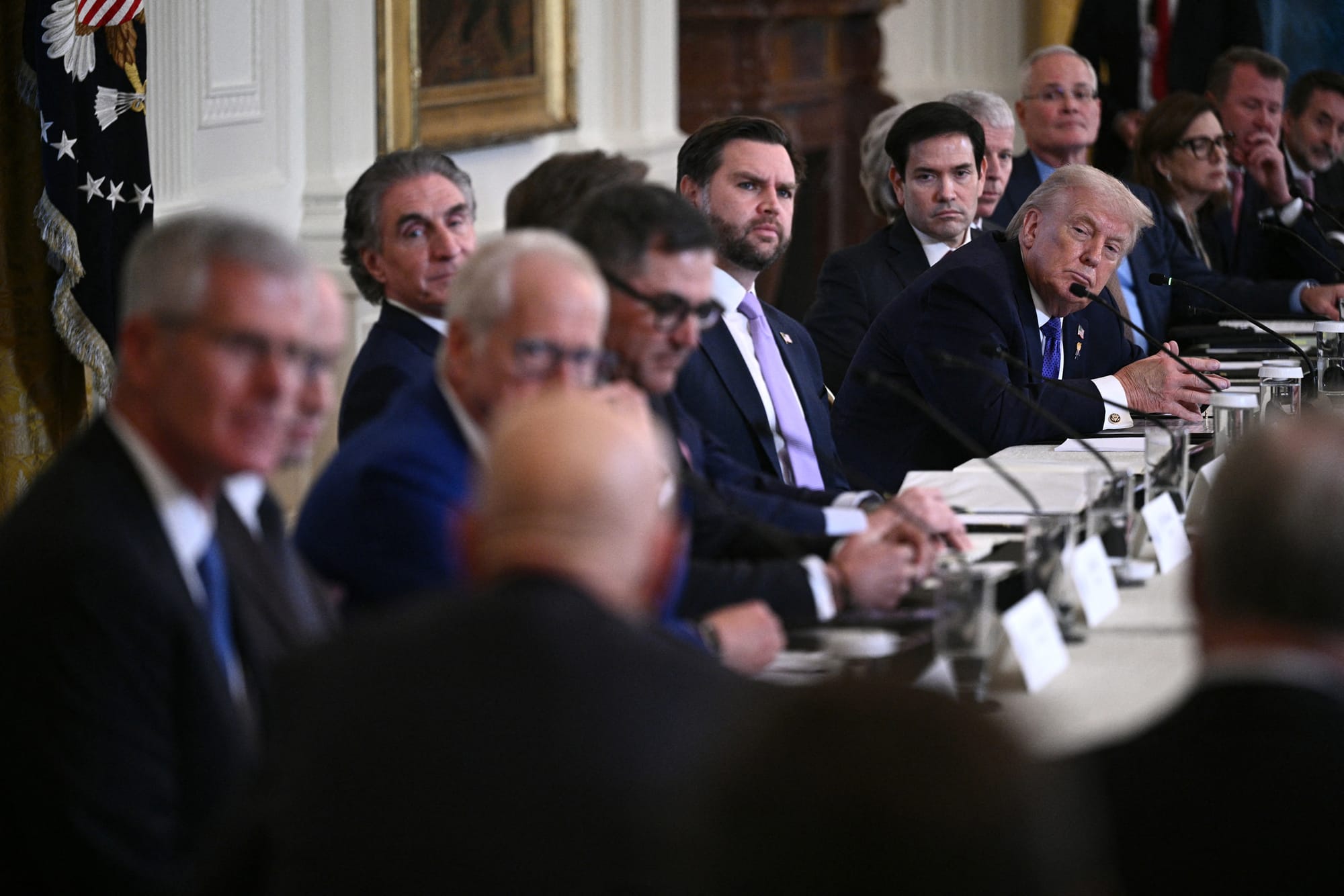
At a January 9 White House meeting where Trump urged roughly 20 oil company executives to commit at least $100 billion to rebuilding Venezuela’s energy sector, ExxonMobil Chairman and CEO Darren Woods delivered one of the most memorable lines of the post-Maduro era: “Today, it's uninvestable.” He said significant changes would have to be made to commercial frameworks and the legal system, and that there needed to be “durable investment protections.”
Woods noted that Exxon had its Venezuelan assets expropriated twice—most recently in 2007—and that re-entering a third time would require considerably more than verbal assurances.
ConocoPhillips CEO Ryan Lance echoed the concern, arguing for a complete restructuring of the entire Venezuelan energy system, including PDVSA itself. His company is still owed approximately $10 billion from winning arbitration claims for the unlawful expropriation of its Venezuelan assets nearly two decades ago.
TotalEnergies CEO Patrick Pouyanne put it simply: “I will tell you the truth—it is not high on my agenda.”
Why the Institutional Changes at the Top of the Regime Matter
All the while international investor confidence remains low, the sweeping turnover of Venezuela’s institutional leadership since January takes on a different character.
Read in isolation, the resignation of Tarek William Saab as Fiscal General, the appointment of Arianny Seijo Noguera as the new Procurador General, and the overhaul of Venezuela’s military high command appear to demonstrate a government managing its own transition. Read in the context of the investor relations problem on full display at the January White House meeting, they look like something more deliberate: a government trying to systematically remove the faces that international investors and U.S. counterparts most associate with the Maduro era’s corruption, opacity, and expropriation record.
Seijo Noguera’s background—international arbitration experience at the ICJ, legal counsel to PDVSA, deep familiarity with the disputes that have left U.S. oil companies holding billions in unresolved claims—is precisely the profile a government needs if its primary legal challenge is convincing foreign companies that this time, their contracts will be honored.
The choice is not coincidental. Former U.S. Ambassador to Venezuela James Story has described Rodríguez's strategy as doing “just enough to make it look as if they're complying”—advancing the minimum reforms necessary to keep Washington engaged while waiting to see whether U.S. political attention fades ahead of the 2026 midterms.
That reading is credible. But it is not the only one. A government that has survived a U.S. military operation, sanctions, and the capture of its previous leader also has strong incentives to make the reforms permanent—because the alternative is a return to the economic isolation that left Venezuela producing fewer than 400,000 barrels a day at the lowest point of the Maduro era, down from 3.5 million in 1999.
What the Numbers Actually Say
Venezuela currently produces approximately one million barrels per day—a significant recovery from the 2020 lows, but still less than a third of its late-1990s output. The country sits atop the world’s largest proven oil reserves, estimated at over 300 billion barrels. The physical resource is not the obstacle. The institutional infrastructure required to monetize it is.
Chevron, the only major Western producer currently operating in Venezuela through a joint venture with PDVSA, produces approximately 240,000 barrels a day. Its vice chairman told the January White House gathering that the company sees a path to increasing that figure by 50% over the next 18 to 24 months from its existing operations—without requiring the scale of new investment Trump was proposing.
That is the realistic near-term ceiling: incremental expansion from an existing operator, not the transformational $100 billion influx Trump projected.
From Caracas to Miami
The choice of Miami as the venue for Rodríguez’s investor pitch was not accidental. South Florida is home to the largest Venezuelan diaspora community outside Venezuela itself, a concentration of Venezuelan business capital, legal expertise, and financial intermediaries who have been watching the post-Maduro transition more closely than any other city in the United States.
It is also the city where the Trump administration's Latin America policy is most visible—and most contested.
For Miami’s Venezuelan community, Wednesday’s presentation carries a weight that no foreign investor fully feels. The pitch to international capital is also, implicitly, a pitch to the hundreds of thousands of Venezuelans in South Florida who left a country that broke its promises to them—and who are now watching to see whether the new government’s promises are any different from the old ones.
Rodríguez offered double-digit growth projections and flexible royalty structures. What she could not offer—and what neither she nor any reform law can simply decree into existence—is the institutional credibility that decades of mismanagement and expropriation eroded.
That will take longer to rebuild than any single summit can signal.
Sociedad Media will continue to monitor Venezuela’s investment environment and its implications for the Venezuelan diaspora community in Miami. Have a tip or a story connected to Venezuela’s economic transition? Reach out at info@sociedadmedia.com—we want to hear from you.


