

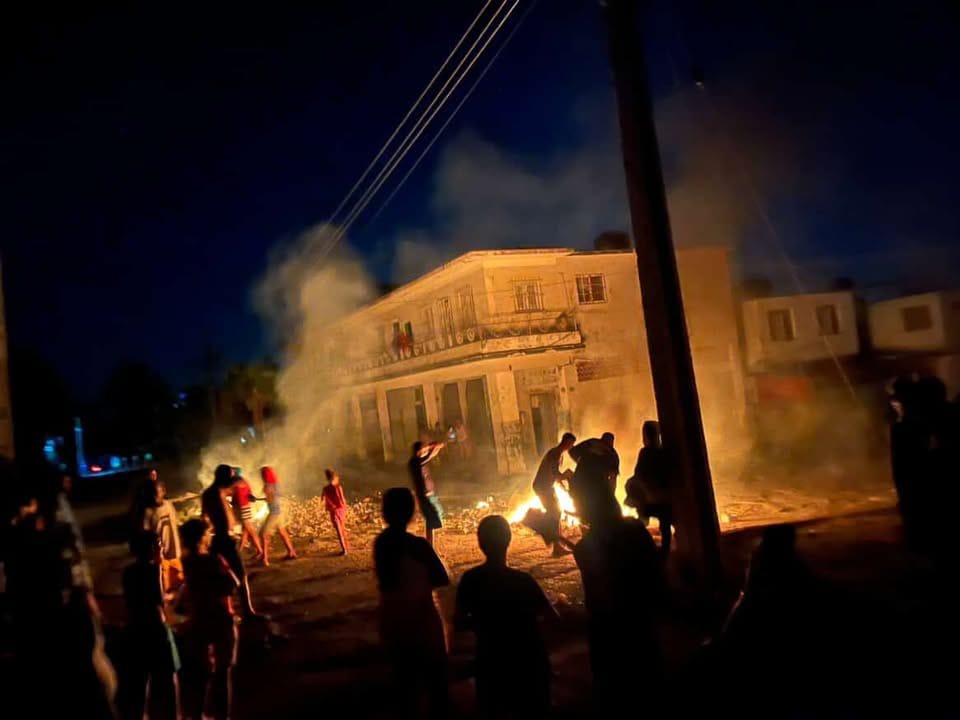
MIAMI – For the third consecutive night, the Cuban people took to the streets to call for “libertad!” from their government in Havana on Saturday, symphonized by the cacaphonic banging of pots and pans—more intimately referred to as the traditional cacerolazao—in total darkness, as demonstrations against the island’s worsening energy crisis amid spreading blackouts show no signs of letting up.
Protests have spread across multiple municipalities in Havana and beyond, with residents filling the streets with cookware and cries of dissent amid energy shortages that in some provinces have stretched beyond 20 hours a day.
On Friday night, several areas of Cuba, notably Havana and the municipality of Jagüey Grande in Matanzas province, have witnessed upheaval in recent days.
Videos circulating on social media on Saturday night captured chants of “freedom” and “down with communism” echoing through neighborhoods left without light or running water.
Florida’s Cuban-American congressional delegation wasted no time responding. Rep. Carlos Giménez (R-FL), who represents Miami-Dade County’s 28th District, took to X on Friday as one of the first nights of protests erupted, posting:
“🚨 #SOSCuba The people of #Cuba are on the streets demanding freedom!!! This moment is incredible! 🇺🇸🇨🇺”
Congresswoman María Elvira Salazar (R-FL), representing Miami-Dade’s 27th District, also voiced support for demonstrations, writing: “More and more are joining each time. The people can no longer bear more misery, more repression, more dictatorship.”
Similar sentiments have been shared among Miami’s exile community and Cuban activists abroad, as Congressional lawmakers on Capitol Hill who have roots among the Cuban Diaspora in Miami and South Florida, have repeatedly argued that the Cuban regime is experiencing one of its weakest moments and have called on the Trump administration to assert sustained political and economic pressure on the ailing government in Havana.
The demonstrations follow a near-total collapse of Cuba’s National Electric System. A broken boiler at the Antonio Guiteras thermoelectric plant—the island’s largest—triggered the cascading outage on Wednesday, leaving millions in Cuba’s western regions without power.
By Friday evening, the generation deficit had reached 2,046 megawatts at peak hour, with system availability on Saturday morning standing at just 1,000 megawatts against a national demand of 2,223 megawatts.
Cuban authorities announced Saturday that repair teams had successfully fixed the Guiteras plant, with engineer Félix Estrada Rodríguez telling state media the unit was expected to resume operations—though he acknowledged difficult working conditions inside the damaged facility.
Despite the announcement, blackouts continued across the country.
The crisis has unfolded against a charged political backdrop that’s been boiling since U.S. President Donald Trump assumed the White House in January 2025. Trump signed an executive order in his first month in office declaring the Cuban government an “unusual and extraordinary threat” to U.S. national security, enabling sanctions designed to restrict the island’s oil supply.
Speaking Saturday at his Doral resort to the inaugural ‘Shield of the Americas’ Summit, Trump said Cuba is in its “last moments of life as it was” and predicted the country would soon have “new life,” following the inevitable fall of the regime in Havana.
In Miami’s Little Havana, the unrest has deepened anxiety among Cuban Americans with family on the island. Residents expressed concern for relatives struggling through the ongoing Cuban crisis, with one telling Local 10 News:
“The people should be fed, should be nurtured, should be cared for, should be given every opportunity to thrive and prosper.”
The Cuban government has attributed the energy collapse to a tightening U.S. oil embargo following the removal of Nicolás Maduro from power in Caracas. Authorities in Havana also concede that an aging infrastructure is exacerbating current shortfalls.
Critics and political opposition groups to the Cuban regime in Miami point to decades of deferred maintenance, mismanagement, corruption, and a failed political and economic system that has defiled and impoverished the Cuban spirit for 60 years.
Analysts note that the protests reflect growing public frustration with a government unable to deliver its most basic services, compounding broader grievances over inflation, food scarcity, and limited opportunity shut out by a government machine that hoards an ever-increasing swath of political power.
Whether Sunday night brings a fourth consecutive round of demonstrations may depend on whether the Guiteras plant can deliver on officials’ promises—and how long Cubans are willing to wait in the dark.
But for now, there is no question that the government in Havana fears its time may be running out.


