

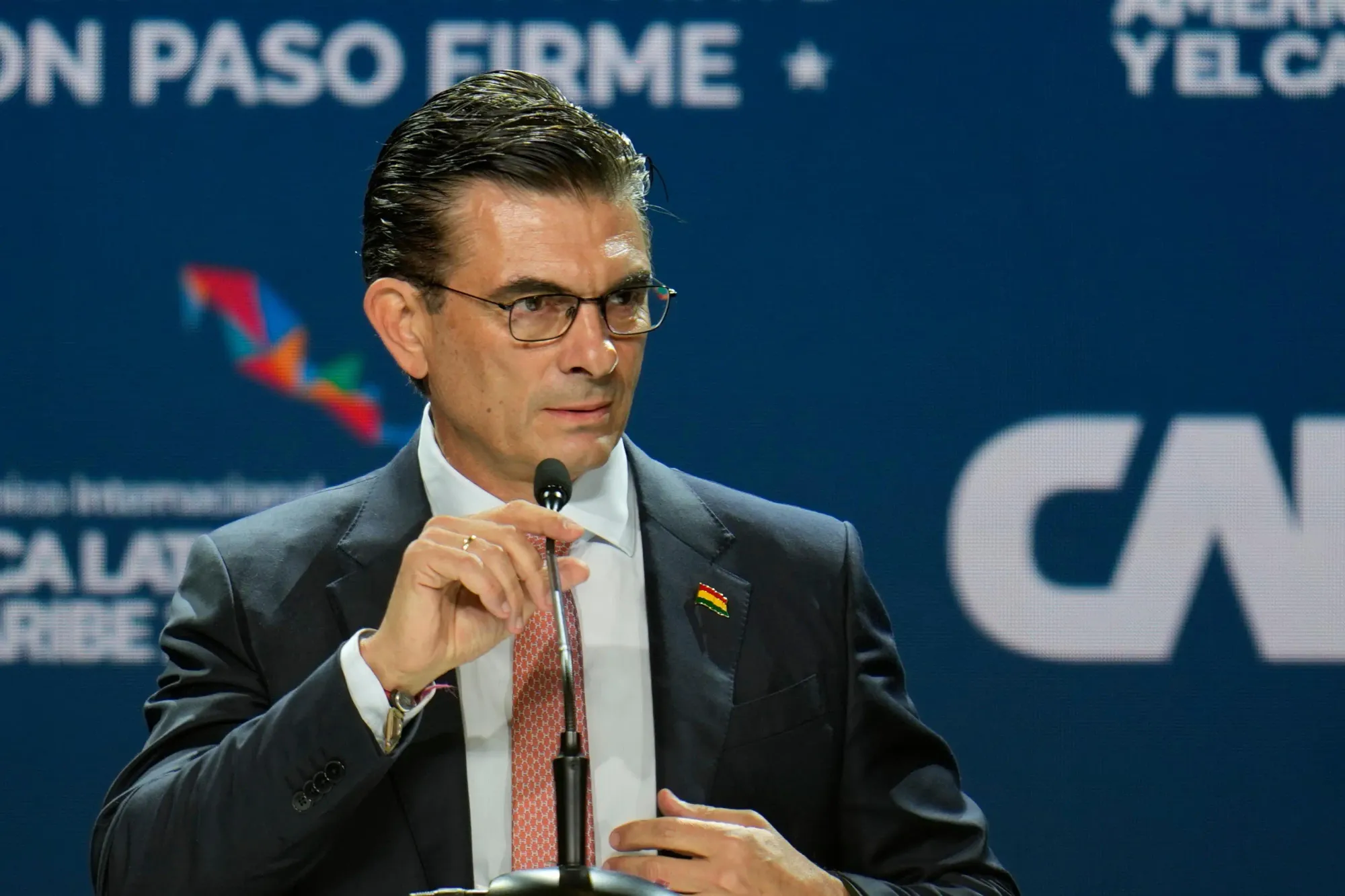
MIAMI – When Rodrigo Paz Pereira stood alongside Donald Trump and eleven other Latin American leaders at Trump National Doral on March 7 for the inaugural ‘Shield of the Americas’ summit, the symbolism was impossible to miss.
Four months earlier, Bolivia had been an isolated, economically paralyzed country aligned with Russia, Venezuela, and Cuba. On Saturday, its president stood in the front row of Washington’s new regional security alliance—a photograph that would have been unthinkable under twenty years of socialist rule.
Bolivia’s transformation under Paz is not yet complete. It may not even be irreversible. But in the space of four months, the 58-year-old center-right president has moved faster and more decisively than almost anyone predicted—and the region is beginning to take notice.
The Inheritance
When Rodrigo Paz was inaugurated in early November 2025, he inherited an economy in rough shape after 20 years of MAS administration (Movimiento al Socialismo, Movement for Socialism): inflation above 20%, foreign currency reserves nearly exhausted, and fuel lines stretching for blocks. Bolivia was also internationally isolated, aligned more with Russia and Venezuela than with its South American neighbors or the United States.
The election of Paz as Bolivia’s new president signaled the end of the MAS era—the party that had won outright presidential majorities in 2005, 2009, 2014, and 2020 could barely top 3 percent in the first round of the 2025 elections.
The MAS found itself trounced not because of a single scandal, but because of accumulated failures: as MAS mayors piled up corruption cases and failed development projects, and as the Arce-Morales internal feud fractured the party beyond repair, Bolivians looked for an exit.
Paz—a son of a former president, educated at American University in Washington, D.C., and former mayor of Tarija—offered one.
100 Days of Disruption
Paz wasted no time. On December 18, he issued Supreme Decree 5503—branded the “Decreto por la Patria”—declaring a national economic emergency and announcing the most significant policy pivot Bolivia had seen in decades. At its heart, the decree was a dramatic and politically hazardous move: eliminating fuel subsidies. Gasoline and diesel prices more than doubled overnight, reversing a 20-year policy that had kept prices artificially low and cost the state $10 million per day.
Paz paired the decree with compensatory measures—a 20% increase in the minimum wage, increases to school stipends and pensions, and the creation of a new emergency cash transfer program—alongside pro-market reforms to attract investment, including streamlined regulatory approvals and tax incentives for repatriated capital. The message was deliberate: Bolivia was open for business, but the social contract would not be abandoned.
The public reaction was swift. Within days, Bolivia’s largest labor federation declared a general strike and led nationwide blockades. La Paz, Cochabamba, and Santa Cruz were paralyzed. The broader escalation was eventually contained only after repealing most of the decree, though the elimination of fuel subsidies remained in place. The episode revealed both Paz’s ambition and the limits of his political capital heading into an election year.
The Paz administration also announced plans to reduce government spending by 30% in 2026, eliminate certain taxes, and pursue anti-corruption and institutional reforms—including the closure of the justice ministry as part of an effort to depoliticize Bolivia’s judicial system.
The U.S. Pivot
Perhaps no single decision by Paz has carried more symbolic or strategic weight than his decision to restore Bolivia’s relationship with Washington—a relationship severed since 2008, when Evo Morales expelled the U.S. ambassador and the DEA from the country.
Amid efforts to repair relations with the United States, the U.S. Drug Enforcement Administration was allowed back into Bolivia after having been expelled for 17 years, with a particular focus on the coca-producing Chapare Province.
On December 2, 2025, Paz’s government granted visa-free entry for up to 90 days for citizens of the United States, Israel, South Korea, and South Africa, reversing restrictions imposed by the MAS government in 2007.
Before taking office, Paz traveled to Washington D.C. and Panama, meeting with officials from the U.S. State Department and multilateral development banks.
He secured a $3.1 billion loan from the Development Bank of Latin America and the Caribbean. Back home, the unofficial dollar rate dropped, and renewed confidence looked like it was set for a return.
In October 2025, following Paz’s election victory, Bolivia was also suspended from ALBA—the Bolivarian Alliance championed by Venezuela and Cuba—after Paz confirmed that Presidents Maduro of Venezuela, Ortega of Nicaragua, and Díaz-Canel of the Cuban government would not be invited to his inauguration due to their authoritarian records.
ALBA denounced the new Bolivian government, calling it “far-right... anti-Bolivarian, anti-Latin American, pro-imperialist, and colonialist, and is not in accordance with the principles of ALBA.”
The move drew mostly positive reactions at home, where ALBA’s economic value had long since faded.
Doral and the Shield of the Americas
Paz’s appearance at the ‘Shield of the Americas’ summit on March 7 cemented Bolivia’s new geopolitical positioning in the most visible terms possible.
Paz was among the dozen heads of state who joined Trump at Trump National Doral in Miami for the announcement of the Americas Counter Cartel Coalition—a new military partnership designed to eradicate transnational criminal organizations and violent drug trafficking groups across the hemisphere.
The summit launched a hemispheric security alliance with drug cartels, Venezuela, Cuba, and Chinese influence, identified as the main challenges.
The alliance is intended to strengthen military cooperation and intelligence sharing among participating countries. For Bolivia—a landlocked nation that serves as a critical cocaine transit corridor between Peru and Brazil, and whose Chapare region has historically been a major coca-producing zone—membership in the coalition carries direct domestic implications.
Bolivia’s lithium also looms over the bilateral relationship.
Nearly 21 million metric tons of lithium reserves lie beneath Bolivian soil, giving the country the potential to become a critical supplier in the global energy transition. The previous MAS government signed several lithium deals with Chinese and Russian firms, but progress was slow and the terms opaque.
The Paz administration has signaled its intention to revisit those arrangements—a prospect that Washington, which has made critical mineral supply chains a national security priority, is watching closely.
The Risks Ahead
Bolivia’s transformation is real—but fragile. The DEA’s reentry and tougher rhetoric on coca cultivation and cocaine production have alarmed segments of the rural population, particularly in the Chapare region. Evo Morales supporters accuse Paz of selling out Bolivia’s sovereignty to the North Americans, and union leaders warn that future concessions to Washington could reignite unrest.
On March 22, Bolivia faces subnational elections for governors, mayors, and local authorities—the fourth vote in fewer than 18 months. The results will be a crucial test of Paz’s real political support across the country, with former MAS figures, including Morales loyalists, running under new party banners and seeking to reclaim regional influence.
The president who stood beside Trump in Doral on Saturday knows that the photograph means little if he cannot hold the country together at home. Bolivia has chosen a new direction. Whether it can sustain it is the question that will define his presidency.


