

Ecuador’s Interior Minister John Reimberg didn’t mince words when reporters asked what his government was telling citizens in the country’s most violent provinces ahead of an unprecedented joint military operation with the United States.
“Stay home,” he said. “We are at war.”
Those three words capture the severity of what is unfolding in one of South America’s most violent countries, but strategically critical nations—a country that only a decade ago was considered one of the region’s safest, but today ranks among its most deadly, harboring the most lucrative transit points for South American cocaine.
A New Phase of the War
Ecuadorian President Daniel Noboa announced Monday the launch of joint operations with the United States to combat drug trafficking in the country, which has caused an explosion of drug-fueled violence in recent years.
Noboa, 38, announced this week that Ecuador and the United States would conduct joint military operations in March targeting the drug trafficking networks that use Ecuadorian ports to move cocaine to global markets.
“In March, we will conduct joint operations with our regional allies, including the United States,” Naboa took to X to warn his people of the risk of violence in the coming weeks.
On Monday, Noboa met in Quito with Commanders Francis Donovan and Mark Schafer, heads of U.S. Southern Command and U.S. Special Operations for Central and South America and the Caribbean, where officials discussed coordinating intelligence sharing and enforcement at the country’s airports and seaports, according to AFP.
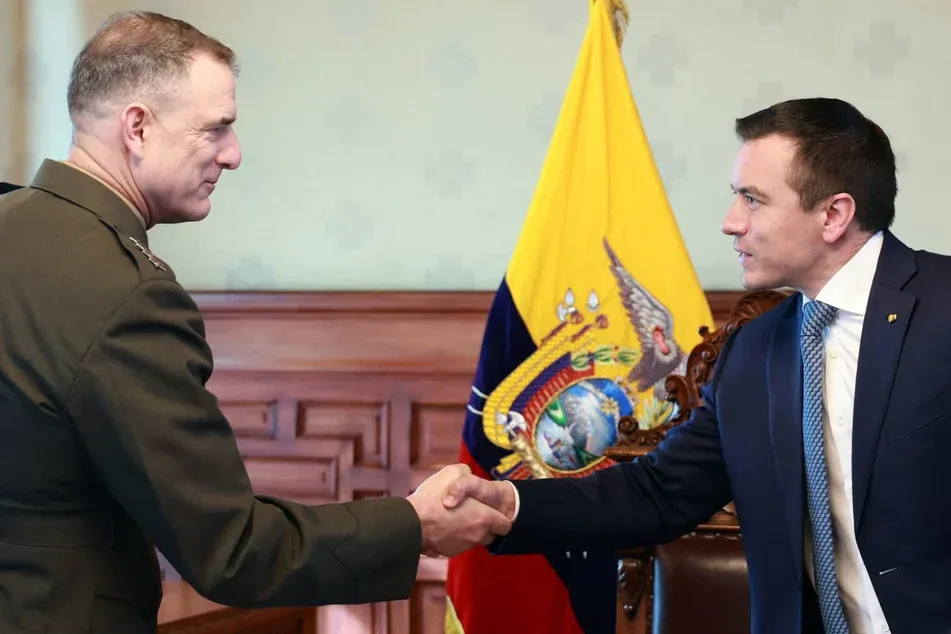
The timing of those talks reveals the expansiveness of the Trump administration’s strategy to crack down on the criminal elements in the region, and in reducing the influence of hostile governments that, if not complicit, at least encourage the activities of the organized crime networks in South America, and in some cases, like in Venezuela, for instance, where the interests of the government can often align with the interests of illicit smuggling operations.
Curfews Orders
The operation’s announcement was accompanied by a sweeping domestic security measure. Noboa announced a curfew from March 15 to 31 in Ecuador’s four most violent provinces: Guayas, Los Ríos, Santo Domingo de los Tsáchilas, and El Oro.
The curfew would run from 11 p.m. to 5 a.m. and aims to protect communities affected by drug trafficking, illegal mining, and gang violence.
Those four provinces are not chosen arbitrarily. Almost 80% of recorded gang violence in Ecuador has taken place in five coastal provinces—Guayas, Manabí, El Oro, Santa Elena, and Esmeraldas on the Pacific Ocean—located along key off-ramps for drug shipments bound for North America and Europe.
Guayaquil, which hosts the country’s biggest port, is the epicenter of the violence, accounting for roughly one quarter of all gang violence events recorded in the South American country.
In towns like Durán, adjacent to the ports of Guayaquil and contested by several rival gangs, the homicide rate averaged 145 per 100,000 inhabitants in 2023—ranking it among the most violent cities in the world, according to Al Jazeera.
How Ecuador Got Here
The story of Ecuador’s descent from the “island of peace” to narco-battleground is a decade in the making—and it runs through the prisons.
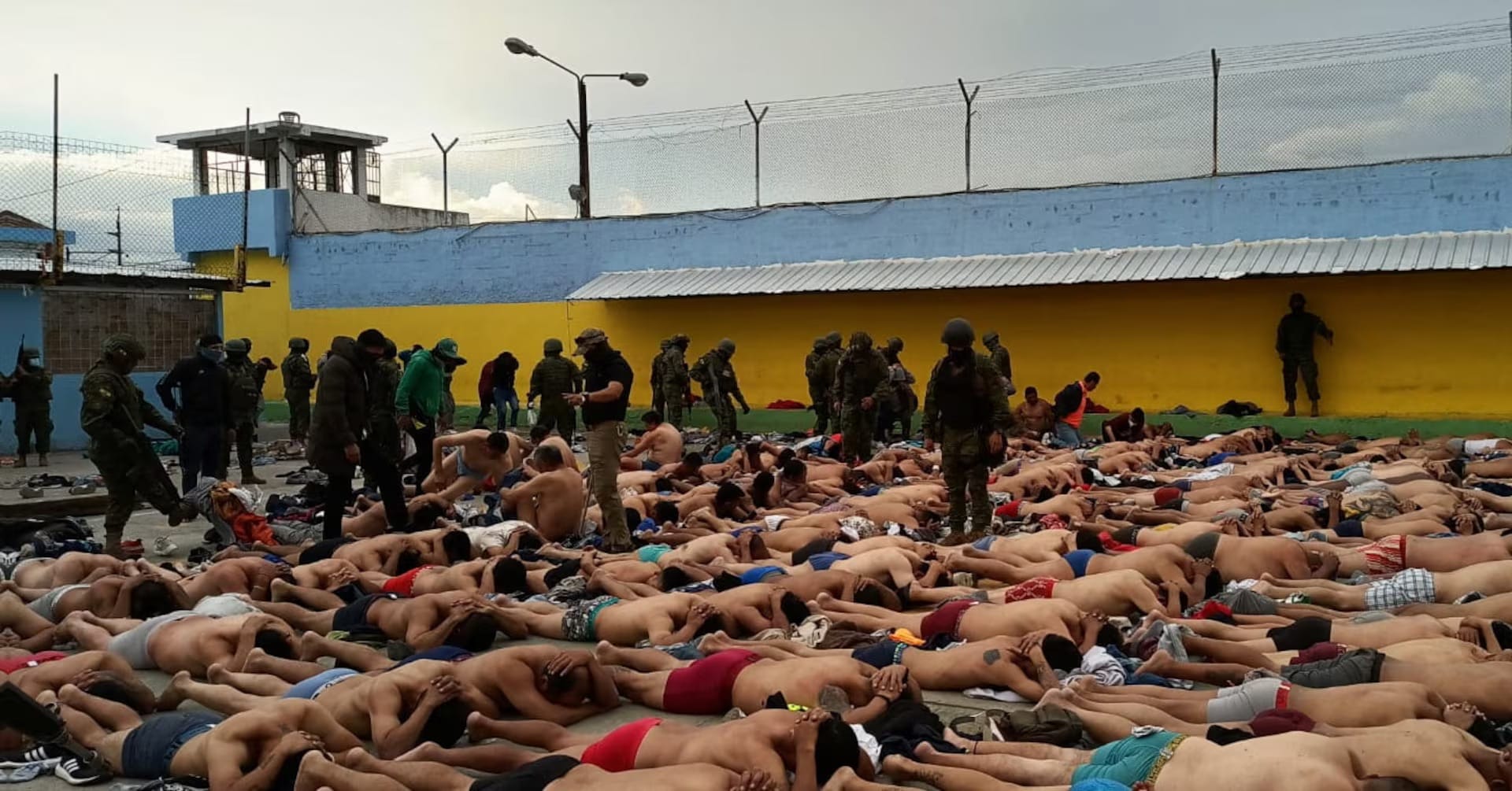
Ecuadorian gangs, unlike traditional cartels, are prison-based organizations whose logistical centers are penitentiaries.
From behind bars, leaders of criminal groups have operated with impunity, directing drug trafficking, ordering targeted killings, and ruling organized crime on the streets. It is from the prisons that the organizations command their criminal operations, and competition for control of the prisons has led the country into chaos.
Ecuador’s most powerful gangs are linked to the most powerful cartels in Mexico: Los Choneros to the Sinaloa Cartel, and Los Lobos to the Cartel Jalisco Nueva Generación—CJNG.
Around 70% of the drugs produced by Colombia and Peru, the world’s largest and second-largest cocaine producers, are shipped through neighboring Ecuador. From Ecuador, loads make their way across the U.S. Southern border or ports in Amsterdam, Antwerp, Genoa, or Trieste across the Atlantic.
The crisis boiled over in January 2024 when Los Choneros leader José Adolfo Macías Villamar—known as “Fito”—escaped from prison in Guayaquil hours before a scheduled transfer to a maximum-security facility.
Following the escape, Noboa declared a state of emergency lasting 60 days, exerting executive authority to suspend people’s civil liberties and mobilize the military inside prisons. A nightly curfew was immediately imposed. Riots erupted across multiple prisons.
Noboa declared a state of internal armed conflict, designating 22 violent criminal gangs as terrorist organizations and tasking the armed forces with security operations in gang-controlled neighborhoods, illegal mining hotspots, and prisons.
“We will not negotiate with terrorists,” Noboa declared.
Wins, Setbacks, and What Comes Next
The crackdown produced real results—and real complications.
The government disrupted criminal groups with force, seizing control of the prison system, arresting many high-level gang leaders, and forcing others to flee the country. Murders dropped roughly 20% in 2024, and security forces seized a record quantity of drugs.
But the removal of gang leaders created a new problem. The arrest and extradition of key figures weakened major organizations like Los Choneros, triggering a violent internal power struggle as competing factions fought to fill the vacuum.
Violence surged again in 2025, with projections estimating around 9,100 deaths.
Ecuadorian security analyst Michele Maffei said broader reforms are still needed. “Cooperation is just the cherry on top,” she said. “Ecuador has to strengthen its judicial system and tackle corruption.”
Noboa pushed last year for the reopening of a shuttered U.S. military base in Manta—but Ecuadorians voted in a November referendum against overturning a constitutional ban on foreign military bases, handing the president a sharp political setback.
Washington found a workaround. In December, the United States announced a temporary deployment of Air Force personnel to the former American base in the port city of Manta–and this week’s joint operation formalizes what has quietly been building for months.
A Regional Front in Trump’s Drug War
For the Trump administration, Ecuador is not an isolated case—it is one front in a broader regional security strategy that has already seen military intervention in Venezuela, strikes on drug-trafficking vessels in the Caribbean, deepening security partnerships in El Salvador and joint military training operations in the Panamanian jungle, and now Iran, which the U.S. State Department alleges to have funded and facilitated the exportation of terror and organized crime networks in Latin America.
Secretary of State Marco Rubio spoke directly with Noboa in January about ongoing regional efforts to promote stability in Venezuela. Focus on law enforcement coordination across the hemisphere has also been bolstered.
U.S. Secretary of Homeland Security Kristi Noem has also toured parts of Central and South America to shore up regional security partnerships ahead of the U.S. deployment in the South Caribbean in the summer of 2025.
Ecuador, with its Pacific ports serving as the hemisphere’s most active cocaine transit point, plays a critical role in the American strategy.
Sociedad Media will continue to monitor events in Ecuador as they develop.
For any information or inquiries, contact us at info@sociedadmedia.com or follow us on social media.


