

MIAMI — Venezuela faces an escalating constitutional crisis as acting President Delcy Rodríguez’s government approaches the three-month mark without announcing presidential elections, defying Venezuelan constitutional provisions that require a vote within 30 days when a president becomes “permanently unavailable” to serve.
The constitutional vacuum has drawn sharp criticism from legal scholars and opposition figures who argue that Venezuela’s Supreme Court manipulated constitutional interpretations to avoid triggering electoral requirements that could threaten the ruling party’s grip on power following former President Nicolás Maduro's January 3 capture by U.S. forces.
Supreme Court’s Controversial Ruling
Hours after Maduro’s removal, Venezuela’s loyalist Constitutional Chamber issued a binding interpretation declaring his absence “temporary” rather than permanent, effectively circumventing Article 233 of the constitution that mandates new elections within 30 days for permanent presidential vacancies.
The Supreme Court ruling cited Maduro’s detention as a “forced absence” caused by foreign military intervention, allowing Vice President Rodríguez to assume presidential powers under provisions for temporary incapacitation rather than permanent unavailability.
This interpretation effectively enables an extended rule without electoral validation.
José Ignacio Hernández, a constitutional law professor at Venezuela’s Andrés Bello Catholic University, told legal publications that the Supreme Court’s decision represents “constitutional authoritarian populism” designed to preserve regime continuity while maintaining a veneer of legal legitimacy.
“The Court invented the extra-constitutional concept of ‘forced absence’ to avoid the democratic requirements that would apply to a permanent vacancy,” Hernández explained in an analysis published by international legal journals.
Historical Precedent Ignored
Venezuela’s constitution requires elections within 30 days whenever the president becomes permanently unavailable through death, resignation, removal from office, or abandonment of duties as declared by the National Assembly. This electoral timeline was rigorously followed when Hugo Chávez died of cancer in 2013, leading to elections that brought Maduro to power.
However, the Venezuelan Supreme Court’s current interpretation creates a parallel framework that could theoretically allow indefinite rule without an electoral mandate. While temporary incapacitation provisions allow the vice president to serve for up to 90 days — extendable to 180 days with National Assembly approval — the Court made no mention of these time limits in its January ruling.
Constitutional experts note that the Court’s decision enables Rodríguez to exercise presidential powers without electoral legitimacy while avoiding the democratic accountability mechanisms embedded in Venezuela’s charter.
Electoral Timeline Uncertainty
Despite constitutional requirements and growing international pressure, the Rodríguez government has provided no timeline for presidential elections.
Acting President and National Assembly President Jorge Rodríguez — her brother — have focused public communications on prisoner releases, oil sector reforms, and cooperation with the United States rather than electoral planning.
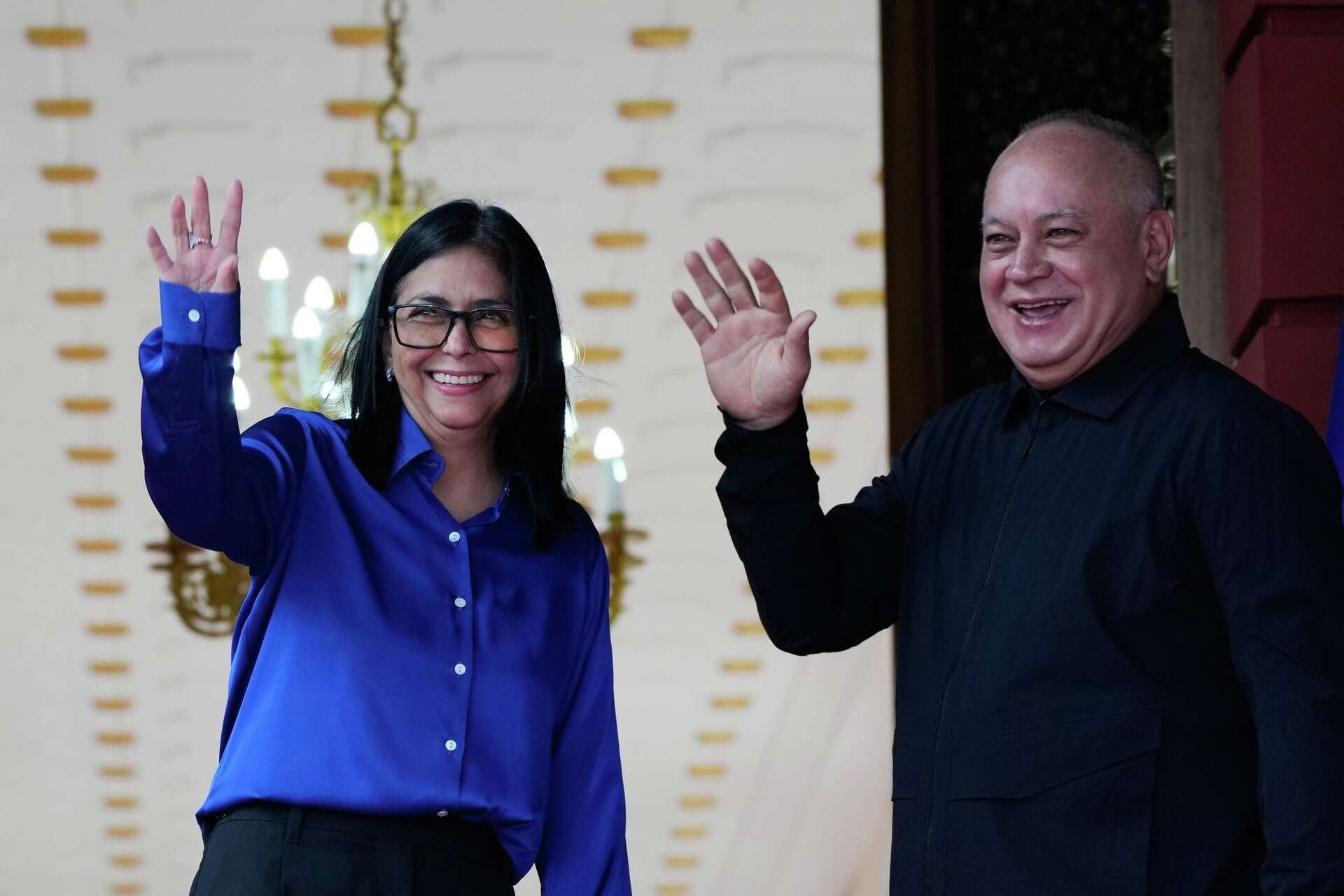
The absence of electoral announcements has created uncertainty about the government’s long-term intentions and whether it views the current arrangement as a permanent transition or temporary expedient pending Maduro’s potential return to Venezuela.
Harvard economist Ricardo Hausmann, a former Venezuelan planning minister now directing Harvard University’s Growth Lab, argues that the constitutional vacuum undermines the legitimacy necessary for sustainable economic recovery and international investment.
“No election has been announced, despite constitutional provisions requiring interim authorities to call a vote within 30 days,” Hausmann stated during recent World Economic Forum discussions on Venezuela’s future. “This has produced a constitutional vacuum that undermines the legitimacy of both the government and the National Assembly.”
Opposition Response and International Pressure
Opposition leader María Corina Machado, winner of the 2025 Nobel Peace Prize, has demanded that Edmundo González — whom the opposition maintains won the disputed July 2024 presidential election— “immediately assume his constitutional mandate and be recognized as commander-in-chief.”
However, President Trump has dismissed Machado’s influence, telling reporters that “it would be very tough for her to be the leader” because “she doesn’t have the support within or the respect within the country.”
This U.S. position effectively sidelines the opposition while working with former Maduro officials to maintain stability.
The Trump administration’s pragmatic approach prioritizes oil sector cooperation and regional stability over democratic transition, creating a stark contrast with traditional U.S. democracy promotion policies in Latin America.
Institutional Legitimacy Questions
Legal scholars emphasize that the current arrangement creates multiple legitimacy deficits that could undermine Venezuela’s institutional stability and international standing. The government lacks an electoral mandate, operates under contested constitutional interpretation, and depends on U.S. tolerance for its continued existence.
Geoff Ramsey, a senior fellow at the Atlantic Council’s Venezuela program, notes that Rodríguez “can’t exactly expect to score points with her revolutionary peers if she presents herself as a patsy for U.S. interests,” creating domestic political pressures that complicate her relationship with Washington.
The constitutional crisis also affects Venezuela’s National Assembly, whose legitimacy to pass major legislation — including recent oil sector reforms — faces questions when operating under an unelected executive authority beyond constitutional time limits.
Regional and International Implications
Venezuela’s constitutional crisis has drawn varied international responses, with some countries supporting the removal of Maduro while expressing concerns about the democratic legitimacy of successor arrangements.
The Organization of American States and the European Union have called for transparent electoral processes to restore democratic governance, while countries including Russia, China, and several Latin American governments denounce the entire post-intervention arrangement as illegitimate.
These international divisions complicate Venezuela’s reintegration into regional organizations and multilateral frameworks, potentially limiting diplomatic and economic opportunities during the transition period.
Economic Recovery Versus Democratic Legitimacy
The constitutional crisis creates tension between economic recovery and democratic legitimacy that may determine Venezuela’s long-term stability. While oil exports surge and international sanctions ease, the absence of an electoral mandate could deter diaspora return and long-term investment.
Hausmann argues that “there cannot be recovery without rights,” emphasizing that sustainable economic reconstruction requires legitimate governance structures capable of enforcing contracts and protecting property rights.
Investment analysts note that energy companies remain cautious about major capital commitments given Venezuela’s history of asset nationalizations and current institutional uncertainty. The lack of electoral legitimacy adds another risk factor to investment calculations in a country already perceived as politically unstable.
Future Scenarios and Timeline Pressures
As the constitutional crisis deepens, several scenarios emerge for Venezuela’s political future. The Rodríguez government could indefinitely extend its mandate using the Supreme Court’s “temporary absence” framework, potentially triggering greater international isolation and domestic opposition.
Alternatively, mounting pressure from constitutional requirements, opposition demands, and international expectations could force electoral announcements, though the government shows little inclination toward this path.
A third possibility involves continued U.S. support for the current arrangement as a pragmatic alternative to electoral uncertainty, effectively institutionalizing rule without democratic mandate in exchange for oil cooperation and regional stability.
Legal and Constitutional Dilemmas
Constitutional law experts emphasize that Venezuela’s crisis reflects broader patterns of “abusive constitutionalism” where governments manipulate legal frameworks to maintain power while preserving procedural legitimacy.
The Supreme Court’s creative interpretation of presidential absence provisions demonstrates how judicial institutions can enable authoritarian rule through seemingly legal mechanisms that violate democratic principles and checks-and-balances embedded in the same constitutional text.
This approach allows the government to claim constitutional authority while avoiding the electoral accountability that would normally accompany such claims, creating what legal scholars term “constitutional authoritarianism.”
Three months after Maduro’s capture, Venezuela’s constitutional crisis reveals fundamental tensions between stability and legitimacy that will shape the country’s political trajectory. The Rodríguez government’s success in avoiding electoral requirements through judicial manipulation may provide short-term stability but creates longer-term questions about institutional sustainability and democratic recovery.
As constitutional deadlines pass without electoral announcements, Venezuela risks entrenching an unelected government that operates beyond democratic accountability while claiming legal authority. This arrangement may satisfy U.S. energy interests and provide temporary stability, but the arrangement may fail to address the legitimacy deficits that could undermine lasting political and economic recovery and potential future international investment.
The resolution of Venezuela’s constitutional crisis will determine whether the country transitions toward renewed democracy or institutionalizes a hybrid-form of authoritarianism under international supervision — with profound implications for Latin American democracy and U.S. foreign policy precedents.
Sociedad Media examines how institutional breakdowns across Latin America challenge democratic governance and constitutional order, tracking the region’s evolving relationship between stability and legitimacy


