

The government of Delcy Rodríguez has proposed restarting discussions with neighboring Guayana “to definitively enter into good-faith negotiations” over the controversial and historically contested Essequibo region that borders Venezuela’s eastern territory.
The interim government in Caracas, which has received somewhat informal recognition from the administration in Washington, according to the U.S. president, views the prospects of a resumption of talks surrounding the oil-rich region as an opportunity to “reach a mutually acceptable solution” over the territory, as part of the Venezuelan government’s most recent attempt to fulfill the 1966 Geneva Treaty, which was signed to help compel the two neighboring nations to seek a “practical, peaceful, and satisfactory” resolution to the Essequibo territory.
The Essequibo region has been a point of contention for Venezuela, making a claim to the territory as early as 1811. Claims later became institutional when in 1899, the Venezuelan government declared that a ruling which awarded the region, Guayana Esequiba, to British Guiana, was deemed invalid by the ruling government in Venezuela.
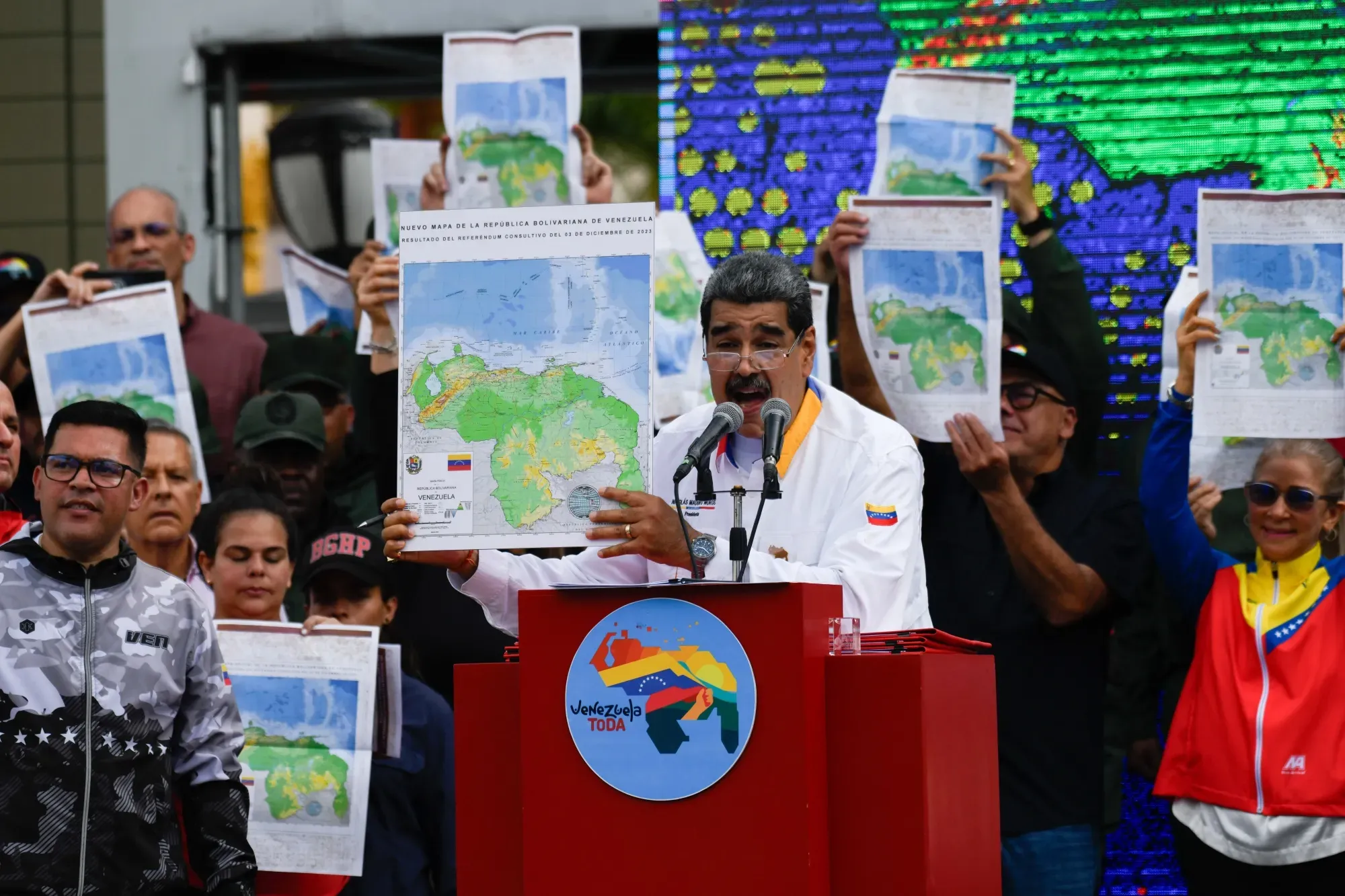
Tensions between the two South American nations later escalated with the Venezuelan government holding a national referendum over the territory in 2023.
Venezuelan revanchism towards the region has also been used as a political tool to galvanize domestic support amidst chronic economic turmoil and hyperinflation, forcing at least 8 million Venezuelan citizens to flee the country to find refuge in neighboring Colombia, Peru, the United States, and parts of Europe.
In 2024, former dictator Nicolás Maduro threatened the use of the Bolivarian Armed Forces to launch a ground invasion in an attempt to seize the region by force before the 2024 presidential election, as part of a campaign to rally nationalist sentiment among the Chavista movement heading into the voting booths.
The United States would later join the Guyanese army in conducting military exercises in the Essequibo territory as a warning to the Venezuelan government.
On social media on Monday, Venezuela’s acting President Rodríguez emphasized that negotiations with the Guyanese government are the “only possible path to the solution of the controversy,” adding that the Venezuelan government seeks to ensure a “practical, acceptable, and satisfactory settlement for both parties,” a reference to the defining language in the Geneva Treaty of 1966.
Rodríguez also asserted that the government of Venezuela “will never renounce its historical rights and titles over the Essequibo region, which has been, is, and will be part of the territorial integrity of Venezuela.”
Rodríguez is in the middle of a delicate balancing act of her own, one in which she must find the room to satisfy the heavy demands of her benefactor–the administration in Washington–whilst simultaneously not appearing to deviate from the strict ideals of the Bolivarian movement, for which party observance is being closely monitored by Chavismo hardliners.
The interim president’s push for the Esequibbo region could be seen as a politically tactful move by Rodríguez to obtain the much-needed credibility from Venezuela’s old guard in Caracas, whose perpetuation of the Maduro-era status quo will very much determine their survival.


