

The Financial Times is now reporting on a stalemate over control of the Strait of Hormuz and the permanent opening of the critical waterway, with Iran insisting on full sovereignty and threatening to charge vessels a toll, refusing offers of shared control.
Two U.S. Navy destroyers have transited the Strait as American mine-clearing operations begin.
The U.S.-Iran Ceasefire expires on April 22. Sociedad Media is monitoring.
Further details on today’s new developments in the negotiations between the two delegations are available below.
On Tuesday evening, hours before his self-imposed deadline for Iran to reopen the Strait of Hormuz or face what he described as the death of “a whole civilization,” President Donald Trump announced that he had agreed to suspend U.S. attacks on Iran for two weeks. Iran confirmed the agreement. Pakistani Prime Minister Shehbaz Sharif, whose government had mediated between Washington and Tehran, called it “a big day for World Peace.”
By Thursday morning, the ceasefire’s terms were in open dispute, the Strait of Hormuz remained effectively closed, Lebanon was observing a national day of mourning after its deadliest day of the war, and both sides were accusing each other of violations before the first formal negotiating session had even taken place.
The ceasefire is real. So is the war.
How the Agreement Was Reached — and What it Actually Says
The ceasefire was mediated by Pakistan’s Prime Minister Shehbaz Sharif and military chief Asim Munir, with the participation of Türkiye and Egypt, and was finalized in a matter of hours on Tuesday. A significant behind-the-scenes detail has since emerged: the last phase of the negotiation was finalized without U.S. Special Envoys Steve Witkoff and Jared Kushner, after Iran asked for them to leave because of their pro-Israel views. After the White House agreed, the ceasefire was secured.
Both men are now back on the U.S. delegation heading to Islamabad.
Iran’s Supreme National Security Council confirmed the ceasefire and claimed victory, saying “nearly all war objectives have been achieved.” It simultaneously published what it said was its 10-point peace proposal, listing demands that include Iranian control over the Strait of Hormuz, acceptance of Iran’s right to uranium enrichment, the lifting of all U.S. and UN sanctions, compensation payments to Iran, withdrawal of U.S. combat forces from the region, and a cessation of war on all fronts — explicitly including Hezbollah in Lebanon.
White House press secretary Karoline Leavitt said on Wednesday that Iran’s 10-point proposal was “literally thrown in the garbage by President Trump” — yet Trump had initially called the same plan “a workable basis on which to negotiate.”
The contradiction within a single news cycle captures the fundamental ambiguity at the heart of the agreement: the two sides announced the same ceasefire while describing entirely different deals.
Lebanon: The War Inside the Ceasefire
Lebanon reeled Thursday after the deadliest single day of the renewed war, with the death toll from Wednesday’s Israeli strikes exceeding 300 people as bodies continued to be pulled from the rubble. The Lebanese Health Ministry said 1,150 people were also wounded in strikes that hit busy parts of Beirut. The total death toll in Lebanon since fighting resumed in March has reached 1,739, with 5,873 wounded.
Israeli strikes on Wednesday, without warning, hit densely packed commercial and residential areas during rush hour, leading to widespread civilian casualties. Lebanese President Joseph Aoun called the attacks “barbaric.” Reformist legislator Melhem Khalaf, watching a bulldozer clear rubble in Beirut, said: “All the targeted areas are safe residential Lebanese areas. What we are witnessing is a massacre against civilians.”
The World Health Organization warned Thursday that some of Lebanon’s hospitals could run out of life-saving trauma medical kits within days. “If we have another mass casualty, like what happened yesterday, it will be a disaster,” the WHO’s representative in Lebanon told Reuters.
The source of this humanitarian catastrophe is a dispute baked into the ceasefire announcement from its first hour. Israeli Prime Minister Benjamin Netanyahu said Wednesday that the agreement would not halt Israel’s campaign in Lebanon. Trump told PBS News that Lebanon is not part of the ceasefire “because of Hezbollah” but will “get taken care of.” These statements directly contradicted Pakistani Prime Minister Sharif, who had explicitly named Lebanon as included in the total cessation of hostilities he announced.
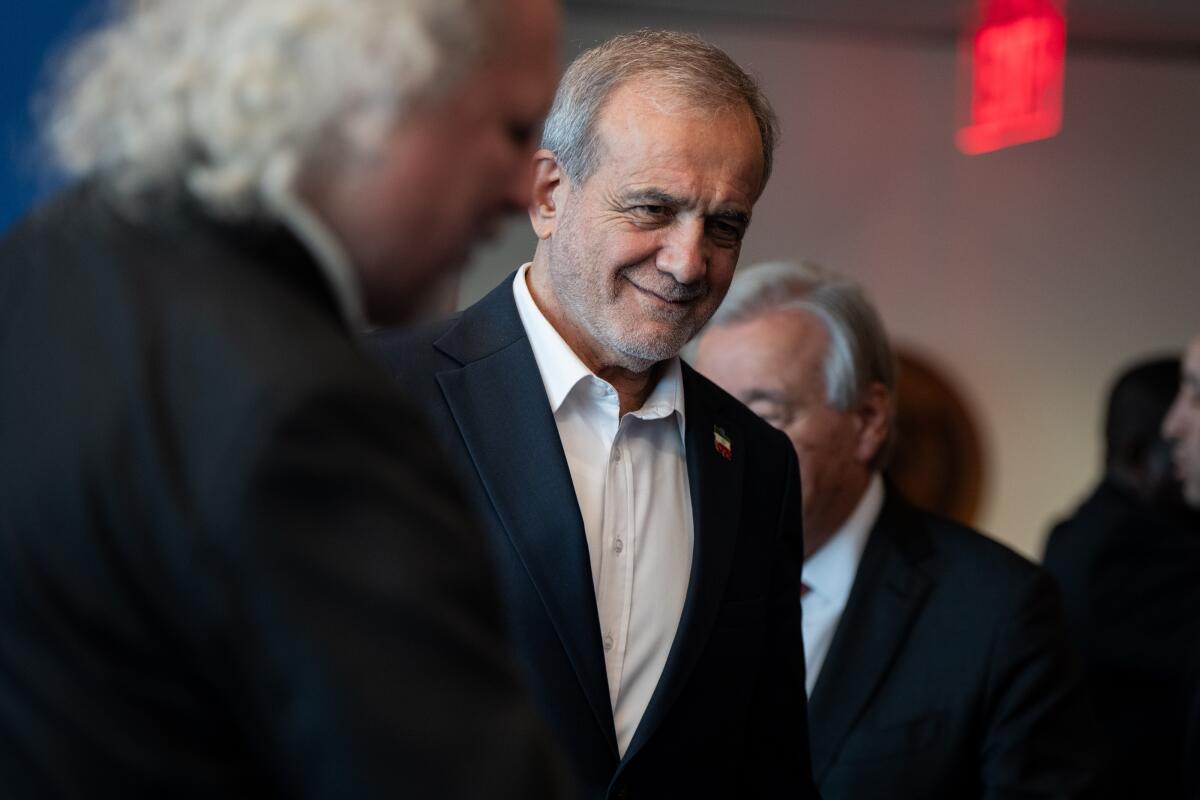
Iranian President Masoud Pezeshkian told Pakistan’s prime minister that a ceasefire in Lebanon is an “essential condition" in the framework of the 10-point agreement with the United States, according to Iranian media.
Iran’s response was immediate. Tehran announced it would close the Strait of Hormuz again in response to Israel’s attacks on Lebanon. The waterway that the ceasefire was supposed to reopen snapped shut within a day of the announcement meant to open it.
In a further escalation on Thursday, Kuwait faced 28 Iranian drone attacks from Iran, and the UAE faced 35 drone attacks, causing extensive damage. Qatar confirmed it had intercepted 7 missiles and drones. Iranian-allied groups in Iraq hit a diplomatic support center at Baghdad International Airport, prompting the U.S. embassy to warn citizens in the region against possible further attacks and to avoid air travel.
Netanyahu’s Surprise Offer — and Lebanon’s Reply
Amid the carnage, Israel made a surprise announcement Thursday. Netanyahu said Israel would authorize direct talks with Lebanon — a country with which it has no diplomatic relations — focused on disarming Hezbollah and “establishing peaceful relations” between the two countries.
A Lebanese official told CNN the response would be “no negotiations under fire.” Lebanon filed an urgent complaint with the UN Security Council, calling the attacks a “blatant violation” of international and humanitarian law.
The Strait of Hormuz: Still Closed
By April 9, there was no sign that the agreement to lift Iran’s blockade of the Strait of Hormuz was being implemented. Ships were once again being prevented from moving through the strait. The Iraqi oil ministry confirmed no Iraqi ships had crossed since the ceasefire came into effect.
Iran announced alternative routes for ships traveling through the strait, citing the risk of sea mines in the main channel, and said passage would only be possible through coordination with Iranian armed forces. That condition — Iranian coordination required for every transit — is not the free and unimpeded passage that Washington sought and that global energy markets need to recover.
Trump posted on Truth Social Thursday that Iran was doing a “very poor job” of allowing oil through the Strait. “That is not the agreement we have!” he wrote. U.S. oil futures rose back to $100 a barrel as skepticism mounted that the ceasefire would hold.
Iran’s New Supreme Leader: A Voice Without a Face
Iran’s new Supreme Leader has issued recent statements, posting on X, vowing revenge and declaring Hormuz a permanent instrument of war, pledging solidarity with Hezbollah, Hamas, and the Houthis. What he has not done — in the forty days since the war began — is appear in public.
Almost a week after his appointment as Iran’s Supreme Leader, Mojtaba Khamenei remained in the shadows. Iranians had yet to see him or hear his voice. There is so little verified footage of the new leader that government news outlets and state-backed social media channels have resorted to circulating AI-generated videos of him to drum up support — depicting him delivering speeches to large crowds and standing beside his father at key moments, scenes that never actually occurred. “They’re calling him the AI Supreme Leader,” one man in Tehran said mockingly, reported by CNN.
Mojtaba Khamenei, 56, ascended to Iran’s highest office on March 9, selected by the Assembly of Experts following the assassination of his father, Ayatollah Ali Khamenei, in the first hours of the U.S.-Israeli strike campaign on February 28. He was in the compound when it was struck. Israeli officials told Axios that while his father, mother, wife, and daughter were killed, Mojtaba was wounded but survived.
What the world has not been able to determine with any certainty is what surviving actually means in his case. A diplomatic memo circulated to U.S. and Israeli allies and reported by The Times revealed that Mojtaba Khamenei is being treated in Qom in a “severe condition, unable to be involved in any decision-making by the regime.” The document also revealed plans for a “large mausoleum in Qom” for more than one grave, which officials interpreted as potentially involving both father and son.
The continued absence of Mojtaba Khamenei has been a matter of discussion during President Trump’s intelligence briefings. One U.S. official told Axios: “We don’t think the Iranians would have gone through all this trouble to choose a dead guy as the Supreme Leader. At the same time, we have no proof that he is taking the helm.”
His first public statement on March 12 was not delivered in person. It was read aloud by a state television anchor while a still photograph was displayed on screen — meaning that nearly two weeks after the conflict began, no video or audio recording of the new leader himself had been released.
Iran expert Alex Vatanka of the Middle East Institute offered the most direct explanation for the invisibility: “He obviously has to take extreme measures to protect himself physically. He’s being hunted down, essentially.”
Russia’s ambassador to Iran has confirmed Mojtaba is alive and in Iran, saying he is “refraining from making public appearances for understandable reasons.”
It is in this context that his Thursday statement on the ceasefire must be read. Mojtaba Khamenei said Iran remains determined to “take revenge” for his slain father and all those killed in the war. He said Iran would bring management of the Strait of Hormuz “into a new phase,” adding that Iran did not seek war but would not relinquish its rights, and that “we consider the entire Resistance Front as one unified whole.”
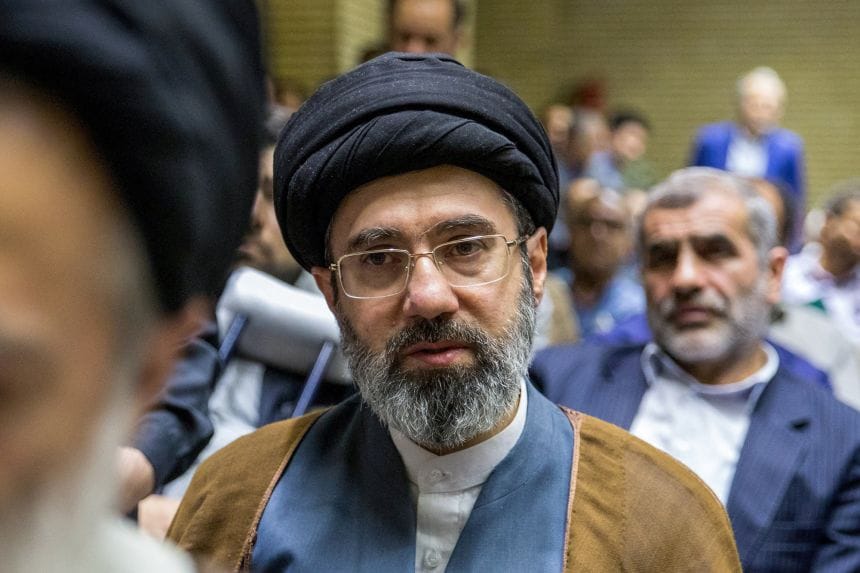
The words were defiant. They were also delivered, once again, in writing — read by someone else, attributed to a man the world has not seen in forty days, whose condition remains unconfirmed, and whose actual role in Iran’s decision-making is, by the admission of the U.S. intelligence community itself, unknown.
Whether Mojtaba Khamenei is directing Iran’s negotiating posture in Islamabad or whether the IRGC is running the war while his name is attached to statements for legitimacy purposes is perhaps the most consequential unanswered question heading into Saturday’s talks.
As U.S. War Secretary Pete Hegseth put it after the first written statement emerged: “Iran has plenty of cameras and plenty of voice recorders. Why a written statement? I think you know why. He’s scared, he’s injured, he’s on the run, and he lacks legitimacy. It’s a mess for them. Who’s in charge? Iran may not even know.”
The Road to Islamabad
Talks are set to begin Saturday morning local time at the Serena Hotel in Islamabad’s Red Zone, which has been requisitioned by the Pakistani government.
The White House confirmed that Vice President J.D. Vance will lead the U.S. delegation, joined by special envoy Steve Witkoff and Jared Kushner. Iranian Parliament Speaker Mohammad Bagher Ghalibaf and Foreign Minister Abbas Araghchi are expected to lead the Iranian delegation.
The negotiations have a strict deadline — the temporary ceasefire expires on April 22.
The gap between the two sides’ stated positions remains substantial. Washington’s framework centers on Iran surrendering its enriched uranium stockpile, dismantling its ballistic missile program, ending support for regional proxy forces, and fully reopening the strait under no conditions. Iran’s published 10-point plan asserts permanent Iranian sovereignty over the strait, the right to enrichment, full sanctions removal, compensation, and U.S. military withdrawal from the region.
Iran’s nuclear chief said Thursday that protecting the right to uranium enrichment was “necessary” for any talks with the United States.
President Trump told NBC on Thursday he was “very optimistic” about the Islamabad talks, saying Iran’s leaders seemed open to peace in private discussions. “They’re much more reasonable,” he said. “They’re agreeing to all the things that they have to agree to. Remember, they’ve been conquered. They have no military.”
What This Means for Latin America
The ceasefire arrived with immediate but partial relief for the energy markets reshaping Latin American economic outlooks since February 28. Oil at $100 per barrel — compared to pre-war levels around $75 — remains a structural burden for oil-importing economies across Central America and the Caribbean.
For Chile, identified by analysts as the most exposed major importer in South America, the continued closure of the Strait means the fertilizer and fuel shocks of the past six weeks have not yet reversed.
For Brazil and Guyana, the elevated price environment remains commercially advantageous, though the uncertainty suppresses the long-term investment commitments both countries need to develop their offshore reserves.
Venezuela’s position remains paradoxical — the world’s largest proven reserves, sanctions constraints, and a transitional government trying to simultaneously attract U.S. investment and navigate a global energy shock not of its making.
The Islamabad talks beginning Saturday are the most consequential diplomatic event of the year for Latin American energy economies. A durable agreement that fully reopens the strait under neutral conditions would begin unwinding the disruption within weeks. A breakdown would push oil back toward $110 or beyond, and extend the shock through the Northern Hemisphere summer — directly into the harvest and transport seasons that determine food security across the region.
For now, the war has paused. The ceasefire is real, and it is fragile simultaneously. The 72 hours ahead in Islamabad will determine which of those two descriptions defines the weeks that follow.
Islamabad: The Talks Begin, the Strait Moves
The negotiations that the ceasefire was designed to make possible are now happening.
Talks between the United States and Iran began Saturday afternoon in Islamabad — the first direct in-person negotiations between Washington and Tehran since the 1979 Islamic Revolution. The U.S. delegation is led by Vice President J.D. Vance, joined by special envoy Steve Witkoff and Jared Kushner. Iran’s delegation of more than 70 people is led by Parliamentary Speaker Mohammad Bagher Ghalibaf and Foreign Minister Abbas Araghchi.
The talks began several hours later than expected and initially proceeded through Pakistani intermediaries before sources confirmed the two sides moved to direct negotiations. Al Jazeera’s correspondent in Islamabad, citing sources close to the mediation, reported that there has been some progress on basic conditions, including on the need for a ceasefire in Lebanon.
Reports also indicate a possible understanding to limit Israeli strikes to southern Lebanon rather than a full halt — not a complete agreement but a geographic constraint that would represent movement on the issue that nearly collapsed the talks before they started. Sources also indicated there could be movement on the unfreezing of Iranian assets, though Pakistan cautioned it was still early and much needed to be confirmed.
The Strait of Hormuz, which has been effectively closed since February 28, showed its first signs of movement. Several ships transited the Strait on Saturday, according to ship tracking data — mostly Chinese tankers and bulk carriers. Two Chinese crude oil tankers, each carrying approximately 300,000 tonnes, passed through sailing close to the Iranian coast.
Traffic remains a small fraction of the normal volume of approximately 100 ships per day, but the movement is the first confirmed transit since the ceasefire was announced Tuesday.
Iran’s public posture going into the room remained hard-line. Tehran presented four non-negotiable conditions to mediators: full sovereignty over the Strait of Hormuz, complete war reparations, unconditional release of blocked assets, and a durable ceasefire across the entire West Asia region.
Iranian Foreign Minister Araghchi said Tehran was entering negotiations with “deep distrust” stemming from prior strikes on Iran during previous rounds of talks, and said his country was prepared to retaliate if attacked again.
Washington’s public posture was characteristically blunt. Trump posted on Truth Social from his Virginia golf club as talks were underway: “We’re now starting the process of clearing out the Strait of Hormuz as a favor to countries all over the world, including China, Japan, South Korea, France, Germany, and many others. Incredibly, they don’t have the Courage or Will to do this work themselves.”
The gap between the two sides’ stated positions remains substantial as the ceasefire expires on April 22. What Vance and Ghalibaf are negotiating in the Serena Hotel in Islamabad’s Red Zone tonight is whether eleven days is enough time to bridge it the gap.
This article was originally published April 9, 2026 and updated April 11, 2026 to reflect the opening of direct U.S.-Iran talks in Islamabad and initial ship movement through the Strait of Hormuz. Sociedad Media is monitoring the Islamabad negotiations and will update this article as the situation develops. The ceasefire expires April 22. Tips and firsthand accounts: info@sociedadmedia.com


