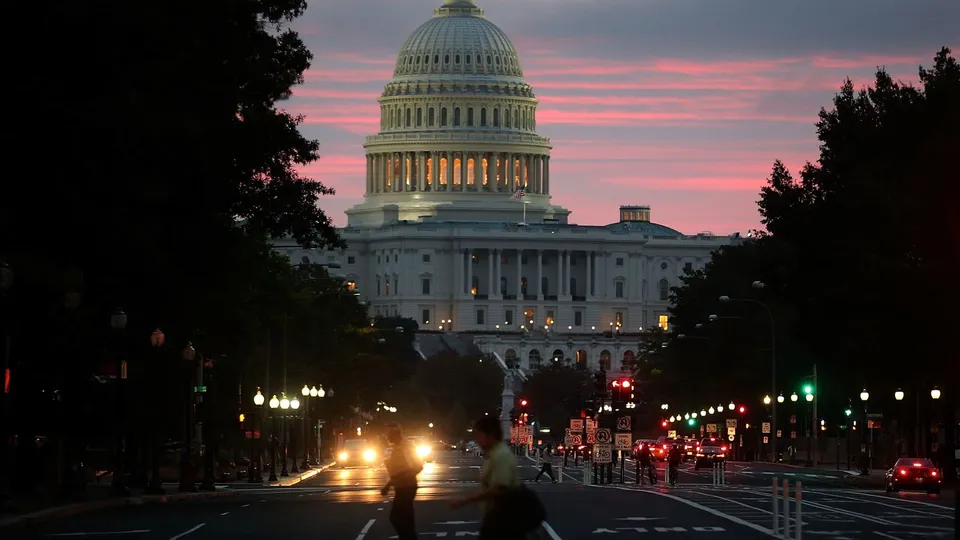
The U.S. House of Representatives voted down a pair of Democrat-led bills, expanding on the Presidential War Powers Resolution, aimed at curtailing the Trump administration's targeted campaign to strike at suspected drug vessels in the Caribbean, on Wednesday.
The first resolution was introduced by House Foreign Affairs Committee ranking member Gregory Meeks (D-N.Y.), which was aimed at ending the administration's campaign that has involved dozens of targeted strikes against "drug boats" trafficking illicit narcotics through lucrative drug routes in the South Caribbean and eastern Pacific Ocean.
The bill would've effectively halted further operations against suspected drug vessels and stopped "hostilities with any presidentially designated terrorist organization in the Western Hemisphere" unless authorized by Congress.
The resolution was voted down 210-216.
🚨🇺🇸 | BREAKING/U.S.-VENEZUELA: The U.S. House of Representatives has voted down two Democrat-led resolutions that would restrict U.S. operations in Venezuela and halt bombings of suspected drug vessels in the Caribbean and eastern Pacific Ocean.pic.twitter.com/ItWs8tNnid
— Sociedad Media (@sociedadmedia) December 18, 2025
The second resolution was brought forward by House Rules Committee ranking member Jim McGovern (D-MA), and would've removed "the use of United States Armed Forces from hostilities within or against Venezuela" unless authorized by Congress.
McGovern's resolution also failed 211-213.
Trump critics, Representative Thomas Massie (R-KY) and Representative Marjorie Taylor-Greene (R-GA), joined House Democrats in favor of both resolutions.
Dozens of strikes have been carried out by the Pentagon in recent months, with the first recorded strike occurring on September 2. At least 80 individuals, or "narco-terrorists", according to State Department officials, have been killed in the strikes.
The operations are part of the Trump administration's approach to crack down on criminal drug trafficking operations in the region and to reduce the flow of illicit narcotics into the United States, in an effort to shore up on the president's America First policy.
U.S. partners in the region, including Paraguay, Argentina, El Salvador, and Ecuador, have joined a chorus of Latin American nations declaring the administration of Venezuelan President Nicolás Maduro an "illegitimate narco-government."
The National Assembly in Quito–the capital of Ecuador–voted on Wednesday in support of a U.S. intervention in Venezuela to remove the "narco-dictator" and "restore democracy in the region."
Critics, however, like Claudia Sheinbaum of Mexico, have come out to publicly denounce U.S. operations in the region, warning that "foreign interference" will risk destabilizing Latin America, calling on the United Nations to intervene to "prevent any bloodshed."