

MIAMI — On Sunday, Democratic Reps. Pramila Jayapal of Washington and Jonathan Jackson of Illinois stepped off a plane in Havana and issued a joint statement that landed in Miami like a stone through glass.
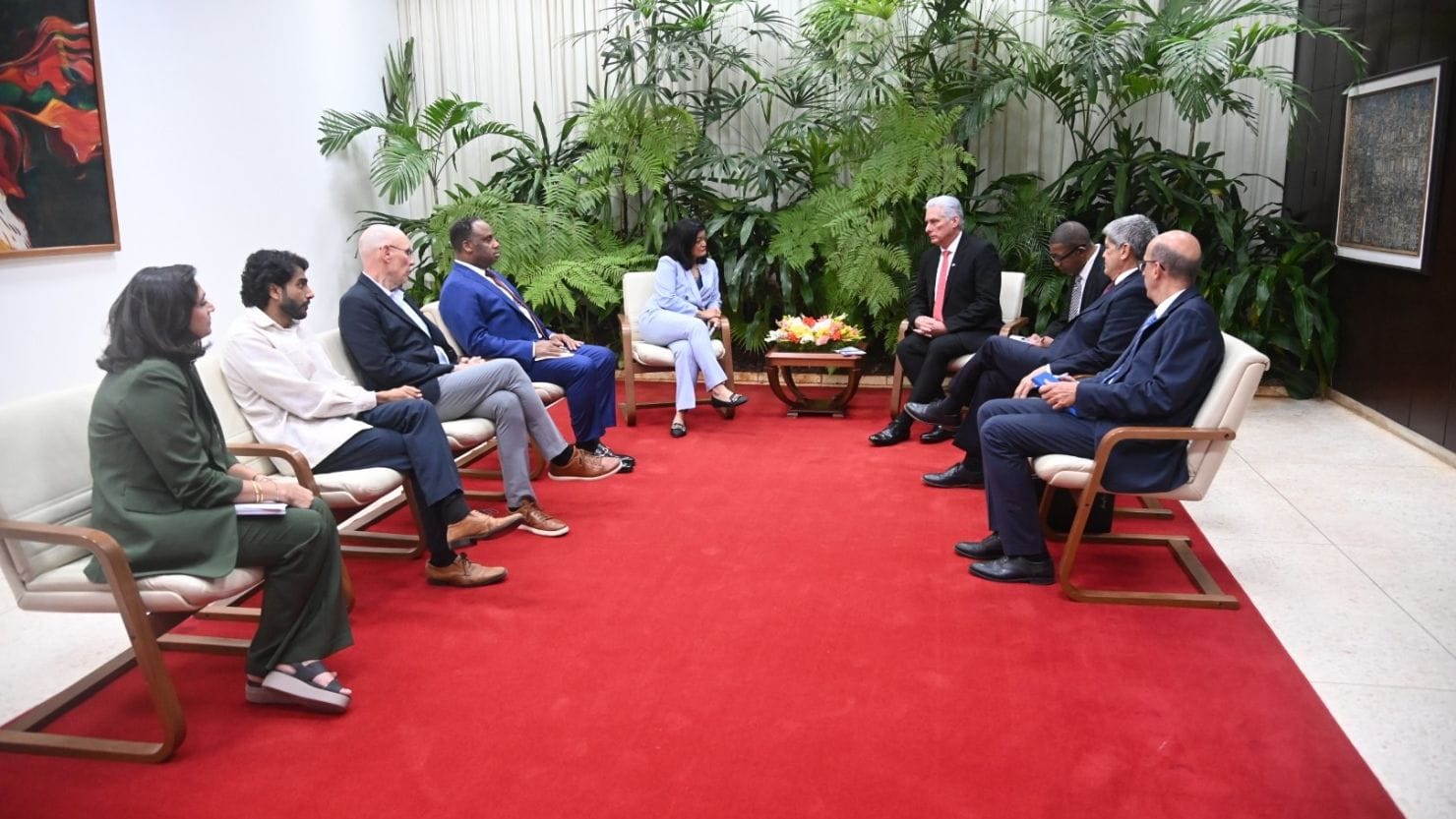
“This is cruel collective punishment — effectively an economic bombing of the infrastructure of the country — that has produced permanent damage. It must stop immediately,” they wrote, following a five-day congressional delegation to Cuba in which they met with President Miguel Díaz-Canel, Foreign Minister Bruno Rodríguez, and members of the Cuban parliament.
It was the first congressional visit to the island since President Trump imposed the de facto oil blockade in January, and the reaction in Washington and Miami was immediate — and sharply divided along lines that have defined U.S.-Cuba politics for more than six decades.
Democrat Outrage
The lawmakers said they witnessed premature babies in incubators weighing just two pounds, at tremendous risk because their ventilators could not function without electricity. Children were unable to attend school because there was no fuel for transport. Cancer patients unable to receive treatment because of medication shortages, and water scarcity caused by the lack of electricity to pump water. Food production on the island is at just 10% of the population’s needs.
Representative Jackson, speaking to reporters at a privately-owned hostel near Havana’s waterfront, was direct: “This is the most sanctioned part of Planet Earth right now, just 90 miles off our shores. Let’s bring the rhetoric down. People are suffering. And they are suffering for no good reason.”
Representative Jayapal also described the trip as evidence that “the moment is here” for real negotiations, citing Cuba’s invitation of an FBI team to investigate a fatal shooting involving a U.S.-flagged boat, the pardon of more than 2,000 prisoners, and new economic reforms opening the island to investment by Cuban Americans living abroad as signals of genuine change.
In their official statement, the lawmakers described meeting families, religious leaders, entrepreneurs, civil society organizations, Latin American and African ambassadors, humanitarian aid organizations, and Cubans across the political spectrum, including dissidents, and said there was universal agreement: “This illegal blockade must end immediately,” Jayapal said.
A significant caveat: Cuba’s government released the pardoned prisoners accused of a variety of crimes, though none so far appear to be political prisoners. The distinction matters enormously to Miami’s Cuban exile community, which has spent decades demanding the release of political detainees as a precondition for any engagement with the Díaz-Canel government and the Cuban regime.
What Washington Thinks
On March 27, Jayapal and Rep. Gregory Meeks introduced the Preventing an Unconstitutional War in Cuba Act, which would block the use of federal funds for military actions against Cuba without congressional authorization, supported by 14 Democratic co-sponsors.
The Trump administration has rejected the characterization of a blockade, with Secretary of State Marco Rubio — the son of Cuban immigrants and the administration’s most committed Cuba hawk — stating the government has not taken any “punitive actions” against the country and only prevented Cuba from receiving subsidized Venezuelan oil after the capture of former Venezuelan President Nicolás Maduro.
Jackson called on Rubio directly, urging that the Secretary of State “should come before the Congress and explain his policy.” Jackson, whose father — the late Rev. Jesse Jackson visited Cuba multiple times during his life, described the humanitarian situation as a “crucifixion” and called a malnourished infant he witnessed in a Havana maternity ward — named Alejandro — an “act of war.”
The contrast between those two framings — humanitarian catastrophe versus strategic pressure — is the fault line on which this debate sits. Both things can be simultaneously true: the blockade is producing severe civilian suffering, and the blockade is a deliberate instrument of pressure designed to force political change.
Jayapal and Jackson emphasize the first. The Trump administration emphasizes the second.
The Miami Dimension
In Miami, the visit landed with the weight of history behind it. The Cuban exile community — concentrated in Little Havana, Hialeah, and across Miami-Dade County — has viewed congressional engagement with Havana with deep suspicion since the Obama administration’s failed normalization efforts a decade ago.
For many exile families, any meeting with Díaz-Canel is a legitimization of a government that imprisoned relatives, drove families from their homes, and has spent sixty-five years denying basic political freedoms.
The photographs of Jayapal and Jackson posing on the Malecón — Havana’s iconic seafront promenade — circulated rapidly across Miami’s Cuban social media networks Sunday night. The images recalled similar scenes from previous congressional delegations that have consistently enraged the exile community.
The political context in Miami makes this moment particularly charged. Trump won Miami-Dade County in November — the first Republican presidential candidate to do so since 1988 — driven in large part by overwhelming support from Cuban-American voters who backed his hardline approach to Havana. Rubio, himself born in Miami to Cuban immigrant parents, remains the most trusted political figure in that community. When Jayapal and Jackson call his Cuba policy “Cold War-era” and a “failed” foreign policy approach, they are challenging the central conviction of the community that gave Trump his most surprising electoral result.
The migration argument cuts differently. Jackson put it plainly: “We can either help the Cuban people stay at home and live a healthy normal life, or there’s going to be a huge migration coming towards the United States.” That is not an abstraction in Miami. The city has absorbed every wave of Cuban migration since 1959. The prospect of another humanitarian exodus — with the Coast Guard already on alert and Guantanamo identified as a potential processing site — is a real concern for a city whose infrastructure, housing, and social services would bear the first impact.
The generational divide within Miami’s Cuban community adds another layer. The older exile generation — those who fled Castro directly and built Little Havana from nothing — remains largely immovable on engagement with the regime. But a younger cohort, including many who arrived in the post-2021 migration wave after the island’s political crackdowns share more complex views: they despise the regime but also have parents, siblings, and children still living through the blackouts and food shortages that Jayapal and Jackson described.
The Bigger Picture
The visit cannot be separated from a broader diplomatic chess match. Both the U.S. and Cuba have acknowledged that talks are ongoing at the highest level, though no details have been disclosed.
Díaz-Canel, in posting photographs of his meeting with the two Democrats on social media, signaled something deliberately: that the Cuban government is managing multiple channels simultaneously, keeping Washington engaged while maintaining the narrative of a nation under siege.
The photo-op could also mean something far more cunning on the part of the Cuban government: capitalizing on the internal divisions over the Cuban issue in Washington.
The Cuban government also invited the FBI to conduct an independent investigation of a lethal speedboat shooting off Cuba’s north coast — a gesture the lawmakers cited as evidence of Cuba’s willingness to engage directly with U.S. law enforcement.
Whether Jayapal and Jackson’s visit accelerates negotiations, strengthens the hand of Cuba hawks in Congress, or simply becomes another futile attempt at a détente in a decades-long American argument about a small island ninety miles from Miami — depends largely on what happens in Havana and Washington in the weeks ahead.
Their reports to Congress, promised upon return, will be watched closely in both capitals — or may not be taken seriously at all in Washington.
In Miami, however, it could earn a lazy glance from the diaspora — but will likely be tossed to the nearest trash heap.
Sociedad Media will continue to monitor developments in Cuban affairs amid continued talks with Washington. Questions, stories, recommendations, or firsthand accounts from Miami’s Cuban community, contact the outlet at info@sociedadmedia.com


