

Two separate convoys of ships are moving toward Cuba right now, carrying grain from Chinese ports to the port of Havana. They are not military vessels, and they carry no weapons confirmed by Sociedad Media. What they carry is rice—90,000 tons of it, in two overlapping aid programs approved personally by Chinese President Xi Jinping—and in the context of 2026, rice is a geopolitical weapon as decisive as any embargo.
This is what the great power competition for Cuba looks like from the ground level. Not missiles. Not naval blockades. Sacks of grain arriving at a port on the north coast of Havana while 10 million people wait to see whether the ration book delivers this month.
Two Programs, One Message
The Chinese rice operation has two distinct components running simultaneously. The first is a 30,000-ton donation announced in January as part of existing cooperation agreements between Beijing and Havana. The vessel Loyalty Hong arrived at the port of Havana on March 25 carrying 15,600 tons of rice—the third delivery under this program.
The second is significantly larger. A separate 60,000-ton emergency aid program was approved by Xi Jinping, with a new shipment of 15,000 tons departing from the port of Shanghai on March 27. The announcement was made by Chinese Ambassador to Cuba Hua Xin on X. Together, the two programs represent 90,000 tons of rice committed by the Chinese government to the island.
Beyond the grain shipments, Xi’s broader assistance package includes $80 million in financial aid officially designated for the purchase of electrical equipment and urgent needs—a direct response to Cuba’s collapsing power grid.
China has also committed to strengthening cooperation in energy infrastructure, including the integration of Chinese-donated solar parks into Cuba’s national electricity grid.
Beijing has been explicit that these shipments are not purely humanitarian. They are a geopolitical statement. China’s Foreign Ministry spokesperson Lin Jian publicly expressed what he called strong opposition to the U.S. blockade of Cuba, urging Washington to immediately cease pressuring the island. The Cuban Embassy in China framed the departing shipments with a message that left nothing to interpretation: Cuba is not alone.
Why Rice. Why Now.
To understand why 90,000 tons of rice constitutes a major geopolitical intervention, you need to understand what rice means to Cuba and what has happened to the island’s food supply over the past decade.
Since 2005, the availability of rice for consumption in Cuba has decreased by 41.5%—from ten pounds per person available in 2005 to just six pounds in 2023, according to official data analyzed by Cuban economist Pedro Monreal. Monreal dismantled government claims that the shortage was caused by excessive consumption, arguing instead that the real cause was an economic system structurally incapable of sustaining domestic production.
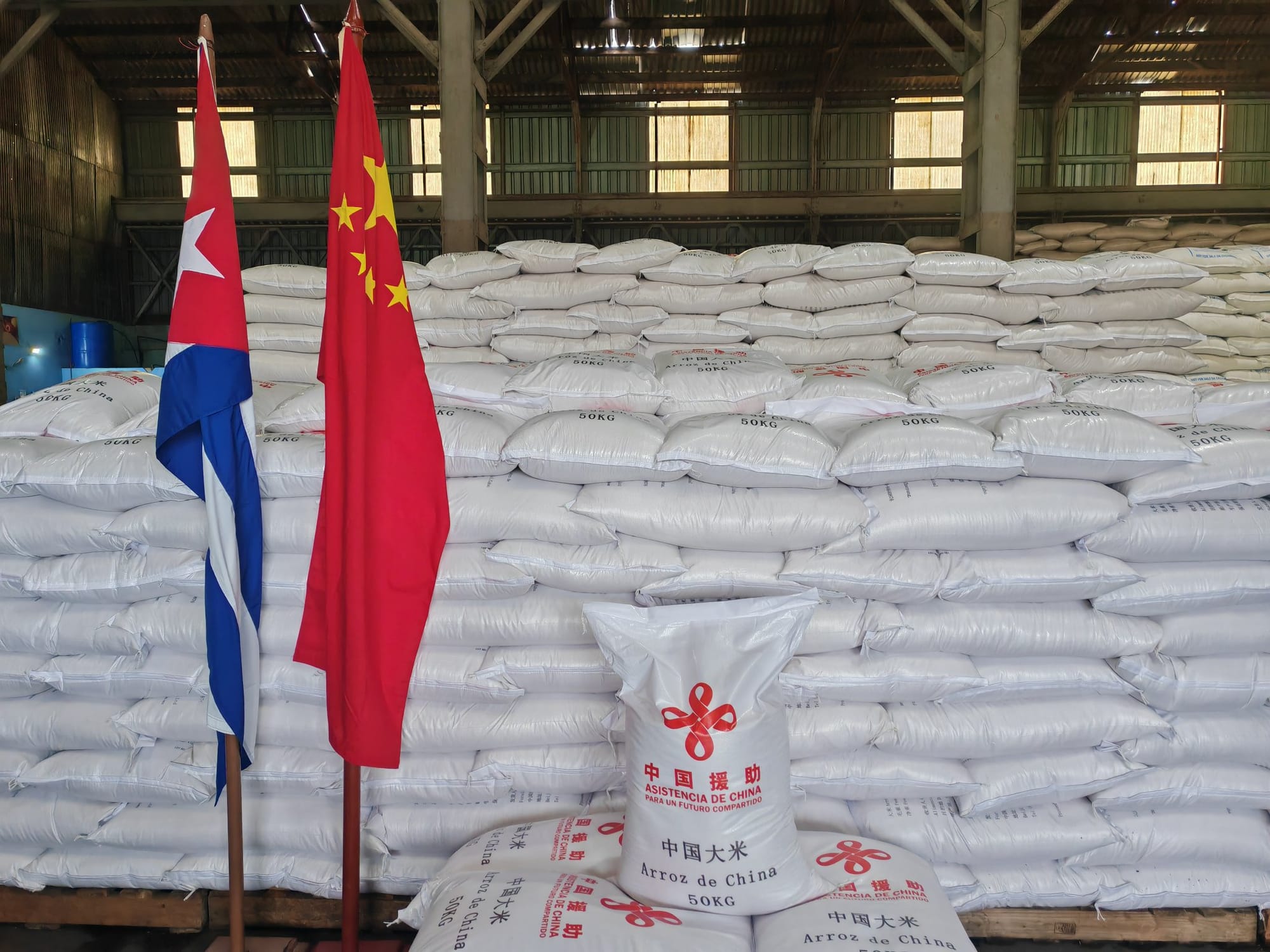
Cuba allocates approximately $2 billion annually for food imports, including basic basket products, amid a prolonged economic crisis, high inflation, and frequent blackouts. This is compounded by the decline in national rice production and the general deterioration of agriculture—factors that have further weakened the country’s food security.
The U.S. oil blockade, imposed after the capture of Nicolás Maduro in January, has deepened the crisis. Without fuel, trucks cannot distribute food. Without electricity, refrigeration fails, and whatever food exists spoils before it reaches the table. Recent reports warn that Cuba has moved beyond a conventional economic crisis into a phase approaching a humanitarian emergency.
In Guantánamo, a provincial government coordinator summarized the food distribution system in five words: “The main fair is what arrives at the warehouse.”
What Cubans Are Actually Saying
The arrival of Chinese rice has not been met with uncomplicated gratitude on the island. On Cuban social media—where, despite internet restrictions, a growing number of residents document their daily reality—the reaction has been sharper.
The shipments sparked reactions described as “crumbs upon crumbs,” with many users questioning the country’s deepening reliance on external donations to sustain basic consumption.
Cubans expressed skepticism about whether the shipments would reach all consumers, citing recurring patterns of shortages and delays in state stores. The uncertainty coincides with a government announcement that beginning in April, the state-regulated family basket system will be restructured—moving from blanket subsidies to targeted financial support for vulnerable individuals.
Some Cubans on social media have gone further, suggesting that food donations are used to replenish state reserves while older, deteriorated stock continues to be distributed through the ration system. A user from Camagüey described the rice sold at the state store in his neighborhood in terms that reflected accumulated frustration, saying the grain was inedible. The post generated widespread reactions, with users across the island reporting similar experiences—describing rice as dirty, smelly, or already expired.
The gap between the diplomatic narrative—China sending solidarity, Cuba not alone—and the lived reality on the ground in Camagüey, Guantánamo, and Havana is the central tension of Cuba’s crisis in 2026.
The Blockade’s Logic and its Limits
Washington’s strategy is straightforward in concept: squeeze Cuba’s energy supply until the economic pressure produces political change. Trump has threatened tariffs against any country that resumes oil shipments to the island. Mexico, which was Cuba’s most viable alternative supplier, has repeatedly signaled it cannot absorb that risk. Russia has sent modest shipments—insufficient to stabilize the grid.
China’s rice operation does not break the oil blockade. It does something arguably more significant—it demonstrates that the blockade’s humanitarian consequences will not go unanswered, and that Beijing is prepared to absorb the diplomatic cost of openly defying Washington’s pressure campaign on a Caribbean island 90 miles from Florida.
China’s Foreign Ministry has framed its support explicitly within a broader geopolitical context, calling the U.S. embargo a “total blockade” and “unlawful unilateral sanctions,” and urging Washington to cease pressuring Cuba under any pretext.
The $80 million in electrical equipment funding adds another dimension. If Chinese solar infrastructure begins stabilizing Cuba’s grid—even partially—it would reduce one of the most visible and politically destabilizing consequences of the blockade: the 20-hour blackouts that have driven Cubans into the streets in Santiago, Bayamo, and Matanzas. Lights back on means protests cooling down. Protests cooling down means the regime survives another quarter.
The Bigger Picture: Cuba as a Proxy
U.S. President Donald Trump said it from the stage of the Faena Hotel in Miami Beach on Friday: “Cuba is next.” The remark followed his enumeration of what he framed as geopolitical victories—the capture of Maduro in Venezuela, ongoing negotiations with Iran. Cuba is the third item on a list.
For Beijing, the calculation runs in exactly the opposite direction. Every ton of rice that arrives in Havana is a demonstration that China’s sphere of influence extends to the Caribbean—that Washington’s Monroe Doctrine is no longer the hemisphere’s operating system. The Chinese ambassador personally announcing shipment departures on X, tagging the Cuban Embassy, framing the deliveries as solidarity—this is not food logistics. It is a message, transmitted in real time, to an audience that extends far beyond the port of Havana.
For the family in Havana waiting on the ration book, the geopolitics are secondary. What matters is whether the rice that arrives is edible, whether it reaches the store before June, and whether the lights come back on. Cuba’s food ration program carries a monthly price tag of $230 million—a sum the government is struggling to sustain as U.S. sanctions, an inefficient state economy, and a tourism industry still recovering from the pandemic continue to drain its reserves.
Ninety thousand tons of Chinese rice will not resolve that equation. It will not replace the Venezuelan oil. It will not rebuild the grid or restart the sugar harvest or restore the purchasing power that decades of economic mismanagement have eroded.
But it will keep people fed through June. And in Cuba in 2026, June feels like a very long way away.
Cuba is Sociedad Media’s beat. From the ports of Havana to the halls of Washington—we cover the island’s crisis in full. Have a tip, a source, or a story from the ground? Write to us at info@sociedadmedia.com
🚨🇨🇺🇨🇳 | ALERTA/CUBA: China’s ambassador to Cuba announces the arrival of a 15,600-ton shipment of Chinese rice in Cuba as part of a 90,000-ton humanitarian aid program personally signed off by Xi Jinping.
— Sociedad Media (@sociedadmedia) March 29, 2026
But many Cubans are skeptical of whether the deliveries will make it to… pic.twitter.com/1WkvNVu8S1


