

MIAMI — Colombia and Ecuador are on the edge of their most serious bilateral confrontation in nearly two decades—and the man caught in the middle is calling on Donald Trump to help.
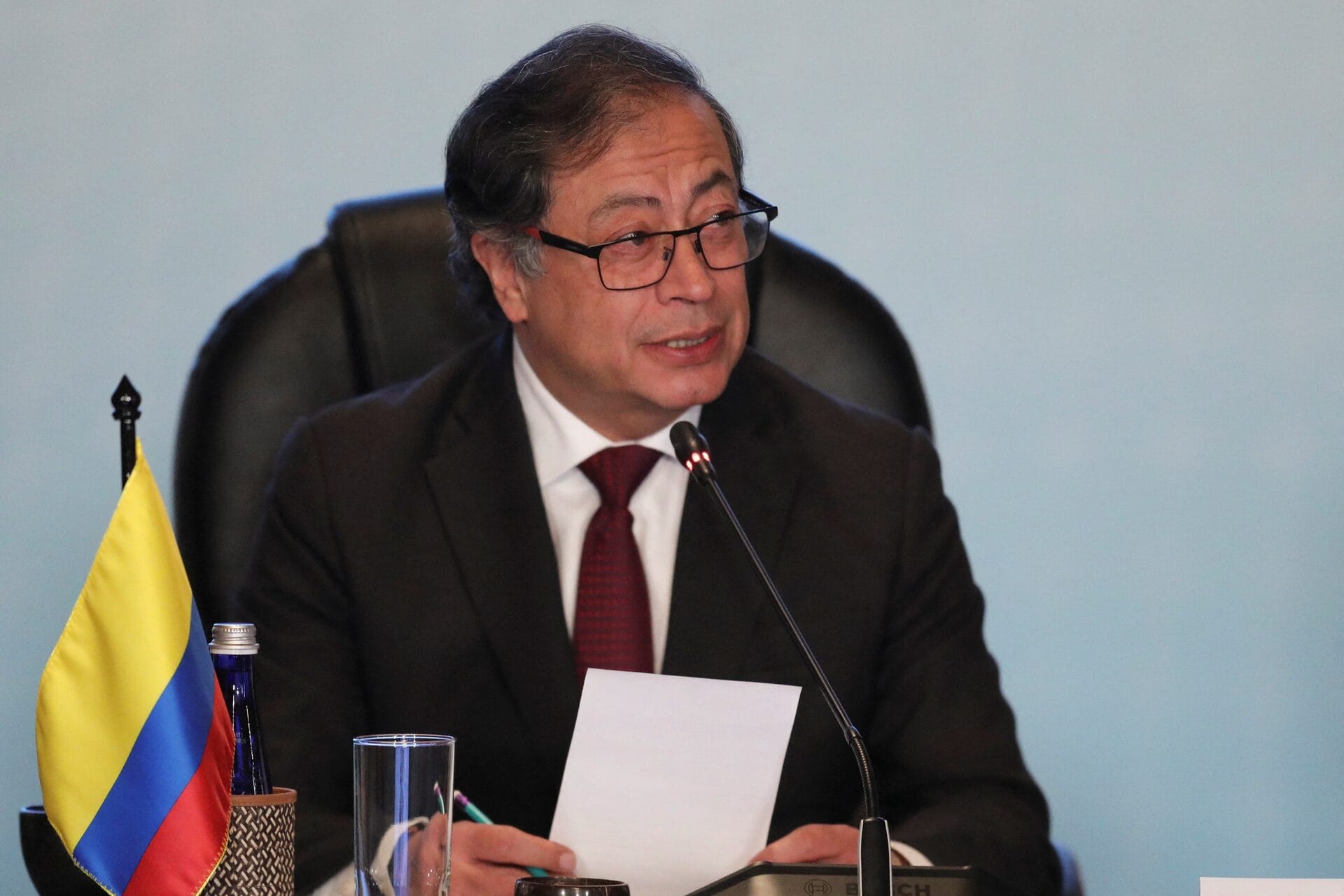
Colombian President Gustavo Petro announced on Monday that explosive devices had been dropped from aircraft near the Colombia-Ecuador border—accusing Ecuadorian forces, backed by the United States, of conducting strikes on Colombian territory.
“The bombings along the Colombia-Ecuador border do not appear to be the work of armed groups—they don’t have aircraft—nor of the Colombian security forces. I did not give that order,” Petro wrote on X.
By Tuesday, the crisis had deepened further. Petro announced that 27 charred bodies had been discovered on his country’s border with Ecuador—a development he framed as confirmation of what he had been warning about the day before.
Colombia said it deployed troops to its border with Ecuador after the two countries traded accusations over an alleged bombing in the area, raising tensions already strained by a trade war that has pushed bilateral tariffs to 50 percent on both sides.
Petro said he contacted Trump directly, asking the U.S. president to intervene and call Ecuador’s Noboa. “I asked him to act and call the president of Ecuador because we do not want to go to war,” he said.
Ecuador’s response was immediate and categorical. Noboa fired back on X: “President Petro, your declarations are false—we are acting in our territory, not yours.” Noboa resumed past accusations of Colombia of allowing criminal organizations to infiltrate through its border and said Ecuador would not back down from its security strategy.
Ecuador’s Foreign Minister Gabriela Sommerfeld separately rejected the accusations, stating that all military operations were being conducted exclusively within Ecuadorian territory as part of the country’s campaign against drug trafficking organizations.
The Context: A Relationship Already in Freefall
Monday’s confrontation did not emerge from a vacuum. The dispute intensified in January when Noboa announced a 30% “security tariff” on Colombian imports, citing a lack of cooperation from Colombia in combating drug trafficking along the border.
Colombia retaliated with tariffs on 73 products, suspended electricity exports to Ecuador, and imposed restrictions on bilateral trade. Ecuador responded by raising fees on the transport of Colombian crude through one of its main pipelines. The two countries have since escalated to mutual 50 percent import levies—an economic confrontation running in parallel to the now military one.
The deeper structural cause is a fundamental disagreement about strategy. Petro’s government has prioritized negotiations with armed groups under its “Total Peace” policy—Paz Total, while Noboa, on the other hand, has pursued a hardline military crackdown—a divergence that has made the shared border a flashpoint between two incompatible security philosophies.
The accusation comes amid a U.S.-backed Ecuadorean military campaign against armed groups in the region launched earlier this month.
In March, Ecuadorian and U.S. forces conducted strikes on a camp belonging to the Comandos de la Frontera—a Colombian armed group composed of FARC dissidents—near the Colombian border. This sequence cannot be overlooked: Petro’s allegation follows Ecuador’s enhancement of its security cooperation with the United States and a joint bombing operation that targeted a Colombian armed group active on both sides of the border.
The 2008 precedent looms over the entire dispute. The current situation recalls what happened in March 2008, when Colombian military forces bombed Ecuadorian territory near the border to eliminate Raúl Reyes, one of the FARC’s most senior commanders—an operation that triggered a full diplomatic rupture between the two countries and nearly produced a regional military confrontation involving Venezuela.
The 2008 crisis took months to resolve. The current one is moving faster.
Washington at the Center
The most extraordinary dimension of Monday’s events is that Petro—who was not invited to Trump’s Shield of the Americas summit, whose government has been at odds with Washington over Venezuela and Cuba, and who spent years characterizing U.S. regional policy as “imperialism,” called Donald Trump to ask for help preventing a war with a U.S.-backed neighbor.
Trump launched a 17-country cartel-fighting alliance this month, which includes Ecuador but not Colombia. Petro was not invited to the Shield of the Americas summit, which White House Press Secretary Karoline Leavitt claimed was due to a lack of cooperation from the Colombian government. Now Petro is asking that same administration to restrain the alliance-member it armed and trained to fight criminal drug trafficking networks operating in South America.
This detail is notable: it illustrates how rapidly a South American border crisis can become mediated through the United States—and how the Shield of the Americas framework, by explicitly including Ecuador and excluding Colombia, has created an asymmetric security architecture along one of South America’s most volatile borders.
What Comes Next
For now, the allegations from Bogotá remain unverified—but the political damage is done, and one further miscalculation could carry deep consequences far beyond the shared border.
Colombia’s May 31 presidential election is eleven weeks away. Petro’s handling of a genuine border security crisis—one in which he is simultaneously accusing a U.S.-backed neighbor of violating Colombian sovereignty and calling the U.S. president for diplomatic intervention—will shape the campaign in ways that no polling model has yet calculated.


