

MIAMI – U.S. Secretary of War Pete Hegseth and White House deputy chief of staff and Homeland Security advisor to the president, Stephen Miller, walked into U.S. Southern Command (SOUTHCOM) in Doral in Miami on Thursday—the nerve center of American military operations across Latin America and the Caribbean—and delivered yet another warning to the organized crime networks in the region.
A Time of War
Secretary Hegseth told top military officials from more than a dozen allied governments in Latin America and the Caribbean, gathered for the first-ever Americas Counter Cartel Conference, that the United States is prepared to act unilaterally and without regional partners to take out drug cartels if necessary.
“America is prepared to take on these threats and go on the offense alone,” he said, warning that governments failing to confront criminal organizations threatening U.S. border security would find Washington conducting military operations inside their countries without their consent.
Homeland Security advisor to the White House, Stephen Miller, was more direct still. “Cartels that operate in this hemisphere are the ISIS and al-Qaeda of this hemisphere and must be treated just as ruthlessly,” he told Latin American defense officials, adding that hard power and lethal force—not criminal justice—are the only tools capable of defeating them.
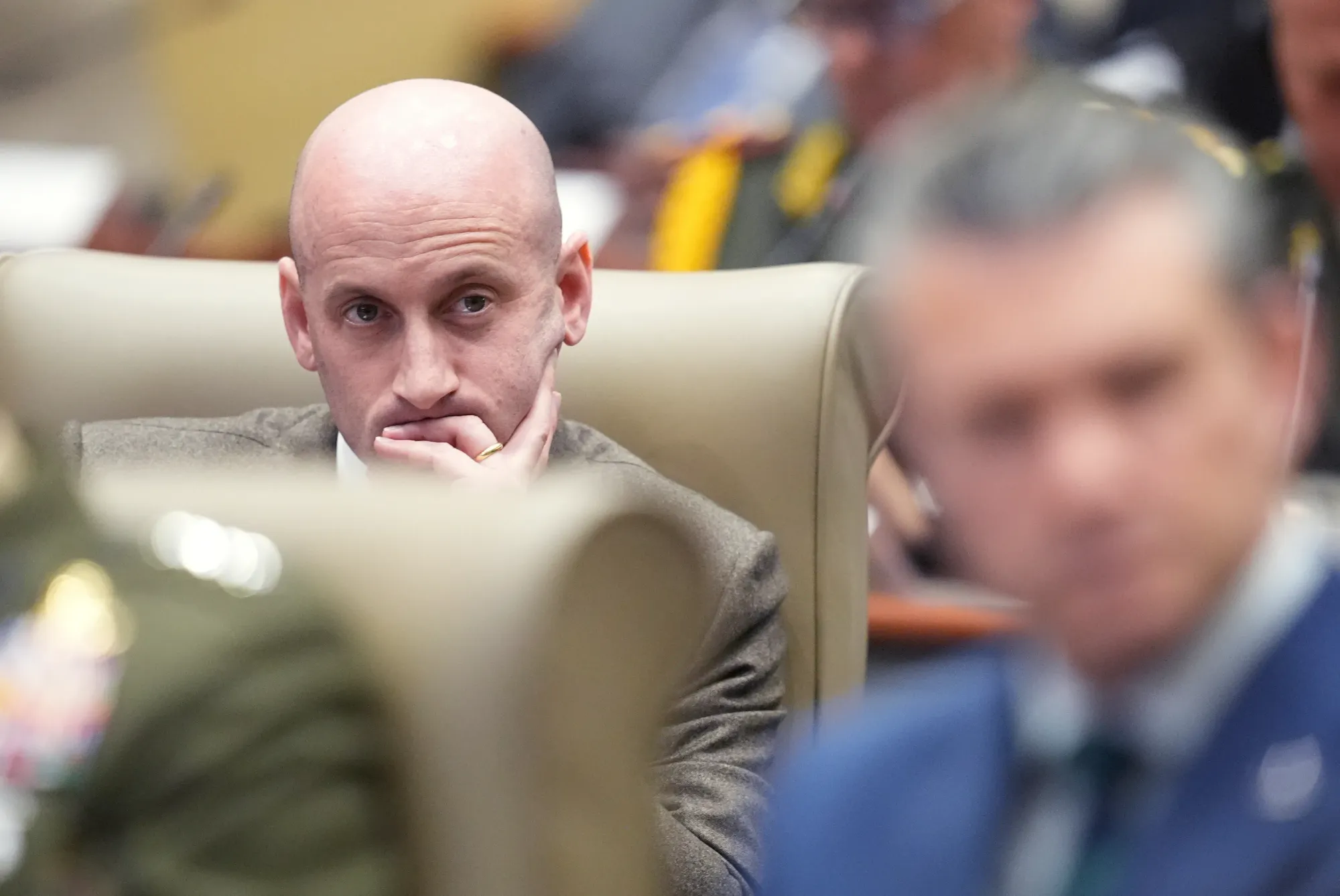
“The human rights that we are going to protect are not those of the savages that rape, torture, and murder,” he said, “but those of the average citizens.”
The language was deliberately blunt. The message to every government in the room was the same: get in the fight, or watch Washington fight without you.
A New Front
Thursday’s conference was not a policy announcement—it was a summary of what the Trump administration has already done, and a preview of what it intends to keep doing.
In September of last year, the Trump administration began authorizing the use of military force to eliminate suspected drug smugglers carrying supplies of drugs on make-shift vessels in the Caribbean and Eastern Pacific Ocean along the coasts of Ecuador and Central America.
The Pentagon confirms that over 100 people have been killed in targeted strikes since early September.
Congressional Democrats and human rights organizations have called foul, condemning the administration’s use of deadly force without a right to a fair trial. Latin American governments in Mexico City and Bogotá also denounced the U.S. military campaign, with Colombian President Gustavo Petro leading the charge.
Late last year, Petro accused the administration in Washington of human rights violations by the targeted killings of “innocent fishermen,” adding that Trump is risking “destabilizing” the region with his aggressive campaign against criminal groups operating with the alleged consent of the regime in Venezuela.
Miller told the gathering that Ecuador’s ongoing joint operations with U.S. military forces would serve as the model for other countries attending the conference, framing it as proof of concept for what security cooperation under the “Trump Corollary” looks like in practice.
The Trump administration’s national security strategy formally describes the approach as the “Trump Corollary” to the 19th-century Monroe Doctrine—an explicit assertion that the Western Hemisphere falls within Washington’s exclusive sphere of political, economic, and geo-strategic influence, and that criminal organizations threatening the United States from within that sphere will be treated as enemy combatants rather than law enforcement targets.
Miller has described Venezuela—now under the transitional government of Acting President Delcy Rodríguez—as a former “central hub” for the trafficking of narcotics, weapons, and human beings, calling its cartel networks operating in the region the “ISIS of the Western Hemisphere” and making clear that the administration views the region’s security and America’s domestic drug crisis as a single, unified problem requiring a single, unified military solution.
Order First, Prosperity Second
Running beneath both speeches was a philosophy that the administration has made no effort to conceal: that economic development, foreign investment, and democratic stability in Latin America are downstream of security, not the other way around.
It is a philosophy with real-world implications for the region’s largest economies.
Brazil, heading into its October presidential election, is watching the conference closely. President Luiz Inácio Lula da Silva has also publicly criticized U.S. military intervention in Venezuela and maintains a fraught relationship with the Trump administration following last year’s tariff confrontation over the Bolsonaro prosecution.
His government’s posture—emphasizing diplomacy and multilateral institutions over hard power—puts him philosophically at odds with everything said in Doral by U.S. officials on Thursday.
The contrast is not lost on Brazilian voters.
In a country where 38% of the electorate identify crime and public security as their top concern, Lula’s reluctance to align with Washington’s security framework is both a principled position and a political liability—one his conservative opponents are moving to exploit.
Argentina’s Javier Milei, by contrast, sent representatives to the conference and has positioned himself as Washington’s most reliable ideological partner in the Southern Cone—a posture that has earned him Trump’s personal endorsement and a favorable hearing from U.S. investors.
The divergence between Milei’s Argentina and Lula’s Brazil illustrates the broader regional realignment the Trump Corollary is accelerating: governments that align with Washington’s security framework are gaining access and investment; those that don’t are being sidelined.
The Conference Next Door
For Miami’s Latin American community—Venezuelans, Cubans, Colombians, Ecuadorians, Brazilians, and Dominicans among them—the conference at SOUTHCOM was not an abstraction taking place in some distant capital. It happened in Doral.
The defense ministers and military commanders of the countries their families came from are now being told by the U.S. Secretary of War that the new battle against the cartels and violent criminal organizations that drove so many of them north is entering its most aggressive phase yet.
The conference is expected to set the stage for a broader Americas summit hosted by Trump in Miami this weekend, where the administration plans to advance a counter-China agenda alongside its regional security framework, according to Bloomberg— making South Florida the temporary capital of the Trump administration’s hemispheric ambitions.
The cartels, for their part, have heard this language before. What they have not seen before is this level of commitment by U.S. officials in Washington to reducing their influence in the region.


