

MIAMI — The world’s biggest sporting event is coming to Miami Gardens this summer, and South Florida is ready. Hard Rock Stadium—home of the Miami Dolphins, the Miami Open, and the Formula 1 Grand Prix—will host seven matches at the 2026 FIFA World Cup between June 15 and July 18, including a quarterfinal and a third-place playoff. Brazil is coming. Colombia is coming. Uruguay is coming. Portugal is coming. And for a city whose identity is inseparable from South American fútbol culture, the summer of 2026 will be unlike anything South Florida has ever seen.
Here is everything Miami residents need to know before the first whistle blows.
The Matches: Seven Games, Four Weeks
Miami will host four group-stage matches and three knockout-round games. The full schedule at Hard Rock Stadium is as follows:
Group Stage
June 15 — Saudi Arabia vs. Uruguay, 6:00 p.m. ET
June 21 — Uruguay vs. Cape Verde, 6:00 p.m. ET
June 24 — Scotland vs. Brazil, 6:00 p.m. ET
June 27 — Portugal vs. Colombia, 7:30 p.m. ET
Knockout Stage
July 3 — Round of 32: Winner Group J vs. Runner-up Group H, 6:00 p.m. ET
July 11 — Quarterfinal, 5:00 p.m. ET
July 18 — Third-Place Playoff, 5:00 p.m. ET
The June 27 match between Portugal and Colombia is the marquee group-stage game—two of the tournament’s most-watched nations, both with enormous fan bases in South Florida, playing 18 miles from downtown Miami. Expect Hard Rock Stadium to feel like a home game for both sets of supporters simultaneously.
The Stadium: Hard Rock Stadium, Miami Gardens
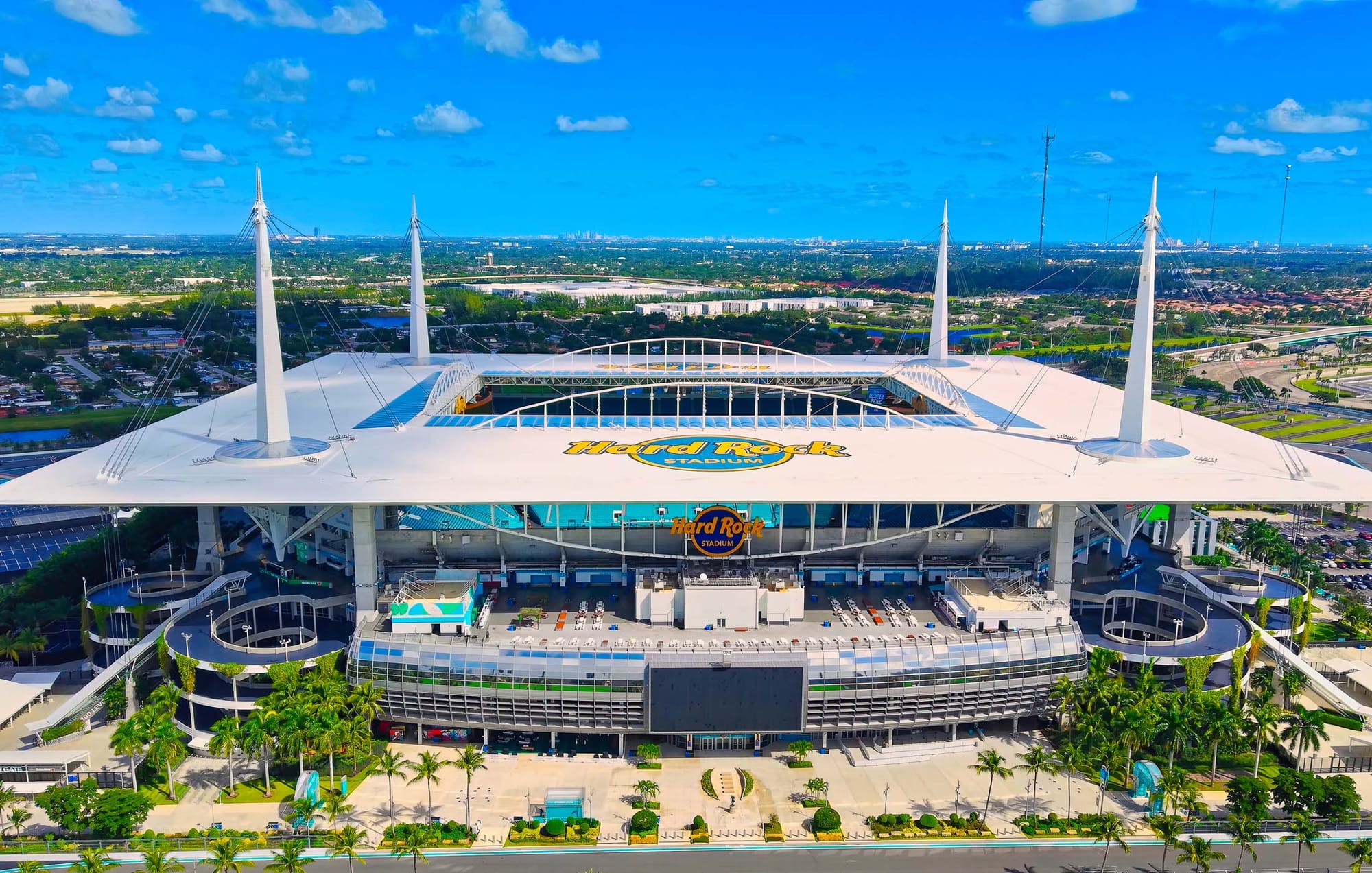
All seven matches will take place at Hard Rock Stadium in Miami Gardens. The venue seats more than 65,000 fans and is built for major events—Super Bowls, the Miami Open, the Formula 1 Grand Prix—and increasingly, top-tier fútbol.
The stadium is located at 347 Don Shula Drive, Miami Gardens, Florida 33056. It sits approximately 18 miles north of downtown Miami and 13 miles north of Miami Beach. Driving from Brickell takes roughly 30 minutes outside of match day traffic. From Fort Lauderdale, expect approximately 25 minutes.
Parking at the stadium is already sold out for World Cup matches. Park and Ride passes are still available at the Hard Rock Stadium and are the recommended option for most fans. The stadium is not currently served by Metrorail, so public transit options are limited. Ride-share demand will be extremely high on match days—book in advance and budget significant wait times after final whistles.
Why Miami Was Made for This Moment
Miami-Fort Lauderdale leads all U.S. markets in World Cup enthusiasm, with extraordinary metrics across every category measured—Spanish-language viewing, tournament interest, and multicultural engagement. Its diverse international population creates what researchers describe as unmatched enthusiasm.
That is not a marketing claim—it is a demographic reality. Miami is home to one of the largest Colombian communities in the United States, a significant Uruguayan and Argentine population, and a Brazilian diaspora that has been growing steadily for two decades.

Hard Rock Stadium for the Portugal vs. Colombia match on June 27 will not feel like a neutral venue. It will feel like Bogotá and Lisbon arrived simultaneously in Miami to become spectators at the most exciting competition in world sports.
The city’s host committee has been preparing for this for years. “Miami is ready to welcome the world,” said Alina Hudak, president and CEO of the FIFA World Cup 26 Miami Host Committee.
“Our city represents the very essence of global fútbol culture, and hosting these FIFA World Cup 2026 matches will be a celebration of our diversity, passion, and world-class hospitality.”
Tickets: How to Get Them and What They Cost
Tickets to the 2026 World Cup are sold exclusively through FIFA’s official portal at FIFA.com. However, remaining seats will be limited due to the extraordinary public demand for Miami matches. There is no other legitimate source. Any tickets purchased through third-party resellers, social media, or unofficial websites carry a significant risk of fraud—a risk that scales considerably for high-demand matches like Portugal vs. Colombia.
The process requires creating a FIFA account and verifying your identity before purchasing. Tickets are issued digitally and linked to the purchaser’s account, which means they cannot be transferred in the traditional sense.

FIFA introduced dynamic pricing for the 2026 edition—the first time the tournament has used this model—allowing ticket costs to fluctuate based on demand, team popularity, and match timing. Premium final seats at MetLife Stadium surged to $8,860, compared to bid documents that originally projected group-stage tickets starting at just $21. Football Supporters Europe called the pricing a monumental betrayal of the World Cup’s traditions, and 69 members of the United States Congress signed a letter urging FIFA to reverse course.
For Miami’s group-stage matches, expect face-value prices to range from several hundred dollars for Saudi Arabia vs. Uruguay up to topping as much as $40,000 for premium seating locations along the sidelines. Resale prices for the latter will almost certainly be significantly higher as the tournament approaches.
The quarterfinal on July 11 and the third-place playoff on July 18 do not yet have confirmed teams—those will be determined by results in the knockout rounds. Knockout-round tickets are sold in advance without knowing which teams will play, which means you are buying the match slot, not the matchup.
The South American Teams Playing in Miami
For South Florida’s Latin American community, the group-stage schedule at Hard Rock Stadium reads like a dream fixture list.
Uruguay plays twice in Miami—against Saudi Arabia on June 15 and against Cape Verde on June 21. Uruguay, ranked among the tournament’s dark horses, arrives in Miami with Federico Valverde of Real Madrid in the best form of his career. He scored a 94th-minute penalty at Wembley against England just days ago. His performances this summer in Miami Gardens will be worth watching closely.
Brazil plays Scotland in Miami on June 24. The Seleção's group-stage run has placed them in a city where their flag flies from apartment balconies in Brickell, and their music plays in restaurants from Wynwood to Aventura. The June 24 match will be one of the most emotionally charged atmospheres Hard Rock Stadium has ever produced.
Colombia plays Portugal in Miami on June 27. This is the match Miami has been anticipating since the draw was announced in December.
Colombia’s rise as one of South America’s most exciting teams—combined with Portugal’s global profile—guarantees a sold-out stadium and a city-wide celebration regardless of result.
Getting to the Stadium: What You Need to Know
Hard Rock Stadium on a World Cup match day will be unlike anything Miami Gardens has seen before. Here is how to prepare.
- By car—stadium parking is sold out. Park and Ride is the recommended option.
Designated Park and Ride lots will be announced closer to the tournament on MiamiFWC26.com.
Arrive significantly earlier than you would for a Dolphins game—international match-day crowds arrive earlier and stay longer.
- By ride-share—book your return ride before you arrive. Post-match surge pricing will be extreme, and wait times after 65,000 people exit simultaneously can exceed one hour. Consider arranging a pickup point several blocks from the stadium to reduce wait times.
- By bike—a dedicated cycling route will be available for fans coming from Miami Gardens and the surrounding neighborhoods, especially for tourists and international visitors.
- By bus—Miami-Dade Transit operates routes to the stadium area. Check the Miami-Dade Transit website for World Cup service updates closer to June.
Immigration & Travel: What Latin American Fans Need to Know
This is the most important section of this guide for international fans traveling to Miami for the World Cup—and the one that requires the most careful reading.
The Trump administration has restricted entry to nationals from 39 countries. While athletes and coaches are exempt from these restrictions, fans from those countries will largely be unable to attend matches on United States soil.
For fans from Latin American countries not on the restricted list—Colombia, Brazil, Uruguay, Argentina, Venezuela, Peru, and most others—standard U.S. visa requirements apply. Citizens of most South American countries require a tourist visa (B-1/B-2) to enter the United States, which must be applied for well in advance at a U.S. Embassy or Consulate.

U.S. Customs and Border Protection has proposed a new policy requiring certain tourists to disclose their social media activity for the past five years, any phone numbers used over the last five years, and email addresses used in the last ten years, as well as biometric data.
This would apply to 42 countries whose citizens do not currently require a visa to enter the United States. However, these rules may be subject to change prior to the start of the 2026 FIFA World Cup.
The practical advice for any international fan planning to travel to Miami for the World Cup is to begin the visa application process immediately—not in May, not in April. U.S. consular wait times in major Latin American cities currently run from several weeks to several months, depending on the country and city. Missing the tournament because of a delayed visa appointment is a real and preventable risk.
The Miami Experience Beyond the Stadium
The World Cup in Miami is not just seven matches at Hard Rock Stadium. It is six weeks of the most intense fútbol atmosphere this city has ever produced, spread across every neighborhood with a television, a terrace, and a passion for the game.
Wynwood, Brickell, Little Havana, Little Buenos Aires in South Beach, and the Colombian corridors of Doral and Kendall will all have their own unofficial World Cup atmospheres running parallel to the official matches.
Fan Fests—free public viewing areas where fans gather to watch matches on large screens—will be announced by the Miami Host Committee in the coming weeks. Follow MiamiFWC26.com and the FIFA World Cup 2026 Miami Host Committee on Instagram at @fwc26miami for official updates on fan zones and local events.
For a city whose identity was built by people who arrived from every corner of the Americas and made Miami their home, the summer of 2026 is a homecoming that does not require a passport. The world is coming here. And here was always ready.
The 2026 FIFA World Cup is Sociedad Media’s summer beat. From the group stage to the final whistle—we cover it for Miami’s Latin American community. Have a story, a tip, or a World Cup experience to share? Write to us at info@sociedadmedia.com


