

WASHINGTON, D.C. - A return to meet with old faces, Secretary of State Marco Rubio testifies before the Senate Foreign Affairs Committee to update members on developing events in Venezuela on Wednesday.
Before taking his new post as the head of U.S. foreign policy in the second Trump administration, Rubio spent 14 years on the Senate committee, guiding three administrations through the muddied waters of global relations.
Today, Rubio is spending much of his time striving to achieve a smooth “transition to a friendly, stable, prosperous” Venezuela following the controversial U.S. capture of the former dictator of the South American pariah state, Nicolás Maduro, in a nighttime assault by U.S. special operators in Caracas.
Critics of the administration, however, have questioned the effectiveness of removing Maduro, while leaving many of his cohorts in power in Caracas. Democrat lawmakers on Capitol Hill have expressed opposition to the operation that led to Maduro’s ouster, framing Trump’s Venezuela strategy as part of an imperialist takeover of assets in the Western Hemisphere.
“You can have elections all day, but if the opposition has no access to the media, if opposition candidates are routinely dismissed and unable to be on the ballots. That’s the end-state that we want, free and fair, prosperous and friendly Venezuela. We are not going to get there in three weeks. It is going to take some time.”
A recent report by The New York Times revealed that a majority of Latin Americans surveyed expressed their support for Maduro’s removal from power, arguing that the Maduro government was largely a corrupt and repressive regime that violated the human rights of dissidents and members of the opposition.
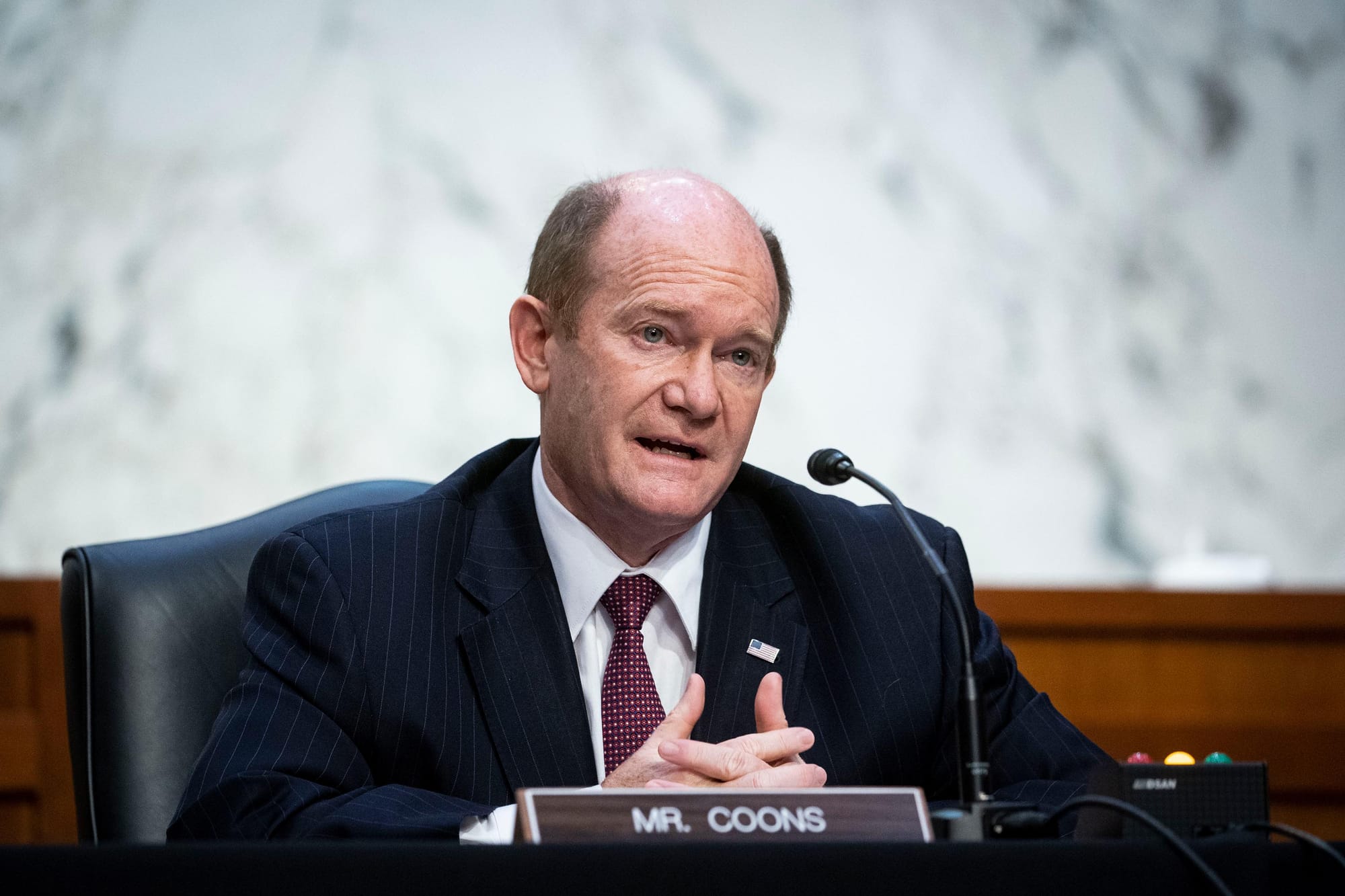
During the hearing, Senator Chris Coons (D-DE) shared his dissatisfaction with the administration’s lack of “consultation” with members of Congress on the Maduro operation, accusing the administration of side-stepping the authority of the legislative body to “declare war.”
Secretary Rubio responded by expressing concerns over the recent history of congressional leaking of classified information. Rubio stated:
“The truth of the matter is that this was leaked. We now know it was leaked by a contractor [at] the Department of War. Had it been published, it would have endangered the lives of people and/or would have probably canceled the ability to carry out the mission.”
Senator Jeanne Shaheen (D-NH) opened a line of inquiry into the potential downsides of funding local governance capabilities for the interim regime to operate in Venezuela. This month, the U.S. government closed on an initial $500 million sale of sanctioned oil following the ouster of Maduro.
The deal, reportedly part of a $2 billion agreement between the United States and Venezuela, had $300 million, approximately three-fifths of the funds generated from the recent sale, which are managed in a Qatari bank, was allocated to keep payrolls open for Venezuelan civil government members and local police and state security forces in an effort to maintain stability for the interim government of Acting President Delcy Rodríguez, who is expected to visit the White House in the coming weeks.
“Our goal was to address an untenable situation in our hemisphere, where Venezuela had become a base for hostile actors and a narco-trafficking regime that posed a serious strategic risk to the United States and the region. We acted to change that reality, with the ultimate objective of moving toward a transition to a friendly, stable, prosperous, and democratic Venezuela with genuinely free and fair elections where all voices are represented.”
One of the more heated rounds came when Democrat Senator Tammy Duckworth of Illinois tussled with the Secretary of State and pressed Rubio on President Trump’s use of the 1798 Alien Enemies Act to combat criminal drug trafficking entities in Latin America.
The act affords the executive branch “wartime authority” to detain or deport non-citizens who have become actors in the perpetuation of an “invasion” of the United States.
Duckworth tied Trump’s use of the act to recent events in Venezuela, asking Rubio: “Are we at war with Venezuela?” Rubio responded by saying “No, we are not at war with Venezuela,” but adding that we are in a “state of war” against non-state actors like Tren de Aragua, a violent criminal network with ties to Venezuela, and which was recently designated as a Foreign Terrorist Organization (FTO) by Rubio’s State Department on Jan. 20, 2025.
The administration has argued that such an organization that comes across U.S. territory to commit crimes in the United States and further their criminal enterprises warrants the executive branch’s use of the Act of 1798.


