

MIAMI — On January 3, 2026, the streets of Doral erupted. Venezuelans poured out of restaurants, apartment buildings, and office towers along the stretch of northwest Miami-Dade that locals call “Doralzuela” — waving flags, honking horns, embracing strangers — as news broke that U.S. Special Operations forces had captured dictator Nicolás Maduro in a pre-dawn raid on Caracas.
After twenty-five years of chavismo, after the economic collapse and the mass exodus and the political prisoners and the rigged elections, the strongman was gone.
Three months later, the streets of Doral are quiet. And in Caracas, the government that Maduro ruled over is still running Venezuela.
It has been exactly three months since Operation Absolute Resolve, and Venezuela still has no elections in sight. Acting President Delcy Rodríguez — Maduro’s former vice president, a chavista insider for nearly eight years — governs with Washington’s backing. Among sources close to the government in Caracas, the most candid answer to the question of when elections will be held is unambiguous: “Elections will be held when ordered by the U.S. government.”
That sentence captures the strange, suspended reality of post-Maduro Venezuela: a country whose democratic future is being managed from outside its borders, by an administration that removed one authoritarian and is now navigating the minefield his removal left behind.
Why Machado isn’t President
The democratic math in Venezuela is not in dispute. In the July 2024 presidential election — the last before Maduro’s capture — opposition leader María Corina Machado’s coalition candidate Edmundo González was widely viewed as the actual winner, though Maduro’s government declared itself victorious.
Machado, who was awarded the Nobel Peace Prize in 2025, remains the most recognized democratic voice in the country. The question of why she is not governing Venezuela is the central question of the transition — and the answer is more complicated than it appears.
The White House has been explicit. Trump said during the days after Maduro’s capture that Machado likely lacks the institutional support needed to govern, and that Venezuela needed to be “nursed back to health” before elections could take place. That framing is not rhetorical cover — it reflects a genuine structural reality that analysts across the political spectrum acknowledge.
The security and defense apparatus that kept Maduro in power for over a decade remains largely intact. Whether those forces will remain pliant in the face of prospective democratic change — and whether they can maintain order as popular pressure for elections grows — are the essential questions for the months ahead.
Installing Machado without the buy-in of the military commanders in Caracas, the intelligence apparatus, the local security forces, the chavista-aligned judiciary, and the complete old guard of the Maduro regime that control the levers of institutional power of the Venezuelan government, risks something worse than the current limbo: a coup, a fracture within the armed forces, or outright civil conflict in a country already holding 7.9 million people in urgent humanitarian need.
Ricardo Hausmann, the Harvard economist and former Venezuelan Minister of Planning, argued at Davos in January that what is being framed as stability in Venezuela is, in practice, repression — with political prisoners still detained and basic freedoms severely curtailed. “I would argue that there cannot be recovery without rights,” he said, noting that the constitutional vacuum created by Rodríguez’s swearing-in without triggering proper electoral mechanisms will deter Venezuela’s eight-million-strong diaspora from returning to help drive reconstruction.
The tension Hausmann identifies is real: you cannot have economic recovery without political legitimacy, and you cannot have political legitimacy without elections, and you cannot have safe elections without dismantling the institutional apparatus that has spent two decades rigging them. That circle has not been squared.
Rodríguez: Pragmatist or Placeholder?
Delcy Rodríguez is not a figure who invites easy characterization. The U.S. Treasury once accused her of being among a group of officials “involved in the destruction of democracy in Venezuela” and of “enriching themselves at the expense of the Venezuelan people” — sanctions imposed in 2018 that Washington lifted entirely on April 2, 2026, formally recognizing her as a legitimate authority.
Since assuming the presidency, Rodríguez has pursued a carefully calibrated pragmatism. She has opened Venezuela’s oil sector to foreign investment through a new hydrocarbons law, cooperated with Washington’s phased transition plan, and oversaw the reopening of the U.S. Embassy in Caracas after a seven-year closure.
A landmark amnesty law, approved in February 2026, covers politically motivated offenses dating back to 1999 under Hugo Chávez, and hundreds of political prisoners have been released — though human rights organizations report that implementation has been uneven and new politically motivated arrests continue.
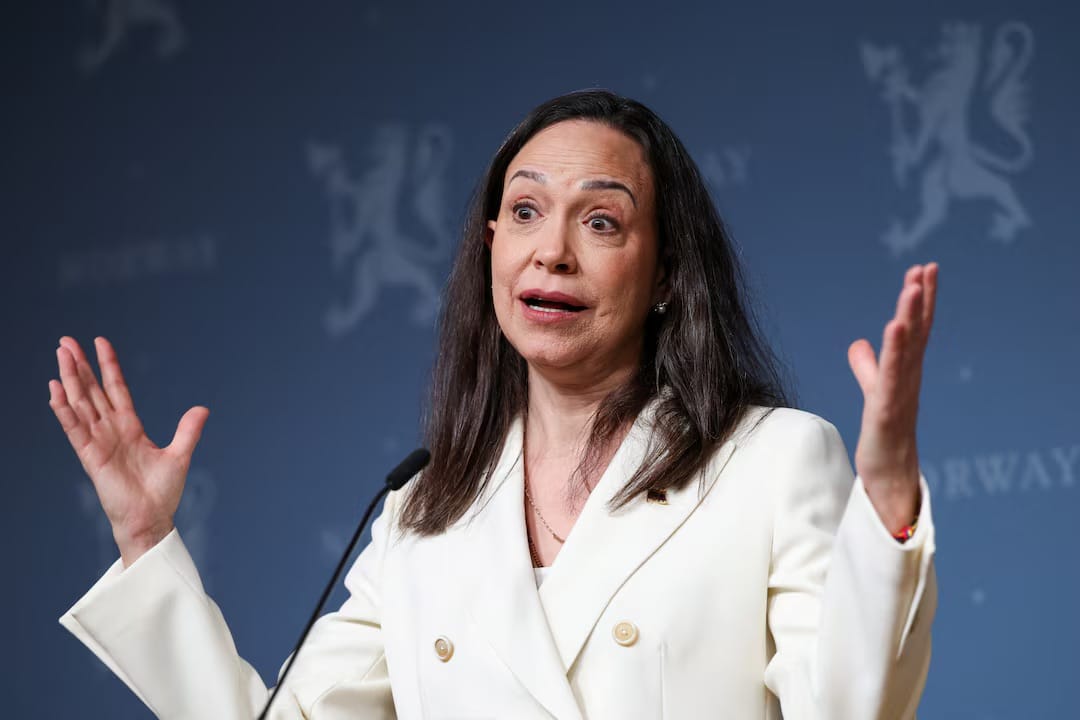
She has also maintained her condemnation of Maduro’s capture as a kidnapping, describing it publicly as the abduction of “two heroes.” That positioning is not incidental — it is a carefully maintained relationship with the old guard chavistas whose institutional support she needs to govern.
Rodríguez is managing two audiences simultaneously: Washington, which needs her compliance, and the chavista military and intelligence establishment, which needs to believe she has not become an American puppet in order to keep her politically alive.
Whether she is a transitional figure — a stabilizing interim leader who buys time for genuine democratic elections — or whether she is consolidating into something more permanent is the question that will define Venezuela’s near-term future. No election has been announced despite constitutional provisions requiring interim authorities to call a vote within thirty days of assuming power. Legal experts and human rights organizations describe this as a constitutional vacuum that undermines the legitimacy of both the government and the National Assembly to rewrite a credible framework for investment and recovery.
Maduro in Court, Venezuela in Limbo
In New York, the legal process against Maduro and his wife Cilia Flores continues. Judge Alvin Hellerstein rejected Maduro’s motion to dismiss the narcoterrorism case, keeping judicial pressure on chavismo alive and conditioning any future political negotiation.
Both have pleaded not guilty. The trial, whenever it begins, will be the most significant prosecution of a sitting — or recently deposed — Latin American head of state since the capture of Panama’s Manuel Noriega by U.S. special forces on January 3, 1990.
The trial matters beyond its legal dimensions. As long as Maduro remains in U.S. custody facing charges, Washington retains leverage over Rodríguez’s government and over the pace of any transition. The threat of further legal pressure — indictments of other chavista officials and seizures of assets — is the mechanism Washington is using to keep Caracas cooperative without deploying additional military force.
Venezuela holds the world’s largest proven oil reserves, estimated at over 300 billion barrels, yet currently produces only around one million barrels per day — a fraction of its late-1990s peak of 3.5 million. Any effort to restore production will require sustained capital investment from international oil companies, and that investment requires the kind of political stability and legal framework that does not yet exist.
The oil future that both Washington and Caracas are negotiating toward remains, for now, a projection rather than a reality.
What Miami is Watching
The Venezuelan community in Miami — the largest outside Venezuela itself, concentrated in Doral, and various other parts of Miami and South Florida — occupies an uncomfortable position in this story. They celebrated Maduro’s fall because it was real and earned. But the democratic transition they expected has not followed along the timeline they imagined.
That uncertainty has deepened rather than resolved. The diaspora question — whether Venezuelans abroad will return to rebuild — is not merely emotional. It is structural. Venezuela’s economic collapse displaced a generation of engineers, doctors, teachers, and entrepreneurs. Hausmann’s argument that recovery requires rights is a diaspora argument as much as an economic one: the people Venezuela needs to rebuild its institutions are watching from Miami, Bogotá, Lima, and Madrid, waiting for conditions that make return viable and safe.
Edmundo González remains in exile. Machado’s party argues that the Rodríguez government — which still includes former Maduro interior minister Diosdado Cabello in a senior role — lacks democratic legitimacy regardless of Washington’s recognition. The opposition that actually won the last election is not in power. The government that lost it, restructured and rebranded under new management, is.
None of this means the transition has failed. It means the transition is hard — harder than a single military operation, however audacious, can resolve. The institutional architecture of chavismo was built over twenty-five years. Dismantling it without triggering collapse is a generational project. Washington understands this. Rodríguez understands this. Machado, who has spent her entire political career working within and against this system, understands it better than anyone.
What Venezuela needs now is not another dramatic event. It is something far more difficult: time, patience, and the slow, unglamorous work of building the conditions under which a real election can actually mean something.
For the Venezuelans in Doral who celebrated in January and are watching carefully in April, that work — and the waiting it requires — is the hardest part of liberation.
Sociedad Media will continue to monitor the situation in Venezuela and any other developments that matter most to the Venezuelan people, including the Maduro trial, the status of “free and fair elections,” and the future of the democratic transition. For questions or concerns, feel free to contact us at info@sociedadmedia.com


