

MIAMI — The phone call between U.S. Secretary of State Marco Rubio and Brazilian Foreign Minister Mauro Vieira on March 8 was publicly described as routine diplomatic contact. It was not.
The central issue, according to officials in Brasília, was whether the Trump administration intends to designate Brazil’s Primeiro Comando da Capital (PCC) and Comando Vermelho (CV) as Foreign Terrorist Organizations. Brazil resisted similar pressure last year. The pressure has returned, and it is sharper than last time.
The designation has not yet been announced. But the State Department has completed the technical documentation supporting it, and the decision awaits only political approval, according to sources familiar with the U.S. government. When it comes — and the weight of reporting suggests it is a matter of when, not if — it will trigger one of the most consequential diplomatic confrontations between Washington and Brasília in a generation, reshape the terms of Brazil’s October presidential election, and raise fundamental questions about how the United States projects security power as far down as the Southern Cone — an area it is increasingly treating as its exclusive domain.
Two Organizations, One Diplomatic Crisis
The PCC and Comando Vermelho are not obscure entities. They are the two dominant criminal organizations in Latin America’s largest country, and their reach extends far beyond Brazil’s borders.
The PCC is Latin America’s biggest drug gang, with a membership of 40,000 lifetime members plus 60,000 contractors. The group is based in São Paulo and is active throughout Brazil, South America, West Africa, and Europe. An international expansion fueled by the cocaine trade made the PCC establish a profitable partnership with Italy’s ‘Ndrangheta and, as of 2023, run over 50 percent of Brazil’s drug exports to Europe.
In August 2025, the Brazilian Federal Revenue revealed that the organization controlled at least 30 billion reais — roughly $5.57 billion — in property investments.
The Comando Vermelho was founded in the 1970s in Cândido Mendes prison as an alliance between common criminals and left-wing militants imprisoned during the military dictatorship.
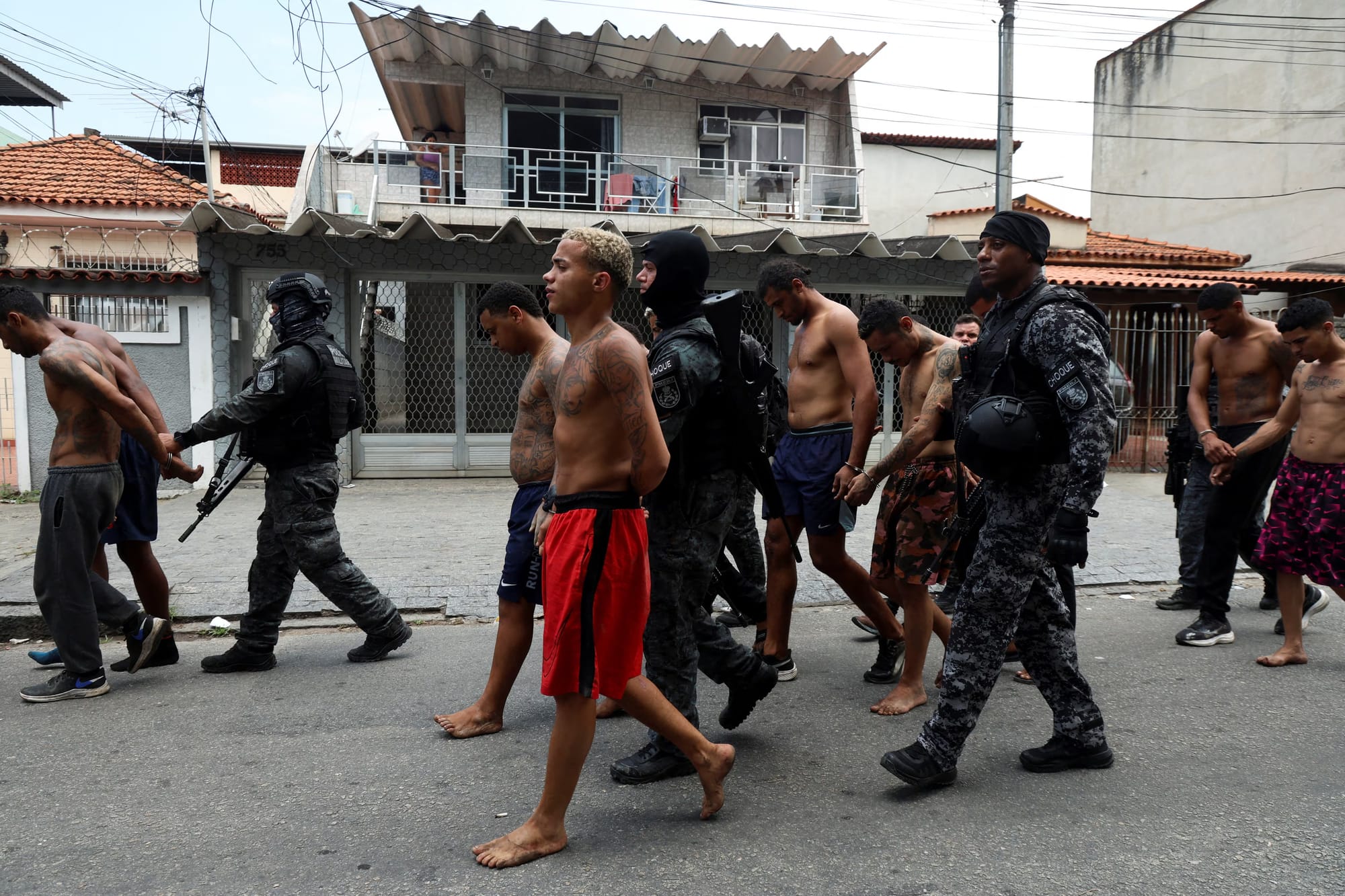
The organization later abandoned its ideological component and became the oldest criminal group in the country, based in the favelas of Rio de Janeiro. In October 2025, Rio’s deadliest police operation in history killed 122 people in an offensive targeting the CV — an event that sent shockwaves through Brazilian politics and hardened the position of state-level governors who favor international security cooperation.
Brazilian prosecutors and investigators describe the PCC as the country’s largest and most transnational criminal organization, deeply embedded in cocaine trafficking to Europe, with sophisticated money-laundering structures, prison-based command chains, and international partnerships.
What a Terrorist Designation Actually Does
The legal mechanics of an FTO designation matter as much as the symbolism. Under U.S. law, a Foreign Terrorist Organization designation makes it a federal crime to provide material support to the listed group, triggers the freezing of assets within the American financial system, and enables immigration restrictions against members and associates.
The Trump administration has already placed 25 foreign organizations on the FTO list since taking office, including Venezuela’s Tren de Aragua, the Cartel de los Soles, and six Mexican cartels. The broader strategy — outlined in the December 2025 National Security Strategy and January 2026 National Defense Strategy — treats Latin American narco-trafficking as a national security threat on par with international terrorism, a framework that critics say is designed to justify extraterritorial action.
For Brasília, the designation is not primarily a law enforcement question. It is a sovereignty question — and the recent trajectory of U.S. policy in the hemisphere has made that concern entirely concrete. The Lula government cites the case of Venezuela, where Washington launched naval attacks in July 2025 after designating the Cartel de los Soles as a terrorist organization, leading to the military capture of Nicolás Maduro in January 2026.
The sequence — designation, sanctions, military action — is the template Brasília fears being applied to its own territory.
Since September 2025, under the label “Operation Southern Spear,” the U.S. government has been attacking boats in the Caribbean that it alleges are carrying drugs into the United States. There have been at least 44 attacks on boats since then, with 48 boats destroyed, and casualties crossing the 150 mark as of mid-March 2026.
The Sovereignty Argument — and its Limits
Brazil’s legal counterargument is substantive. Justice Minister Ricardo Lewandowski has argued that “terrorism always involves an ideological element” and that criminal gangs “commit offenses already defined in the Penal Code.”
Brazil’s Anti-Terrorism Law defines terrorism as acts intended to provoke social or generalized terror on the basis of race, color, ethnicity, or religion. Under that definition, neither the PCC nor CV qualifies — they are profit-driven criminal enterprises, not ideological movements.
Former São Paulo prosecutor-general Mario Sarrubbo warned that declaring the groups terrorists would “only make the country vulnerable internationally to economic embargoes and even territorial violations, which would be unreasonable under any circumstances.”
The counterargument — from Washington and from Brazil’s own right-wing politics — is equally pointed. São Paulo Governor Tarcísio de Freitas described the potential designation as an “opportunity,” arguing that once the U.S. views the PCC as a terrorist organization, “it becomes easier to open the way for cooperation, integrate intelligence, access financial resources, and structure an even more effective fight.”
But analysts warn that the likelier outcome is not collapse but adaptation. Designation could accelerate precisely the sophistication it seeks to disrupt, driving more transactions through crypto and trade-based laundering, deepening penetration of legitimate sectors, and increasing investment in state capture as insurance against enforcement.
Other countries where drug gangs have been designated as FTOs — including Mexico, Colombia, and Haiti — have not seen a material decline in violence.
The Electoral Weapon
The FTO question arrives in Brazil at a moment of acute political vulnerability for President Lula — and the timing is not coincidental.
A recent AtlasIntel/Bloomberg poll found that corruption — at 54.3% — and crime and drug trafficking — at 53.3% — are Brazilians’ top concerns, far ahead of the economy and inflation at 19.2%. Nearly 89% of respondents rate crime levels as high or very high, and 91.5% believe criminal organizations control important spheres of politics and the judiciary.
This means that more than 90% of voters effectively claim that crime will influence their ballot, which projects a conservative, right-wing response to the nation’s crime crisis in the election.
A Datafolha survey published in late March showed Lula with just a three-point lead in a hypothetical runoff against Flávio Bolsonaro, down from a 15-point advantage in December. Other polls have Bolsonaro leading.
The tightening has been driven in large part by the security issue — an area where Lula has repeatedly struggled to find the right register, most visibly when he described drug dealers last October as “victims of drug users.”
Eduardo Bolsonaro, Jair’s son, has actively lobbied Washington for the FTO designation. The issue would hand the Brazilian right — with Flávio Bolsonaro now a presidential candidate — a potent weapon in a 2026 campaign in which voters have identified security as one of the top issues.
Lula faces a difficult choice: embrace the designation and appear subservient to Washington, or resist it and be painted as soft on narcoterrorism. Either decision will be consequential for President Lula, considering the strength of the political left across the country.
Analyst Maurício Santoro noted that headlines about FBI arrests of PCC operatives abroad would carry enormous electoral impact in a country where public security consistently ranks as voters’ top concern. The right’s embrace of Washington’s framing and the left's resistance to it is drawing the battle lines of the October race, with a significant portion of those lines being drawn in Washington, not Brasília.
Officials in Brasília are calling it interference in a sovereign electoral process. The Trump administration has not said so publicly, but the designation’s political timing — arriving in an election year, championed by the Bolsonaro family’s U.S. allies — is not a coincidence that Brazilian analysts are missing.
The Perception Gap
There is one important complication in the security narrative that neither Lula nor his opponents, have found a clean way to address. The depth of public anxiety about crime exists alongside a reality that points in the opposite direction. Brazil’s homicide rate fell to 17.9 per 100,000 inhabitants in 2024 — the lowest in over a decade — with 38,075 intentional killings, a 6% drop from the prior year and a 16% cumulative decline since 2020.
Brazil is simultaneously getting objectively safer by the measures that count most and feeling more dangerous to the people who live there. That gap — between statistical improvement and visceral fear — is the political space that the FTO designation is designed to occupy.
For Flávio Bolsonaro’s campaign, the designation is not primarily a law enforcement tool. It is a signal that the Bolsonaro family’s allies in Washington view Brazil’s gangs the way Brazil’s security-conscious voters already do.
For Lula, that signal is the problem. Every day the designation remains pending, the question of who is serious about the PCC hangs in the air. And in an election where the race will hinge on crime, corruption, and the ability to make ends meet, no incumbent can afford to look like the answer is not him.
The Trump administration’s FTO designations for the PCC and Comando Vermelho remain pending as of publication. Sociedad Media will continue to monitor developments. For tips and updates: info@sociedadmedia.com


