

MIAMI — On a front porch in West Miami, decades before he became the most powerful Latino in American diplomatic history, a boy sat at his grandfather’s feet and listened.
Marco Rubio later wrote that as a child, he heard stories of Cuban heroes, of life under the communist regime his family left behind, and that he boasted he would someday lead an army of exiles to overthrow Fidel Castro and become president of a free Cuba.
That childhood declaration, made in a neighborhood built by Cuban exiles, would not simply define one man’s career. It would define the arc of American foreign policy in the Caribbean for a generation — and it would do so because the community that forged Rubio’s worldview had spent sixty years building precisely the institutional infrastructure needed to make such a vision politically possible.
Understanding how the United States treats Cuba in 2026 requires understanding Miami. Not Washington. Not Langley. But Miami — the city ninety miles from Havana — where the bulk of the Cuban exiles landed in the early months of 1959 with the clothes on their backs and the certainty that they would be going home soon, and where their descendants have built one of the most effective foreign policy lobbying communities in American history.
The First Wave: Who They Were and What They Carried
The story begins not with politics but with people — and with a specific kind of people.
The emigration of Cubans directly following the 1959 Cuban Revolution has been referred to as the “golden exile.” The majority of those who left in this period were urban, middle-aged, well-educated, and white-collar professionals who emigrated primarily for religious or political reasons. These Cubans were doctors, lawyers, engineers, business executives — the professional class whose property, livelihoods, and social status were incompatible with Castro’s nationalizations and Marxist social structure.
Many of them were connected to American companies operating in Cuba that were being seized by the new government.
In the period between January 1959 and October 1962, called the historical exile, approximately 248,100 Cubans emigrated. They came primarily to South Florida, drawn by geography and by a nascent community already beginning to form. The U.S. government, which viewed the Cuban exodus through the lens of Cold War competition with the encroaching Soviet Union, was largely welcoming.
President Eisenhower established the Cuban Refugee Emergency Center in 1960, which offered public services to Cuban emigrants, and many immigration restrictions were specifically waived for Cubans entering the United States.
Critically, in the first emigration wave, many emigrants considered their exile to be only temporary, because many were convinced that the Castro government was bound to fall soon. They did not come to build new lives in America. They came to wait it out. They preserved Cuban institutions in miniature — schools, social clubs, civic organizations — against the day they would return and resume what had been interrupted. Miami was not a destination. It was a staging ground for a brave revival of old Cuba.
That waiting would prove foundational. Because the return never came.
Operation Pedro Pan and the Children of Exile
While adults organized politically, another dimension of the exodus was unfolding that would have profound long-term consequences for Miami’s identity and its political culture.
Between December 1960 and the end of 1962, more than 14,000 unaccompanied children were sent by their parents from Cuba to Miami. The operation, which came to be known as Operation Pedro Pan, was an agreement of cooperation between the U.S. State Department and Catholic Charities of Miami. It started after Fidel Castro’s rise to power, initially for children whose parents were fighting against him underground, but then expanded to all Cuban families who wanted to flee out of fear for their future under the new regime.
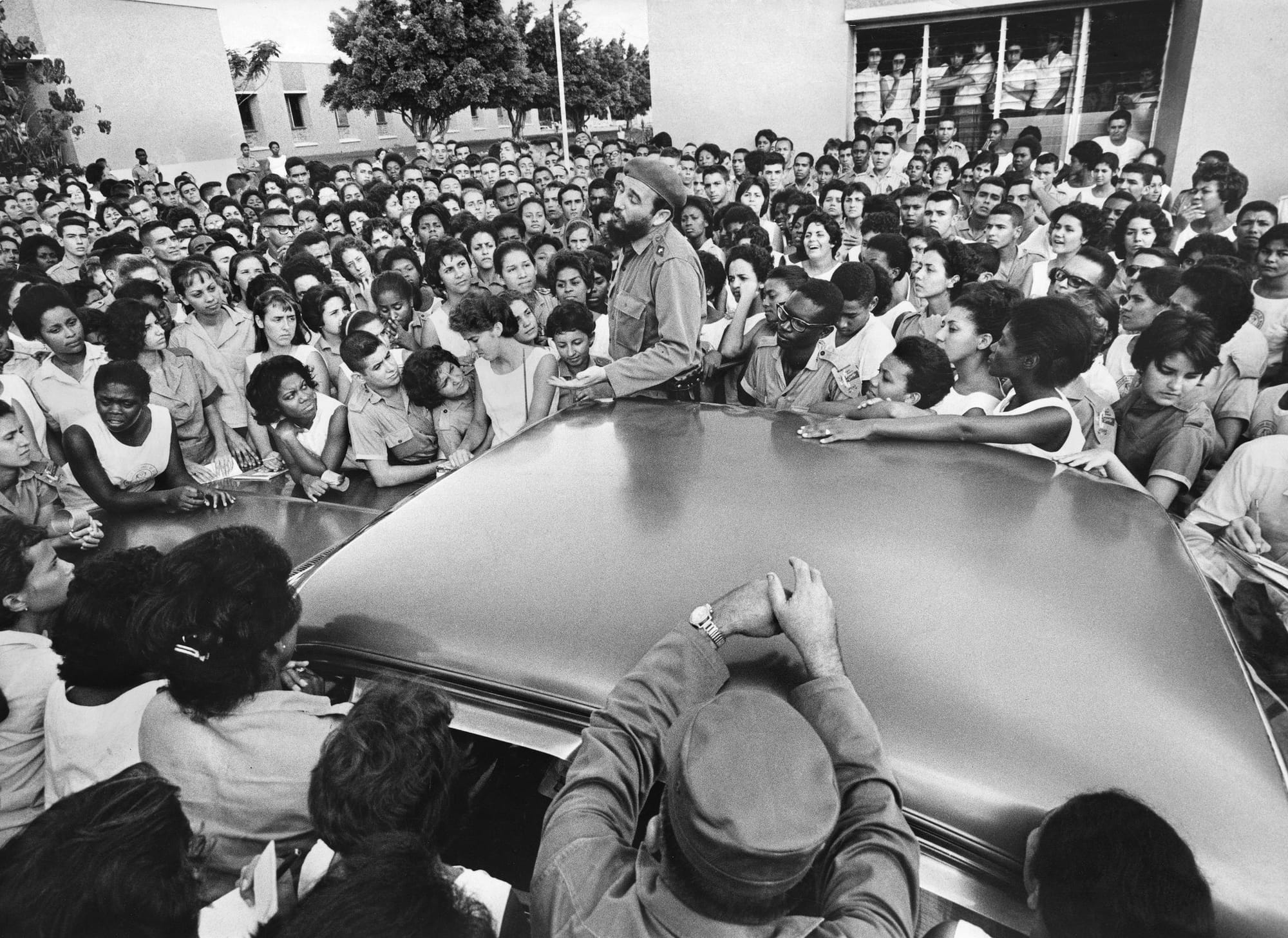
The scale was staggering. Operation Pedro Pan was the largest recorded exodus of unaccompanied minors in the Western Hemisphere at that time. Parents sent their children ahead — sometimes to relatives, sometimes to friends, sometimes to strangers, and even to Catholic orphanages — trusting that the Castro government would fall quickly and the family would be reunited on the island. Many waited for years. Some never returned.
The Pedro Pan generation — those children, now in their seventies and eighties — became the core of Miami’s exile civic culture. They grew up in a city defined by loss and political urgency, shaped by parents who had given up everything and who communicated to their children that Cuba was not merely a place that had been left behind but a cause that demanded perpetual engagement — the patient, eternal focus for a stubborn hope that would be fiercely guarded by later generations.
The emotional architecture of Miami’s Cuban political identity was built in those households.
The Bay of Pigs and the Cementing of Grievance
In April 1961, approximately 1,400 Cuban exiles trained by the CIA landed at the Bay of Pigs on Cuba’s southern coast. The invasion was a catastrophic failure. Cuban government forces captured approximately 1,200 of the invaders within three days. President Kennedy, who had inherited the plan from the Eisenhower administration, declined to provide the air cover that might have changed the outcome.
The Bay of Pigs failure had consequences that went far beyond its immediate military dimensions. In the exile community of Miami, it confirmed what many had suspected: that Washington’s commitment to Cuban liberation was conditional and unreliable. It deepened the conviction that the exile community needed its own political leverage — that depending on the goodwill of American presidents was insufficient and that only direct political power could guarantee that Washington would not abandon the cause again.
And that conviction would spend the next two decades turning itself into institutions.
The Freedom Flights and a Community Takes Root
By the mid to late 1960s, a swell of discontent arose in Cuba, fed by economic hardship along with the erosion and virtual disappearance of political freedoms.
When Castro closed down approximately 55,000 small businesses in 1968, virtually eliminating all private property, more Cubans turned against the revolution. It was now the turn of the middle and lower-middle classes and skilled laborers. President Lyndon Johnson inaugurated the so-called “freedom flights,” and by 1974, a quarter of a million Cubans had been welcomed into the United States.
These arrivals swelled Miami’s Cuban community, transforming it from a temporary exile enclave into something more permanent and more powerful. Businesses opened on Calle Ocho. A Spanish-language media ecosystem — radio stations, newspapers, and television — rose from the ground.
The community began to engage American electoral politics with the sophistication that came from having educated professionals who understood how democratic systems worked.
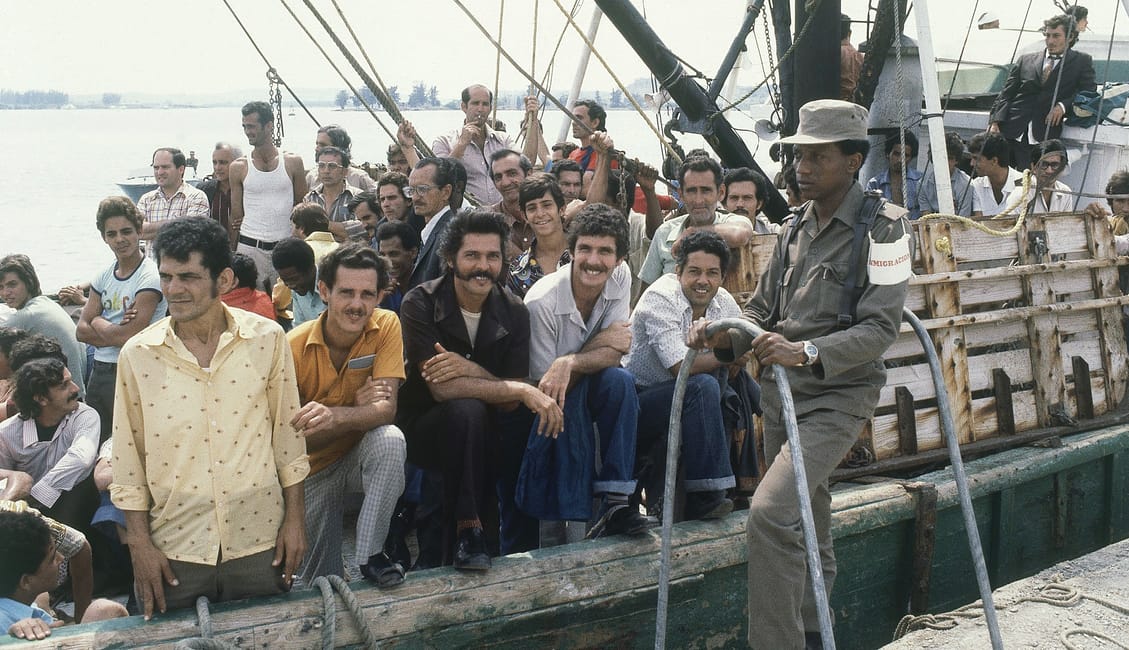
With the cancellation of the Freedom Flights in the 1970s and the entrance of Cuban emigrants from the 1980 Mariel boatlift, a shift developed in the self-perception of Cuban exiles. There was a growing sense that the Castro government was surviving for the long-term, and that their residence outside Cuba would also be long-term. With this shift came a greater involvement in American politics and the solidification of the Cuban business district in Little Havana.
The shift from temporary exile to permanent community was the precondition for everything that followed politically.
The Mariel Boatlift and the Community’s Complexity
In April 1980, Fidel Castro opened the port of Mariel, and within five months, approximately 125,000 Cubans arrived in South Florida in what became known as the Mariel boatlift. The arrival was dramatic and disruptive. Of the newcomers, 71 percent were blue-collar workers — the very people in whose name the revolution had been made. Castro also sent a group of criminals and mentally ill individuals, which proved challenging for the Carter administration.
The Mariel arrivals introduced new complexity into what had been a relatively unified exile identity. The arrival of the Mariel exiles in 1980 introduced new opinions to Miami. While many of the original exiles were motivated by their desire to reclaim property and land expropriated by the Cuban state, many of the new exiles wished to maintain contact with their families in Cuba. Their concern for the effects of the embargo on their relatives had led to a decline in support for outright opposition to dialogue with the Cuban government.
The community was becoming more diverse, more internally debated — and more politically mature. The question of how to leverage that diversity into sustained foreign policy influence would find its answer in 1981.
Jorge Mas Canosa and the CANF: Building the Machine
In January 1981, the same month Ronald Reagan took office, the Cuban American National Foundation was established. Its founder was Jorge Mas Canosa — a Cuban exile who had arrived in Miami in 1960 and built a construction empire before turning his full attention to politics.
Mas Canosa’s lobbying efforts significantly shaped U.S. foreign policy toward Cuba, contributing to key legislative acts including the Cuban Democracy Act and the Helms-Burton Act. He was known for his ability to mobilize the Cuban American vote and influence political leaders, including several U.S. presidents.
The Reagan administration strongly supported the Cuban American National Foundation, which was formed the month the president took office. The lobby built institutional ties with the administration through their ideological alignment, giving conservative Cuban-American groups growing influence and increasingly early access to information through the 1980s.
The CANF’s model was sophisticated. It combined campaign contributions, voter mobilization, media pressure, and direct access to executive branch officials in ways that gave it influence disproportionate to its actual membership. One of the most notable collaborations occurred in 1992 between the Cuban American National Foundation and Democrat Robert Torricelli.
Torricelli, whose liberal views on the embargo characterized his early career, sought election campaign funds from the CANF. He adopted a stronger anti-Castro, pro-embargo stance, secured CANF funds, and was reelected to Congress. Torricelli subsequently sponsored the Cuban Democracy Act, which was signed into law by President George H. W. Bush in 1992.
The Torricelli episode illustrated a principle that would become the CANF’s most powerful tool: the ability to change the Cuba policy positions of politicians who needed Florida. It did not matter whether a politician was Republican or Democrat, conservative or liberal. What mattered was Florida’s electoral votes, and in Florida, the Cuban-American community in South Florida was a decisive bloc.
The Helms-Burton Act: Exile Policy Written Into Law
The 1996 Helms-Burton Act represented the apex of the exile community’s legislative influence. The law, formally named the Cuban Liberty and Democratic Solidarity Act, did something unprecedented in American foreign policy: it codified the terms under which the embargo could be lifted into statute, removing significant discretion from the executive branch and locking in requirements that would prove remarkably durable.
The Helms-Burton Act of 1996 codified the economic embargo and stipulates that regime change on the island is a condition for lifting the sanctions. As Rubio stated during his 2026 Senate confirmation hearing, this requirement “is not just a political preference, but part of what U.S. law mandates.”
The act also created Title III, which allowed U.S. nationals — including Cuban Americans — to sue foreign companies that “traffic” in property confiscated by the Cuban government after 1959. This provision created a direct financial stake for the exile community in the maintenance of maximum pressure, and successive presidents suspended it until the Trump administration’s first term activated it in 2019.
By embedding the exile community’s core demands into federal statute, the CANF and its congressional allies achieved something that no amount of lobbying could have produced on its own: a legal architecture that would shape American policy toward Cuba regardless of which party held the White House.
Elián González: The Community at its Peak and its Limits
In November 1999, a five-year-old Cuban boy named Elián González was rescued from the waters of the Florida Straits, the sole survivor of a raft crossing in which his mother drowned.
His Miami relatives fought to keep him in the United States. His father in Cuba, supported by the Cuban government, demanded his return.
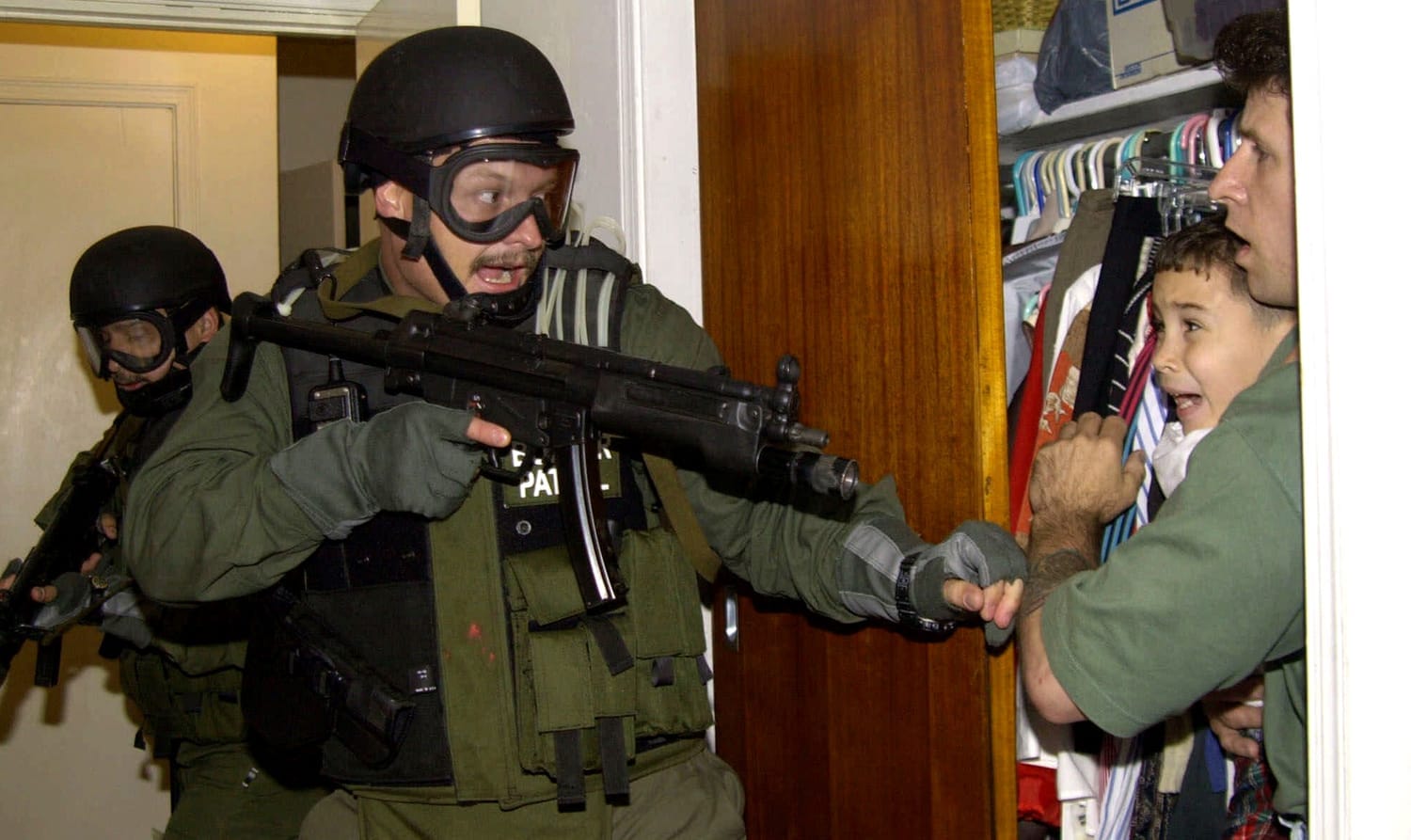
The case of five-year-old Elián González ignited a media storm. The Clinton administration was faced with deciding whether to allow the child’s Miami relatives to keep him, the course of action supported by Florida’s Cuban-American community, or to return him to his father in Cuba.
In April 2000, armed U.S. federal agents conducted a pre-dawn raid on the Little Havana home of Elián González’s relatives and flew him to a reunion with his father.
The exile community’s reaction was volcanic. The federal government’s decision to return Elián was experienced as a betrayal of the deepest kind — not merely a policy disagreement but a statement about whose suffering and whose rights Washington prioritized. The affair generated enormous anger, but it also revealed something important about the community’s political limits: it could shape legislation and influence policy over time, but it could not override a direct executive branch decision backed by federal law enforcement.
The Elián González case had negative effects on conservative influence within the Cuban-American community in the short term, contributing to shifts in the community’s internal politics and its relationship with the Democratic Party. Al Gore, who supported returning Elián to his father, lost Florida — and thus the presidency — in 2000 by 537 votes. The causal relationship is debated by political scientists, but the perception was that Gore’s Cuba policy cost him Florida — and that it would become a lesson absorbed by every subsequent presidential candidate.
The Obama Normalization and the Community’s Response
In December 2014, President Barack Obama announced a historic diplomatic normalization effort with Cuba — the restoration of diplomatic relations, the opening of embassies, and the easing of travel and trade restrictions. It was the most significant shift in U.S.-Cuba policy since the embargo was imposed, and it bypassed the legislative constraints of Helms-Burton by operating through executive authority.
Miami’s exile establishment and Cuban-American residents responded with fury. The move was experienced as a legitimization of the very government the community had spent fifty years opposing. In Little Havana, the reaction was direct: the normalization was a betrayal that rewarded a dictatorship without extracting meaningful political concessions for the Cuban people.
In Miami, President Donald Trump signed an executive order reversing some of the Obama administration’s Cuba policies in June 2017 — a symbolic act performed in the heart of the exile community, in the city where the community had built its political home, as a direct signal of whose foreign policy preferences his administration would honor.
The reversal was architected in significant measure by two Miami Cuban-American politicians who had risen through exactly the institutions the exile community had built over decades: Senators Marco Rubio and Rep. Mario Díaz-Balart.
Marco Rubio: The Community’s Product in the World's Most Powerful Office
In shops and restaurants throughout Little Havana, pictures memorialize decades of ambitious politicians sipping cafecito and donning guayaberas during pilgrimages to the vibrant Cuban neighborhood.
When they come, regardless of their party, it is expected that they share their visions for a post-communist Cuba. Exile politics are inescapable in South Florida, no matter the office on the ballot.
Marco Rubio did not simply participate in that culture. He was formed by it. In his 20s, Rubio immersed himself in exile politics. He interned in the offices of Reps. Ileana Ros-Lehtinen and Lincoln Díaz-Balart, Cuban stalwarts on Capitol Hill.
During his early political campaigns, canvassing neighborhoods where conversations about local concerns reliably turned toward Cuba’s past and future, Rubio later wrote that he discovered who he was: “I was an heir to two generations of unfulfilled dreams,” he said.
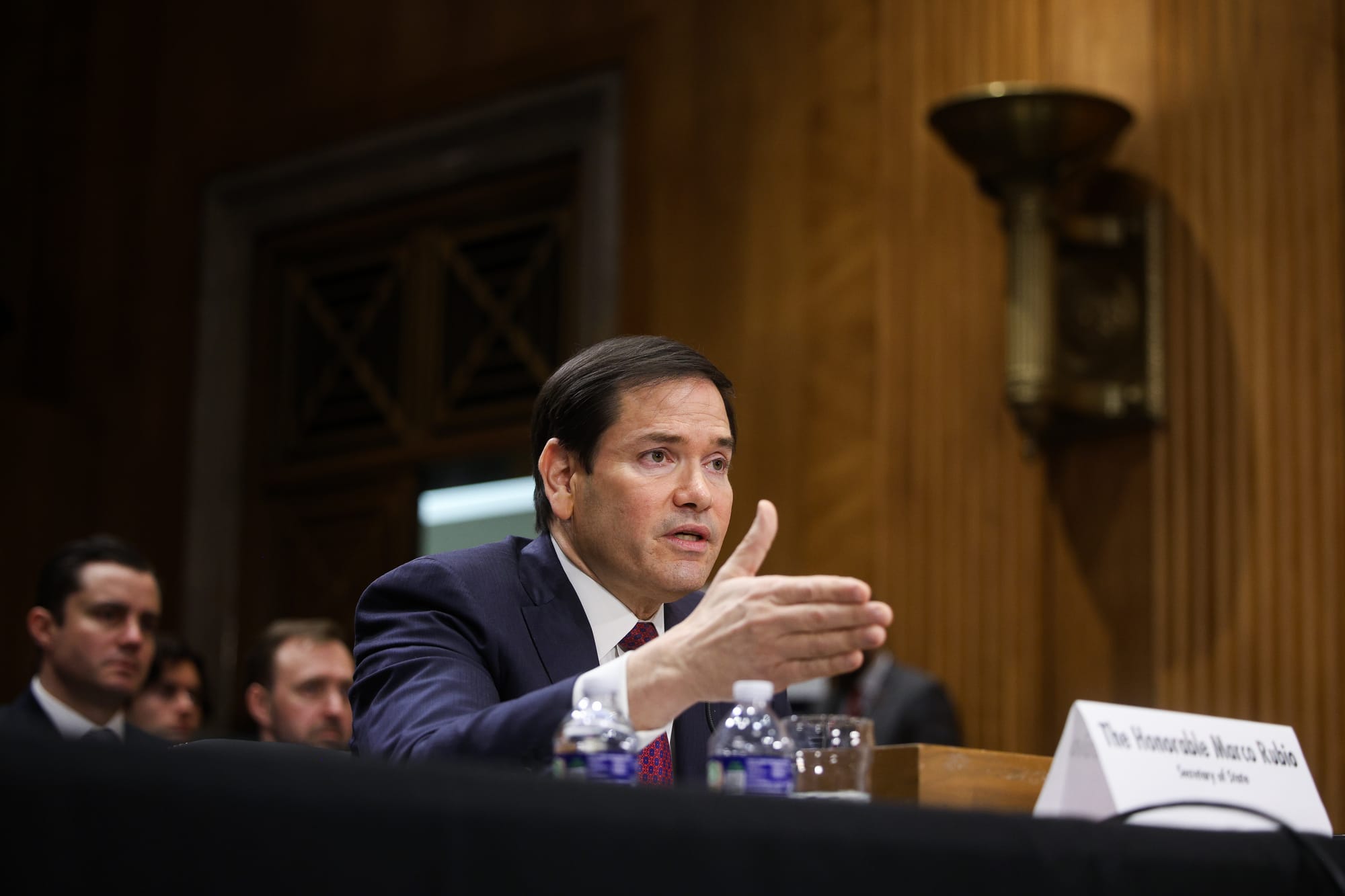
That inheritance is now the architecture of American foreign policy in the Caribbean. As Secretary of State, Rubio has developed a geopolitical vision centered around what he perceives as an axis of interconnected authoritarian regimes. The Economist has portrayed him as the architect of Trump’s policy toward Cuba, Venezuela, and Iran, with maximum pressure and ongoing negotiations as its twin instruments.
Rubio said mere hours after Maduro’s capture in January 2026: “If I lived in Havana and I was in the government, I’d be concerned at least a little bit.”
The remark was not off-the-cuff. It was the distilled expression of a worldview formed on a front porch in West Miami, refined through decades in exile politics, and now operating from the most powerful diplomatic position in the world.
The Stronghold Today: Unity, Tension, and the New Miami
The community that built this infrastructure has never been perfectly unified, and it is less unified today than at any point in the past. The ideological makeup of the Cuban-American lobby shifted after Raúl Castro lifted travel restrictions in 2013.
The group constituting the resulting exodus has been young and much more moderate than earlier groups.
The post-2021 migration wave — driven by political repression and the island’s catastrophic energy crisis — has brought to Miami a generation of Cubans with lived experience of the contemporary island, families still there, and in many cases more complex views about engagement and sanctions. They share the exile community’s fundamental rejection of the Castro-era government. But some hold more nuanced positions on the tools of opposition.
Ricardo Herrero of the Cuba Study Group puts it plainly: “If you throw a rock in Miami you’ll find several people who want to be president” of Cuba. He insists the next leaders must come from within the island. “We can plant a ruler, but there will be a massive disconnect with the ordinary Cuban.”
The CANF itself remains active. Its current leader, billionaire Jorge Mas Santos — son of founder Jorge Mas Canosa — recently declared his family’s wealth was “at the service of a free Cuba” after visiting the White House with Inter Miami C.F.
Trump reportedly told him Cubans could return “very soon.”
The encounter encapsulates the enduring nature of the relationship. Sixty-seven years after the first exiles landed in South Florida, the community their parents built is still walking into the White House, still shaping American policy toward the island ninety miles away, still holding Washington to the standard its founders established on the front porches of Little Havana.
The stronghold is still holding.


