

MIAMI — For most of the twentieth century, Latin America was defined in the global imagination by one demographic reality above all others: youth. A fast-growing, energetic, ambitious, and overwhelmingly young population was the region’s great competitive asset — a labor force in waiting, a consumer market expanding by the decade, a political constituency that would shape the hemisphere for generations.
That story is over. And it ended faster than almost anyone predicted.
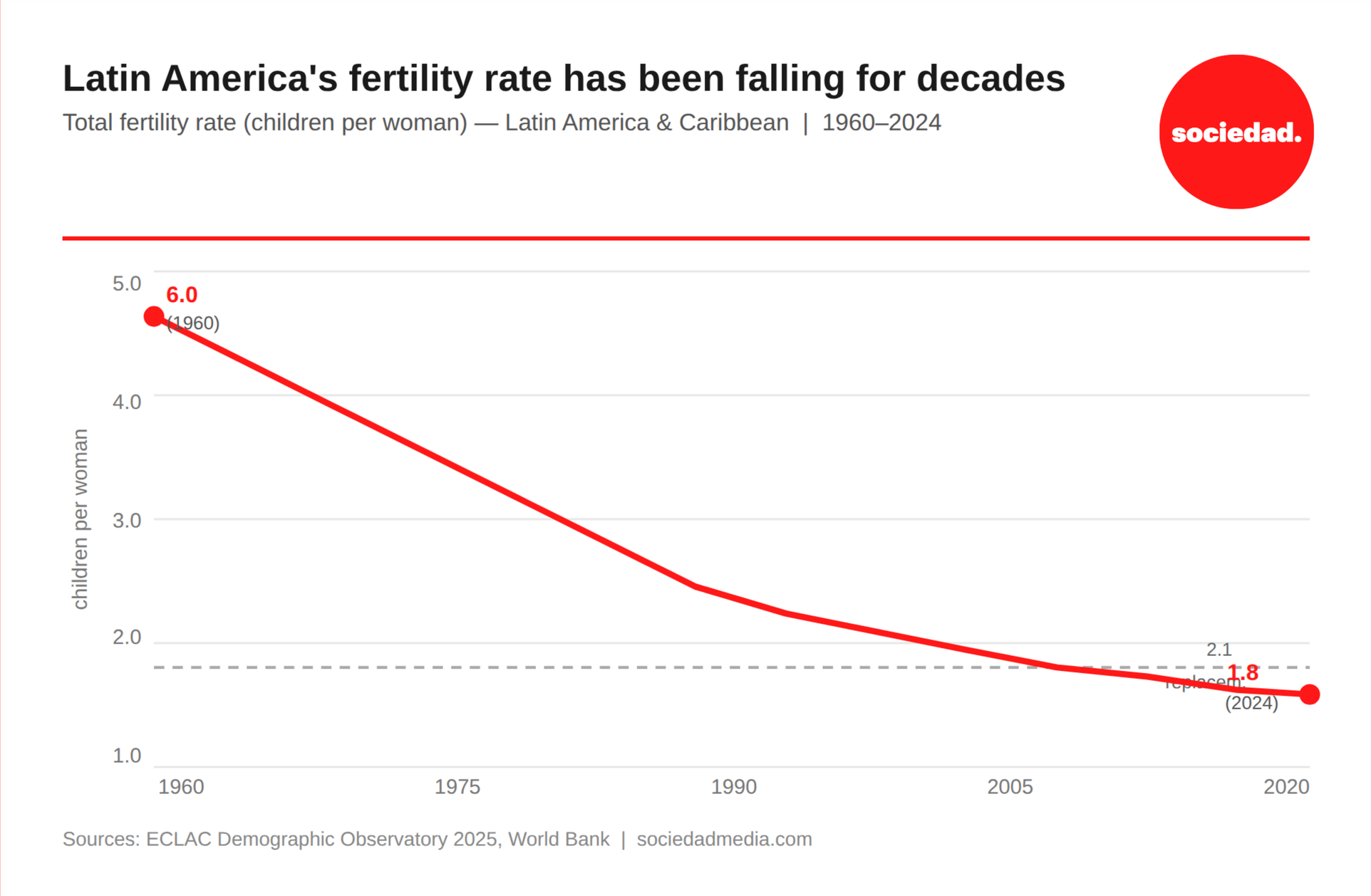
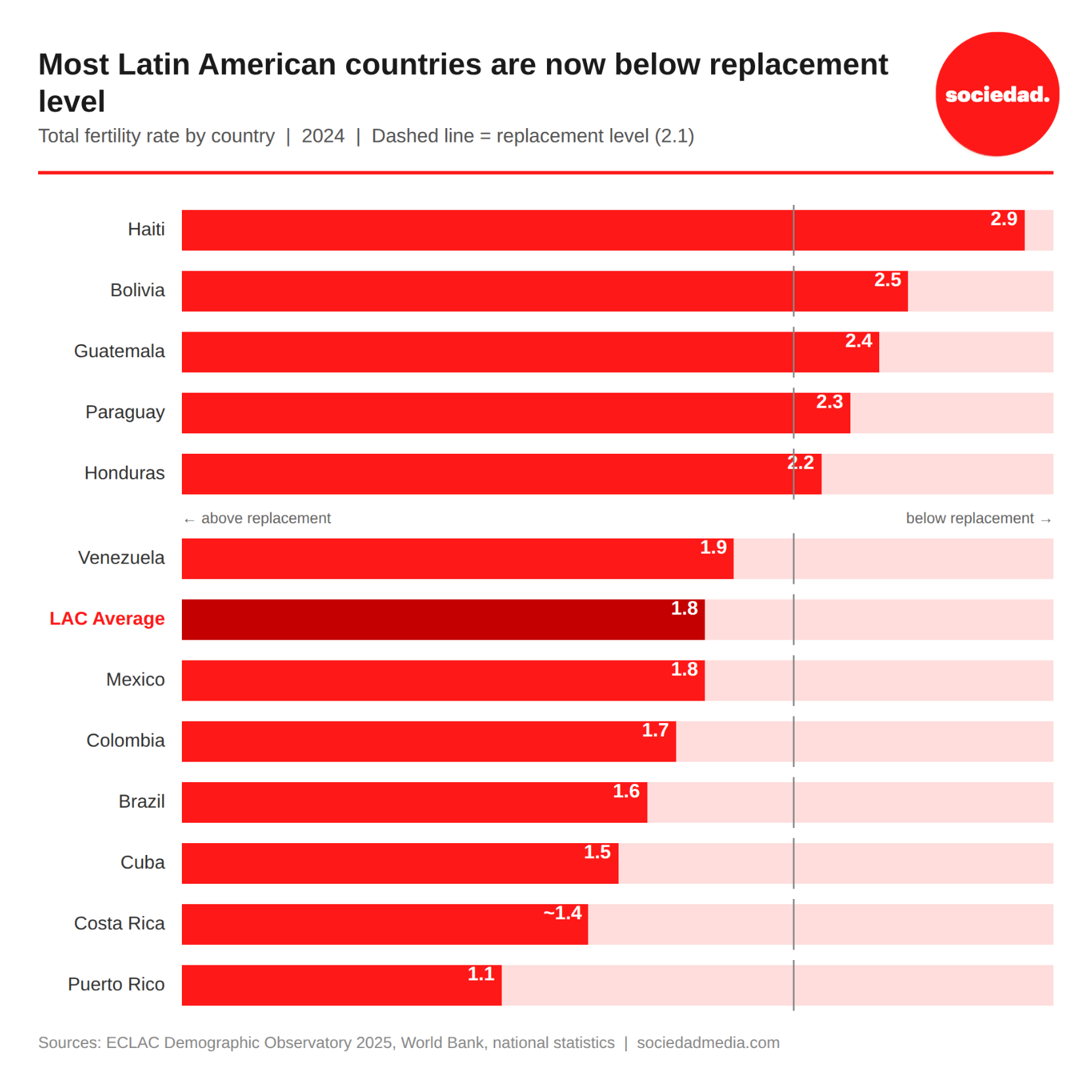
In 2024, the total fertility rate in Latin America and the Caribbean reached 1.8 children per woman — a figure that has remained below the replacement level of 2.1 children per woman since 2015. By 2024, 76% of the region’s countries and territories recorded fertility rates below that threshold, the level needed to keep a population stable in the absence of migration.
The numbers are striking on their own. What makes them genuinely alarming — and scientifically puzzling — is how fast the collapse has happened, and how poorly it was anticipated.
Faster Than Anyone Forecast
In 2024, Latin America and the Caribbean’s population reached 663 million people — 3.8% below what demographers had forecast in the year 2000, when estimates pointed to a total of 689 million. The decline was faster than anticipated, driven by a birth rate that fell more quickly than projected and compounded by migration flows and pandemic-era mortality that no model had foreseen.
The gap between projection and reality is not a rounding error. It represents tens of millions of people who were never born — and whose absence is already reshaping schools, labor markets, and pension systems across the region.
In Argentina alone, demographer Rafael Rofman has noted that his country’s fertility declined more in the previous six years than in the previous six decades. As a result, he estimates, there will be roughly 30% fewer four-year-olds entering Argentine preschools in 2024 than there were in 2020. That is not a long-term trend playing out quietly in the background. It is a structural transformation happening in real time, fast enough to be visible within a single election cycle.
Brazil tells a similar story. A 2023 census put Brazil’s population at 203 million — well below the 208 million previously estimated by the national statistics institute, and even further from the 216 million calculated by the United Nations.
The census showed that Brazil's population grew during the 2010s by just 0.52% per year — half the rate seen throughout the 2000s, and the lowest growth rate recorded since 1872.
Those missing people were not emigrants — they were never born.
The Numbers No One Can Fully Explain
The conventional explanation for falling fertility rates — rising education, greater female labor force participation, urbanization, and access to contraception — accounts for some of what is happening in Latin America. But demographers are increasingly candid that it does not account for all of it, or for the speed.
Latin American and Caribbean countries are experiencing fertility drops that are unexpected and have been difficult to explain. The declines are outpacing what standard demographic models predicted based on the region’s income levels and development trajectories.
Luis Rosero-Bixby, a demographer who founded the Central American Population Center at the University of Costa Rica, has used the word “vertiginously” to describe how births are falling in his country. Fertility among native-born women in Costa Rica is now approaching just one child per woman — a figure associated with the most demographically stressed societies in East Asia, not with a middle-income country in the tropics.
One factor that may be contributing, though difficult to quantify, is the psychological toll of sustained economic instability, political crisis, and insecurity. Across Venezuela, Haiti, Nicaragua, and Cuba — all countries that have experienced mass emigration in recent years — fertility rates have collapsed alongside social infrastructure. Young people are not choosing to have children in environments where the future feels unstable or where they plan to leave. That decision, multiplied across millions of households, shows up in the demographic data.
Inequality Inside the Numbers
The fertility decline in Latin America does not fall evenly. Studies show that lower-income women tend to have more children than they would like, while higher-income women tend to have fewer than they want.
Motherhood also widens the gap between income groups because it is more likely to be a barrier to employment for women from lower-income families, who are less likely to be able to afford childcare. Education plays a role, too, with more educated women tending to have fewer children.
This means the region faces a double bind. At the top of the income distribution, women who want children are having fewer than they desire because of economic and professional constraints. At the bottom, women are having more children than they want because of inadequate access to reproductive healthcare and family planning services.
Adolescent fertility rates in Latin America and the Caribbean remain among the highest in the world, reflecting ongoing structural inequalities and gaps in access to sexual and reproductive health services — though even here the trend is improving.
Adolescent fertility fell from 69.9 live births per 1,000 women aged 15 to 19 in 2014 to 50.3 per 1,000 in 2024, a decline of nearly 39%. The most significant gains were recorded in Argentina, Chile, Costa Rica, the Dominican Republic, Panama, and Uruguay, according to the Economic Commission for Latin America (CEPAL).
The decline in teen pregnancy is a genuine public health achievement. But it also accelerates the overall fertility decline, since adolescent births had historically inflated the region’s total fertility numbers. As that cushion disappears, the headline rate falls further.
A Region Growing Old — Fast
The downstream consequences of sustained below-replacement fertility are not abstract. They are already arriving.
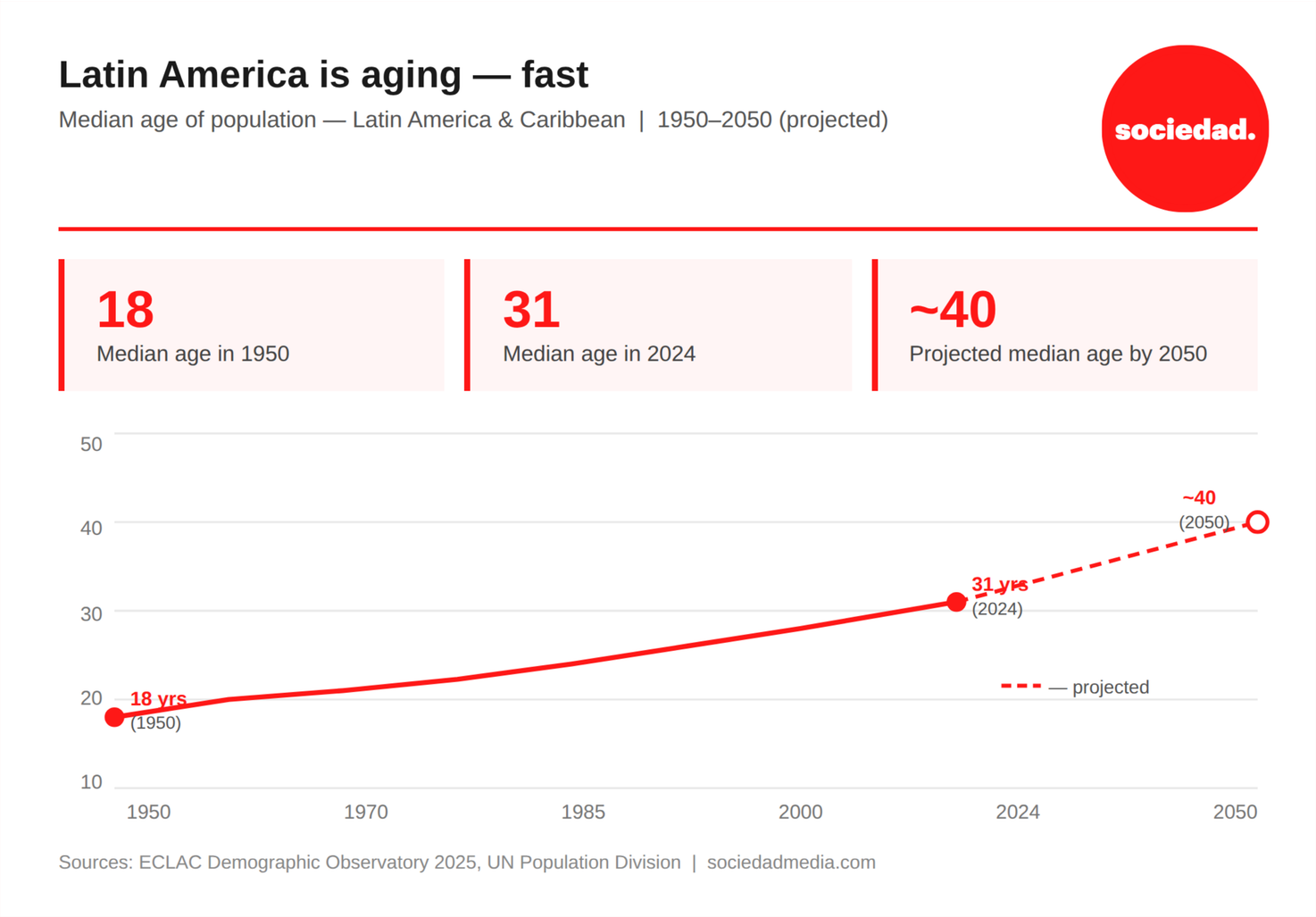
In 1950, the median age in Latin America and the Caribbean was 18. By 2024, it had risen to 31. By 2050, it is projected to reach approximately 40. That shift — from one of the world’s youngest regions to one approaching the median age of contemporary Western Europe — will compress into a single century what took Europe several centuries to experience.
In 1950, roughly 41% of the Latin American population was under 15 years of age. By 2024, that proportion had fallen to 22.5%. At the same time, the working-age population between 15 and 64 rose from 55.6% to 67.6% of the total.
This is what demographers call the “demographic dividend” — a window of time when a large working-age population supports a relatively small dependent population, creating favorable conditions for economic growth. Latin America is in that window now. The problem is that the window is closing, and the region has not fully taken advantage of it.
One prominent Brazilian demographer has warned that if current trends continue, deaths could exceed births in Brazil as soon as 2035. At that point, natural population growth ends. What follows is a society that must sustain pension systems, healthcare infrastructure, and social services with a shrinking base of working-age contributors — the same fiscal math that has strained Japan, South Korea, and Southern Europe for decades.
What does this Mean Politically?
Demographic decline has political consequences that are rarely discussed openly in Latin American policy circles, but which are beginning to register.
Pension systems across the region were designed for populations that would keep growing. Contribution bases assumed more young workers entering the labor force than retirees exiting it. That assumption no longer holds in an increasing number of countries, and the adjustments required — later retirement ages, reduced benefits, higher contribution rates — are politically toxic in societies already marked by deep inequality and institutional distrust.
Migration, historically treated as a safety valve for countries with surplus labor, is now complicating the demographic picture in new ways. Countries that have lost large shares of their young population to emigration — Venezuela, Cuba, Nicaragua, El Salvador — face compounded demographic stress: not only are they having fewer children, they are also losing the young adults who would otherwise form households and start families.
For the Miami diaspora communities that Sociedad Media serves, this dynamic is deeply personal. The Venezuelan, Cuban, and Central American families who have rebuilt their lives in South Florida represent, in demographic terms, exactly the young working-age population that their countries of origin can no longer retain. Their departure is both individually rational and collectively devastating for the societies they left behind.
An Opportunity Hidden in the Data
Not everything in the demographic shift is cause for alarm. Demographers like Rosero-Bixby and Rofman have pointed to one underappreciated opportunity embedded in the numbers.
Shrinking cohorts of schoolchildren offer governments an unexpected chance to improve educational quality. Costa Rica, which invests more than 6% of GDP in education, is projected to see its student population fall from one million in 2002 to just 320,000 in 2075. Rosero-Bixby argues that declining enrollment should allow governments to improve teacher-student ratios, extend instruction hours, and invest in teacher training — rather than continuing to build new schools for children who will not come.
That reorientation has not yet happened at scale. Education ministries across the region continue to plan for population growth that the data no longer supports. The gap between demographic reality and institutional planning is, in its own way, as significant as the fertility decline itself.
The region’s population is currently projected to peak at approximately 730 million in 2053, according to CEPAL, then begin a sustained decline. The window between now and that peak is the last period in which Latin American governments will have the demographic conditions to build the institutions, pension systems, and healthcare infrastructure that an aging society will require.
Whether they use it is the defining policy question of the next generation.
Sociedad Media will continue to cover demographic trends shaping Latin America and their impact on the region’s populations and the diaspora communities in Miami & the United States. For tips or story leads, contact the outlet at info@sociedadmedia.com


