

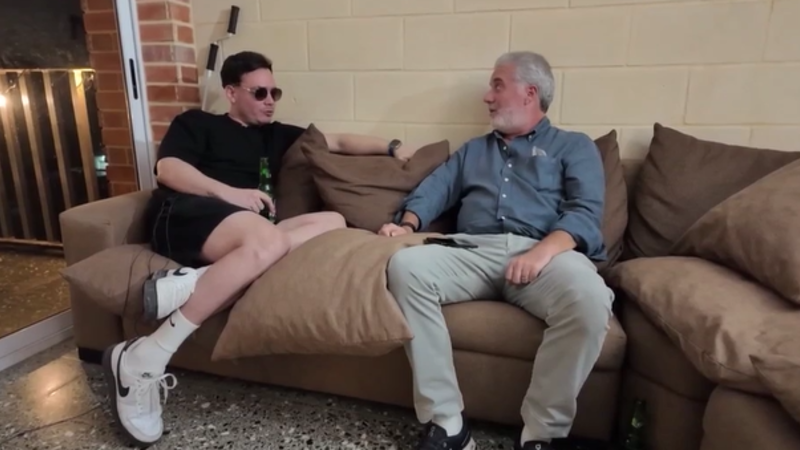
MIAMI — The lights were out across much of Havana. Outside, Cubans were navigating their third major island-wide blackout of March with candles, wood fires, and buckets of stored water. Inside a well-appointed apartment in the Kohly neighborhood—powered by a private EcoFlow battery generator, stocked with cold beer, furnished with foreign-branded appliances—a 33-year-old man in designer sunglasses sat down with CNN to explain why the revolution his grandfather built no longer works.
His name is Sandro Castro. His grandfather was Fidel, and Fidel is likely spinning in his grave over the ideals his grandson shared with the world in this viral interview.
The exclusive interview, conducted by CNN correspondent Patrick Oppmann on March 30 and published Monday night, is the most consequential thing a member of the Castro family has said in public in years—not because of its diplomatic weight, but because of what it represents: the grandson of the man who proclaimed Cuban socialism as an eternal, non-negotiable fact of national life declaring, on camera, that most of his countrymen want something different.
“I think the majority of Cubans want to be capitalist, not communist,” Sandro Castro told CNN.
Who is Sandro Castro?
Sandro Castro is one of several grandsons of Fidel Castro and his longtime partner Dalia Soto del Valle, a schoolteacher from central Cuba who lived quietly with the leader for decades. Fidel never publicly acknowledged this branch of his family—part of the carefully maintained mystique of a revolutionary who presented himself as having no private life apart from his country. The couple had five sons together: Alexis, Alex, Alejandro, Antonio, and Angel. Sandro is the son of Alexis, a telecommunications engineer.
Where the rest of the Castro family has remained intensely private, Sandro has spent years doing the opposite. He has built a following of over 150,000 on Instagram and other social media platforms— a significant number in a country where reliable internet access remains a luxury—through a stream of videos that mix satire, self-promotion, and pointed commentary on Cuba’s deteriorating conditions.
He owns nightclubs, he drives fast cars, and posts on Instagram. Pro-government bloggers have called for his arrest. Cuban state security officials have, by his own account, called him in for questioning—though he says he was released each time because he has never called for violence or regime change.
CNN described him as part of a dynasty that resembles, in his particular corner of it, something like “One Hundred Years of Solitude” meets “Keeping Up with the Kardashians.”
What He Said: The Quotes That Matter
The interview covered several subjects, and the most striking moments came in plain, direct language.
On the economic system his grandfather built and his own identity within it: “There are many people in Cuba that think in a capitalistic way. There are many people here who want to do capitalism with sovereignty.” And then, without apparent hesitation: “I think the majority of Cubans want to be capitalist, not communist,” Sandro exclaimed.
On the daily reality of life on the island during the crisis: “It’s so difficult. You suffer thousands of problems. In a day, there might not be electricity, no water. Goods don’t arrive. It’s so hard, really hard.”
He delivered these lines while his manager handed him another ice-cold beer—a detail CNN noted pointedly, given that the cold beer was itself a luxury unavailable to most Cubans that night.
On President Miguel Díaz-Canel: Sandro did not mince words. He said Díaz-Canel is not doing a good job—“because there are so many things he should have done a long time ago, so many things that weren’t done properly, and those things are now coming back to haunt us.” He did not address the structural reality that Díaz-Canel operates under the authority of Raúl Castro and the Communist Party, which limits his freedom of action considerably.
On a potential deal with Washington, Castro expressed support for economic engagement with the Trump administration, saying there are many Cubans who would welcome it. He stopped short, however, of endorsing Trump’s threats against the island. “I support his deal,” was the thrust of his position, “but not his threats.”
On his famous surname: “My name is my name. I am proud of my name logically. But I don’t see this help you are talking about. I am just one more citizen.” The interview was conducted in an apartment in Kohly—a secluded Havana neighborhood where Cuban military and intelligence officials live, and where electricity, clean water, and cold storage remain reliably available in ways they do not for the rest of the island.
On what his grandfather Fidel would make of his capitalist leanings: “He was a person who had his principles like everyone else. But he also respected others’ opinions.” It was a careful answer, and a historically contestable one—Fidel Castro’s government imprisoned, tortured, and executed thousands of Cubans whose opinions differed from his own, and from the state that he ruled over with an iron fist.
He also, in a lighter moment, asked CNN how he might obtain a U.S. visa to visit friends in Miami. He apologized for his rudimentary English, then added: “It’s like Maduro’s”—with what CNN described as a mischievous smile.
The Contradiction the Interview Puts on Display
The substance of what Sandro Castro said is genuinely remarkable given his surname. But the setting in which he said it is equally telling.
Cuba is in its deepest crisis in decades. Three nationwide blackouts in March. No significant oil shipment in three months. Cubans searching garbage bins for food, burning wood for heat, and making do without refrigeration, running water, or medical care that depends on electricity.
The UN has described the humanitarian situation as approaching collapse.
Sandro Castro conducted this interview in an apartment in one of Havana’s most exclusive neighborhoods, powered by private battery technology, cooled by appliances unavailable to ordinary Cubans, with cold beer on hand. He acknowledged having a generator—an “advantage most Cubans lack,” as one report put it—while discussing the suffering of the Cuban people in empathetic terms.
That gap between his stated solidarity with ordinary Cubans and his materially privileged position in the hierarchy his grandfather built is not lost on observers.
His family sometimes asks him to remove his more controversial posts, he told CNN. He has so far declined. Pro-government voices want him arrested. State security has questioned him. His last name, whatever he says about it, appears to have served as protection. His father, Alexis Castro, was on the phone with him, preparing talking points when CNN arrived for the interview.
“Friends in Miami”
For Miami’s Cuban exile community—hundreds of thousands of people whose families fled precisely the system Sandro Castro’s grandfather imposed—the sight of a Castro grandson calling most Cubans capitalists at heart is a complicated one.
For many, it confirms something they have always believed, and spent their lives trying to convince the world: that the revolution failed the Cuban people on its own terms, and that even its beneficiaries can see it.
For others, the credibility of the messenger matters as much as the message—and a Castro who lives comfortably in Kohly while his country goes dark is not the same as a Cuban who spent decades in exile or in prison for believing the same thing.
What the interview undeniably does is add an unexpected voice to a conversation about Cuba’s future that is already moving at historic speed. Trump has threatened to “take” Cuba. Rubio told Al Jazeera on Monday that “Cuba is next.” A Russian tanker just arrived in Matanzas. And now Fidel Castro’s own grandson is sitting in a Havana apartment, telling CNN that capitalism is what Cuba needs.
The revolution’s most famous family is not speaking with one voice. That alone is the news.
Sociedad Media will continue to monitor developing events amid the ongoing Cuban crisis and Havana’s “discussions” with officials in Washington. This story is central to our coverage. We will continue tracking every development as the island moves through its most consequential moment in decades. Write to us with questions, tips, or general inquiries at info@sociedadmedia.com—we want to hear from our readers


