

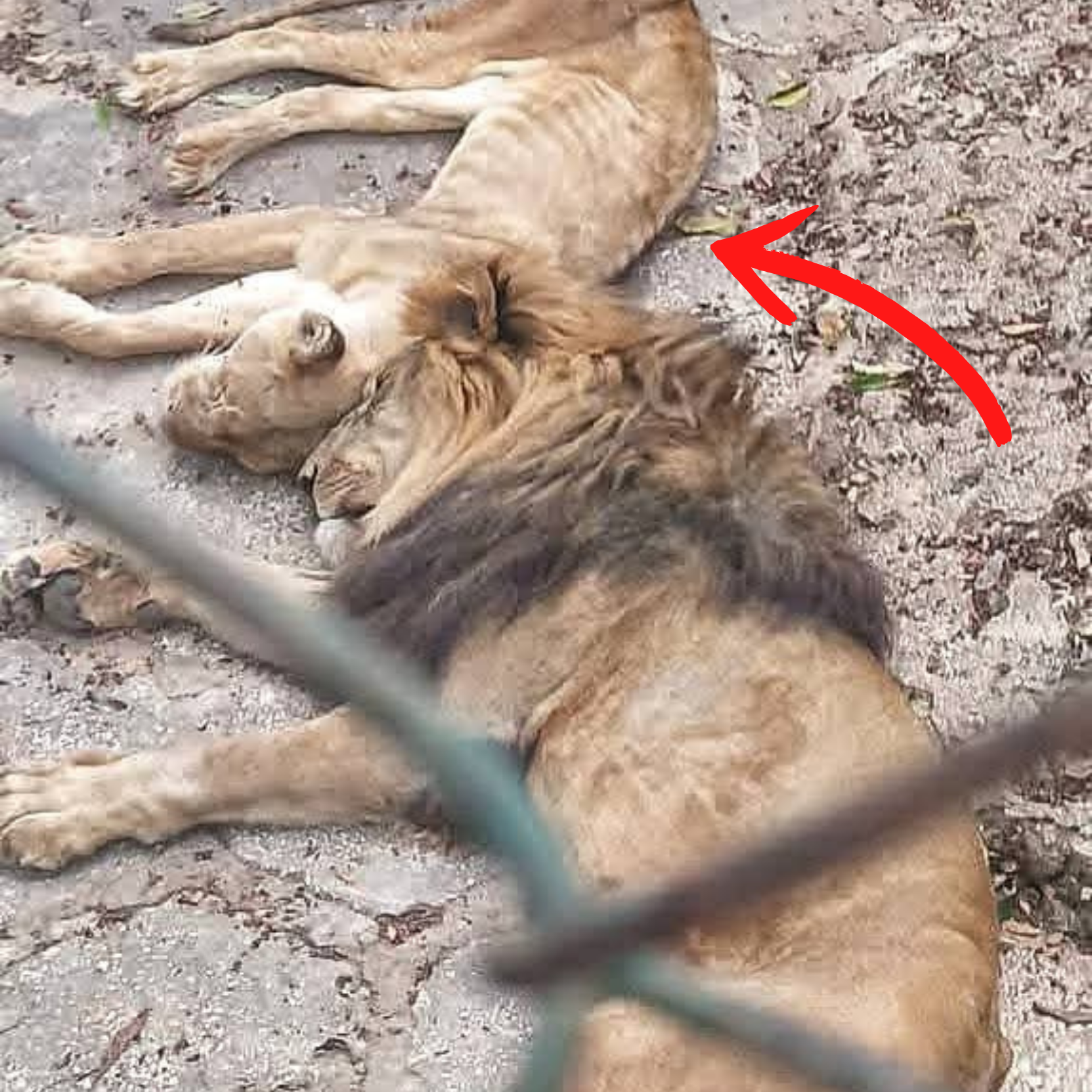
MIAMI — The photos circulating on Cuban social media are difficult to witness: three lions at the Casino Campestre zoo in Camagüey, their ribs and hip bones protruding sharply through matted fur, lying motionless on bare concrete floors covered only with scattered dry leaves and fleas.
Images diffused on social networks show three specimens — including an adult male with a mane, with ribs and hip bones visibly marked, as well as marked muscular atrophy — are revolting to users. The animals rest in conditions that visitors describe as deplorable, without vegetation or structures that replicate their natural habitat.
When concerned citizens recently attempted to feed the visibly malnourished animals, zoo officials called police to stop them. Pedro González, who shared his account on the Facebook group Revolico Camagüey, challenged the zoo director’s response when he stated, “The animals have a diet and are not hungry,” asking: “Where is that diet when the animals are starving?”
A National Pattern of Neglect
The disturbing scenes in Camagüey represent far more than isolated mismanagement. This episode is part of a documented pattern of animal neglect in zoos across the island, affecting facilities from Havana to Santiago de Cuba, revealing how Cuba’s deepening economic crisis has reached even its most captive inhabitants.
In December 2025, a lion at the Florida municipal zoo in Camagüey went eight days without food. In February 2026, the Animal Welfare Organization of Cuba (BAC) reported neglect and starvation at the Puerto Padre Zoo in Las Tunas. In January 2026, the Santiago de Cuba Zoo’s big cats were reportedly being fed scraps and were sleeping on their own waste.
The scope of the crisis extends far beyond Camagüey. At the Manzanillo zoo in Granma province, two lions named Gerardo and Karen are showing severe signs of malnutrition. Gerardo, brought from Kenya nine years ago, and his Cuban-born heir, Karen, have deteriorated dramatically from their healthier appearance in 2023.
The Economics of Animal Starvation
According to zoo experts questioned by local Cuban outlet, 14ymedio, lions require about 10 kilograms of meat, bones, offal, fish, chicken, and meat waste daily, according to Ciber Cuba. The reality falls devastatingly short of these needs. Sebastián, a worker at the Manzanillo park for years, stated: “There is not enough money here to buy food for all the animals. The Meat Company cannot provide enough meat for the lions, that’s why they are so skinny.”
The feeding schedules reveal the severity of the situation. “We can only give them two meals a day, and sometimes there is only enough for one,” workers report. In some documented cases, lions have been observed eating vegetables — one TikTok user reported seeing “a lion eating a cabbage” — highlighting the desperate shortage of appropriate nutrition for the wild animals.
Institutional Failures and Official Denial
The Casino Campestre Zoo, the largest in Cuba, hosts over 900 animals from 72 species as of 2023, managed by the Cuban National Zoo and Aquarium Enterprise. Despite this scale and official oversight, conditions continue to deteriorate.
Cuban authorities have remained silent, offering no public statements in response to these reports. When confronted directly, zoo personnel offer dismissive responses. In Santiago de Cuba, when questioned about sick animals lacking food, a zoo worker responded with just three words: “There they are,” exemplifying what activists describe as institutional indifference and the treatment of the animals as mere spectacles to the public.
Legal Framework Without Enforcement
Although Cuba enacted an Animal Welfare Decree-Law in 2021, with fines ranging from 500 to 4,000 Cuban pesos, enforcement by institutions is rare. The law exists on paper while animals suffer in plain sight of visitors and social media documentation.
Animal welfare organizations like Bienestar Animal Cuba (BAC) have attempted to gain access to facilities for independent verification, but report that the Zoo Enterprise maintains a policy of opacity while complaints mount on social and independent media.
National Zoo System in Collapse
The crisis extends to Cuba’s flagship institution. The 26 Zoo in Havana shows significant deterioration with rusty cages, empty ponds, and poorly maintained paths, as well as a clear lack of upkeep. Recent visitor reports describe “almost no carnivores” visible, with large sections of the zoo closed off, officially for repairs but likely due to lack of animals.
In recent years, the National Zoo of Cuba has felt the impact of the economic crisis affecting the country, to the point of closing its doors to visitors due to a lack of fuel. The facility, which relies on gasoline-powered buses for tours, has been forced to reduce operations to weekends only during fuel shortages.
When Human and Animal Hunger Converge
The zoo crisis has come to reflect Cuba’s broader economic collapse, where the country is undergoing a profound economic crisis, characterized by food shortages and instability in basic public services. This scarcity affects not just zoo animals but has driven desperate survival measures across Cuban society.
The dire hunger crisis has reached a point where survival takes precedence over ethical values, with families resorting to hunting wild and domestic animals as a means to eat and feed their families. The Food Monitor Program reports that chronic protein shortage has driven Cubans to desperate measures once unimaginable: poaching birds, capturing and selling cats, even using toxic chemicals for fishing in rivers, and something that has become increasingly common: consuming iguanas.
International Comparison and Expert Analysis
The conditions documented in Cuban zoos stand in stark contrast to international animal welfare standards. Professional zoo management requires consistent veterinary care, species-appropriate nutrition, and environmental enrichment—all absent from the Cuban facilities.
Veterinary experts note that the visible skeletal prominence and muscle wasting documented in photos like those revealed this week indicate severe protein-energy malnutrition that can lead to organ failure and death. The psychological stress evident in the animals’ behavior — lethargy, reduced movement, and social withdrawal — compounds the physical deterioration.
Public Response and Activism
BAC concluded its message by reaffirming its commitment to exposing every case of negligence and abuse, stating that its efforts will continue “on the side of those without a voice and those who can no longer tolerate silence.”
Citizens have organized informal assistance efforts, though these face official resistance. The contradiction highlighted by one frustrated visitor encapsulates the absurdity: “Feeding the animals is forbidden, yet letting them starve isn’t.”
Social media has become the primary platform for documenting conditions found in Cuban zoos, with viral videos and photos generating widespread outrage.
Comments reflect both anger and helplessness: “The animals are like my people in Cuba, dying of hunger,” wrote one user, while another asked, “Why don’t they let it go? Animals shouldn’t be kept like that.”
Another user put it more bluntly: “Here, the lions, too, go hungry.”
Looking Forward: An Unsustainable System
The evidence suggests Cuba’s zoo system faces an existential crisis. Without fundamental economic recovery or international intervention, conditions are likely to worsen. Animal welfare organizations have begun urging the public to boycott zoo visits, arguing that continued operations under current conditions constitute prolonged animal cruelty.
But by the appearance of emaciated lions and big cats, it appears Cuba’s zoo operations have already reached a point of failure.
The lions of Camagüey have become unwitting symbols of a broader national crisis — captive, dependent, and slowly starving while their caretakers claim everything is above board. Their plight reflects not just failed zoo management but the breakdown of institutional accountability across Cuban society.
As one social media user observed while viewing the emaciated cats: “The poor creatures don’t even have the strength to roar anymore.” In Cuba today, it seems, even the king of beasts has learned the silence of hunger.
Sociedad Media tracks human rights and institutional failures across Latin America, including the deteriorating conditions affecting both people and animals under authoritarian governance


