

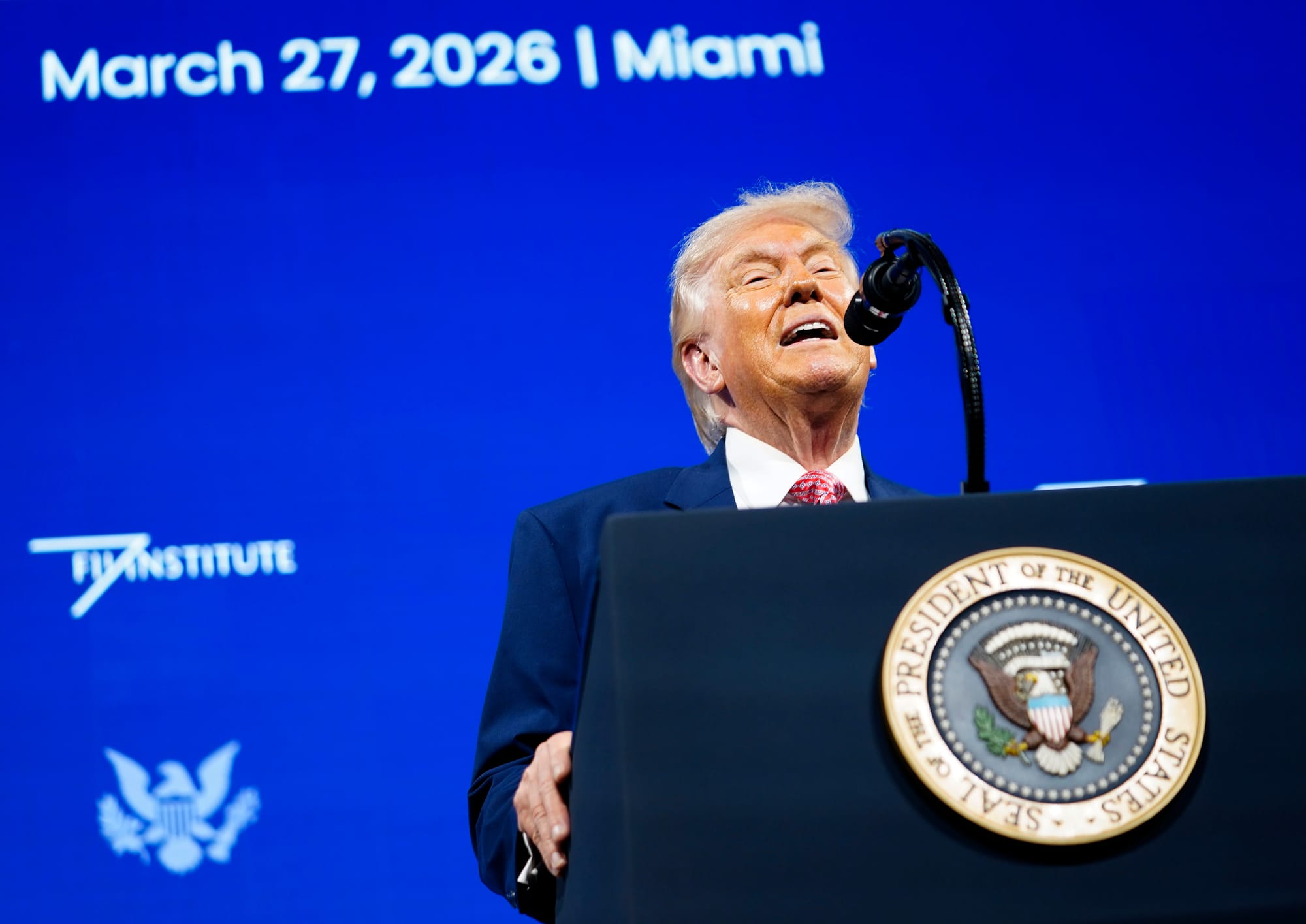
FAENA HOTEL, MIAMI BEACH — He said it from the stage of one of the most expensive investment forums in the Western Hemisphere, surrounded by Saudi sovereign wealth fund managers, global CEOs, and the kind of capital that reshapes nations. And then he immediately asked everyone to forget he said it.“And Cuba is next, by the way. But pretend I didn’t say that,” President Donald Trump joked to the crowd at the Future Investment Initiative (FII) Priority Summit at the Faena Hotel in Miami Beach on Friday.
“Please, please, please media, please disregard that statement. Thank you very much—Cuba’s next,” he said.
The FII Priority Miami 2026 summit, held from March 25 to 27 under the theme “Capital in Motion,” brought together over 1,500 participants, including business leaders, investors, and global policymakers, backed by the Saudi sovereign fund. Trump was touting what his administration frames as a string of military and geopolitical victories—the capture of Venezuelan leader Nicolás Maduro in January, ongoing negotiations with Iran—when he turned, almost as an aside, to Cuba.
The remark was casual. It was also the most direct statement yet that the island 90 miles from South Florida is next on Washington’s agenda. Nobody in the room pretended not to hear it.
The Island That Washington is Watching
The context for Trump’s remark is a Cuba in genuine crisis. The island is enduring power outages lasting up to 20 to 30 hours daily, with an electricity generation deficit exceeding 2,000 megawatts. Cuba’s GDP has fallen by 23% since 2019, with a further 7.2% contraction projected for 2026.
About 80% of Cubans believe the current crisis is worse than the Special Period of the 1990s.
The fuel situation is at its most acute since the Special Period. Cuba’s last oil shipment arrived in December, before the U.S. raid that captured Nicolás Maduro and severed Venezuela’s oil lifeline to the island. Trump has since threatened tariffs against any country—including Mexico—that attempts to resume shipments.
Russian oil has arrived in modest quantities. It has not been enough. More than 115 bakeries across the island have been converted to run on firewood or coal. Tens of thousands of surgeries have been postponed. The government has installed 955 solar panels in rural homes and social centers, with more systems expected to come online before the end of March, adding 100 megawatts to Cuba’s crumbling electric grid.
Díaz-Canel has acknowledged the obvious: “Even with everything we’re putting together, we still need oil.”
The Talks Nobody is Fully Admitting To
The most significant development in U.S.-Cuba relations in a generation is happening quietly, in Caribbean meeting rooms, between people whose names only occasionally surface in the press. Cuban President Miguel Díaz-Canel confirmed in a speech that Cuban officials had held talks with the United States, calling them the first time Havana had publicly acknowledged the meetings.
“These conversations are focused on finding solutions to bilateral differences we have between the two nations through dialogue,” he said, adding that “international factors have facilitated these exchanges.”
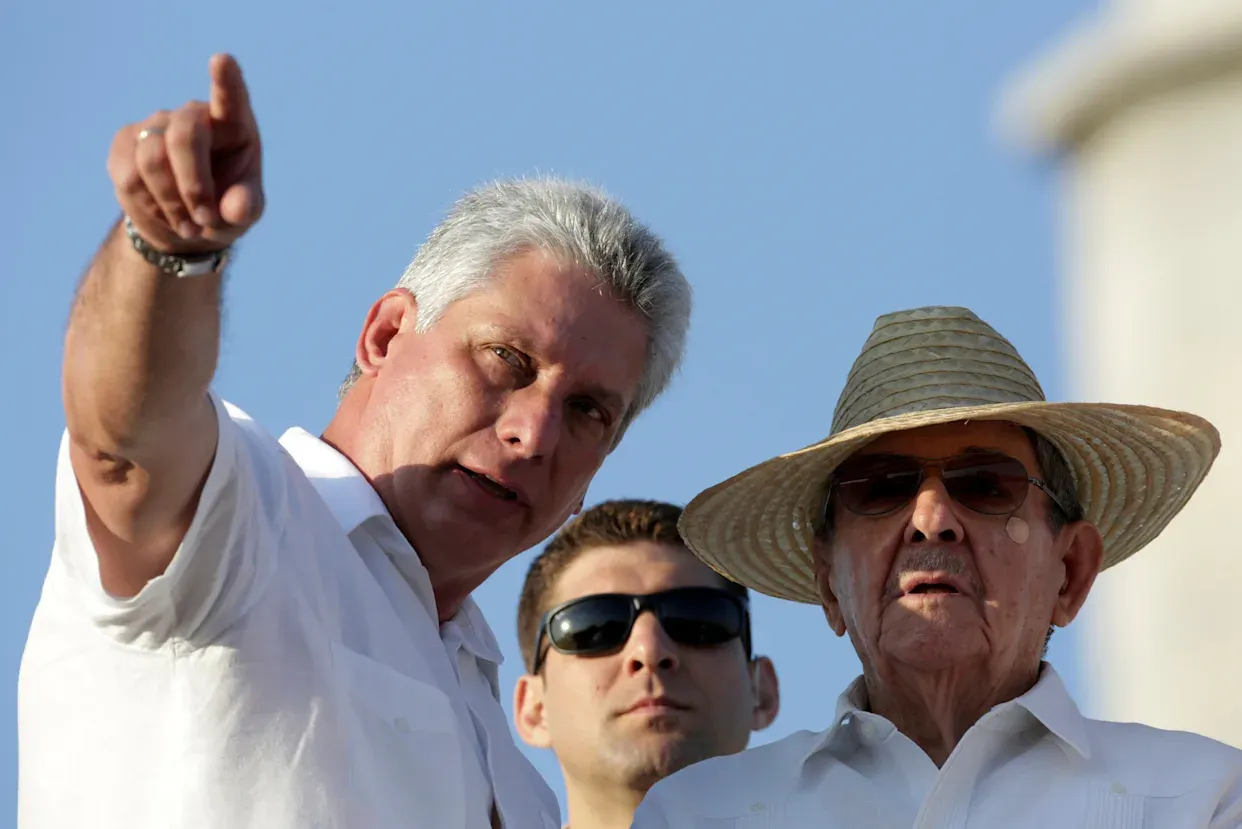
U.S. Secretary of State Marco Rubio and top aides met secretly with Raúl Guillermo Rodríguez Castro—Raúl Castro’s grandson—on the sidelines of a Caribbean Community leaders meeting, according to two U.S. officials who spoke on condition of anonymity.
Rubio declined to confirm the meeting publicly. “I won’t comment on any conversations we’ve had,” he said in St. Kitts. “Suffice it to say that the United States is always prepared to talk to officials from any government.”
Raúl Guillermo Rodríguez Castro was visible during Díaz-Canel’s remarks, sitting prominently next to the country’s deputy prime minister—a signal of his role that Havana made no effort to conceal. Díaz-Canel confirmed that Raúl Castro himself is directing the dialogue process from behind the scenes, describing him as “one of those who has directed, together with me and other institutions of the party, government and state, how we should conduct this dialogue process”—operating under the direction of the “historic leader of the revolution,” despite holding no formal office.
The 94-year-old Raúl Castro, who has not made a public appearance in years, is apparently the man Washington is really negotiating with.
What Rubio Wants. What Havana Will Not Give
The gap between Washington’s demands and Havana’s red lines could hardly be wider. Rubio has been explicit about what he believes needs to happen. “You see Cubans go all over the world and find success except in Cuba. That has to change and for that to change you need to change the people in charge, you need to change the system that runs the country, and you need to change the economic model that it’s following,” he said. “Maybe now there’s an opportunity to do it.”
Havana’s answer has been equally unambiguous. Cuba’s Vice Foreign Minister Carlos Fernández de Cossío stated categorically: “The political system of Cuba is not up for negotiation, and of course neither the president nor the position of any official in Cuba is subject to negotiation with the United States.”
Díaz-Canel, in a wide-ranging interview with Mexican newspaper La Jornada, accused Washington of acting with “fascist” logic, saying there is “a resurgence of fascism” in the international context and pointing directly at the United States as responsible for an “irrational and aggressive” policy toward the island.
He framed the oil blockade not as leverage but as collective punishment—a crime against the Cuban population rather than pressure on its government. And yet the talks continue.
Cuba Opens the Door—Just Slightly—to Miami Money
The most surprising development of the past two weeks has come not from Washington but from Havana itself. Cuba’s Deputy Prime Minister and Foreign Trade Minister Oscar Pérez-Oliva Fraga told NBC News that “Cuba is open to having a fluid commercial relationship with US companies and also with Cubans residing in the United States and their descendants.” He added, “This goes beyond the commercial sphere. It also applies to investments—not only small investments, but also large investments, particularly in infrastructure.”
The statement was extraordinary. Fidel Castro spent decades insisting that Cuban-American exile capital would never return to the island. His grandnephew, now Cuba’s economic czar, just said the opposite on American television.
Whether that opening is a genuine economic pivot or a tactical concession designed to buy time and relieve pressure is the question that Miami’s Cuban exile community—and its investment class—is now debating. The answer will define what kind of deal, if any, eventually emerges between Washington and Havana.
China’s Shadow Over the Negotiation
Any deal between the U.S. and Cuba must contend with a third party that has spent decades quietly entrenching itself on the island: China.
Trump’s January 29 executive order declared a national emergency, citing Cuba “blatantly” allowing China and Russia to “base sophisticated military and intelligence capabilities” on the island, just 90 miles from Florida’s coast.
Declassified intelligence showed Chinese signals-intelligence collection facilities had been operating in Cuba since at least 2019. A December 2024 Center for Strategic and International Studies report identified four facilities across Cuba with equipment capable of collecting signals intelligence, including the Bejucal complex south of Havana, once the Soviet Union’s largest listening station outside its borders, as well as newer facilities at Wajay, El Salao, and Calabazar.
Cuba’s southeastern position—less than 100 miles from Florida’s military bases, combatant command headquarters, and space launch centers—makes it one of the most strategically valuable intelligence platforms in the Western Hemisphere. Any normalization deal between Washington and Havana would almost certainly require Cuba to wind down Chinese intelligence operations on its soil.
Whether Havana, which has depended on Beijing’s support through decades of U.S. isolation, is willing to make that trade is among the hardest questions in the negotiation.
What Comes After Iran
Trump’s “Cuba is next” remark at the Faena was not made in a vacuum. He positioned it explicitly as part of a sequence—Iran first, Venezuela second—then Cuba—framing the island as the next stop in a hemispheric restructuring that began with the capture of Maduro in January and has continued with the military campaign against Tehran.
Cuba’s communist government has faced mounting pressure from Trump, who imposed a de facto oil blockade in January and has mused openly about “taking” the country.
Speaking at the Saudi-backed FII forum, Trump said his MAGA movement wanted “strength” and “victory,” citing the January raid where U.S. forces seized Maduro as proof of concept. Congress members Gregory Meeks and Pramila Jayapal introduced the “Preventing an Unconstitutional War in Cuba Act” to block federal funding for military actions against the island until December 31, 2026—a sign that any aggression towards the Cuban island will be viewed with disapproval from elements of the Democratic Party in Washington.
For Cuba’s 10 million residents, the stakes of what is being decided in hotel ballrooms in Miami and back-channel meetings in the Caribbean could not be higher. The pots are still banging in Havana’s streets. The lights are still going out for 20 hours at a time. And the most powerful man in the world just told a room full of investors that the island is next.
Cuba is Sociedad Media’s beat. From the blackouts to the back-channel talks to the ballrooms of Miami Beach—we cover it all. Have a tip or information connected to the island’s future? Write to us at info@sociedadmedia.com


