

On the morning of January 3, 2026, hundreds of Venezuelans poured into Parque Almagro in Santiago and wept. Nicolás Maduro had been captured. The regime that had driven eight million people from their homeland was finally, visibly falling apart. For a community that had spent years building lives in exile — learning Chilean lingo, sending remittances home, raising children who had never seen Caracas — the moment felt like the beginning of an ending.
Six weeks later, José Antonio Kast was inaugurated as President of Chile. And the relief curdled into something more complicated.
In his inaugural address on March 11, Kast said he had already ordered the military to build a physical barrier along the border with Bolivia, a regular crossing for migrants arriving on foot. In his first day in office, he launched the Shield Frontier Plan, a strategy for erecting walls five meters in height equipped with motion sensors, facial recognition, and infrared cameras, with funding for surveillance drones along Chile’s northern borders.
The message to the estimated 665,000 Venezuelans living in Chile — approximately 334,000 of them without regular legal status — was the same one Kast had been delivering since November: your days are numbered, and the Chilean state is now prepared to make good on that count.
The Campaign That Built a Mandate
Kast’s victory was not narrow. He won the December 14 runoff with over 58% of the vote, securing victories in all sixteen regions — the second-highest vote share since Chile’s transition to democracy. The margin was built on a campaign that made Venezuelan migration the central issue of Chilean politics.
Kast made the Venezuelan refugee crisis a central element of his campaign and promised strict border enforcement and large-scale deportations. Campaign pledges included building ditches on the northern border, mass deportations of illegal migrants, and constructing maximum-security prisons amid the country’s rising crime epidemic.
The language Kast used on the campaign trail was deliberately confrontational, “If you do not leave voluntarily, we will arrest you, we will detain you, we will expel you,” he told rally crowds.
During a visit to the desert border in November 2025, he was more specific: “If you don’t go on your own, we’ll detain you, we’ll expel you, and you’ll leave with only the clothes on your back.”
The polling confirmed he was reading the country correctly. A survey from polling firm Cadem found that 81% of Chileans back the expulsion of irregular migrants, while 74% favour incarceration for those who enter the country illegally. A poll published in his first week in office showed Kast with 57% approval — the highest for any Chilean president in the first week since 2010. The survey also found that 80% agreed with the implementation of the border plan.
The Shield Frontier Plan in Practice
On his first day in office, Kast signed executive orders targeting what his government calls a national emergency. He traveled to the frontier area of Chacalluta to oversee construction. “We have made clear and concrete decisions to close our border to illegal immigration, drug trafficking, [and] organized crime,” Kast told reporters. “We want to warn them that Chile will confront them with the full force of the state, with the full force of the law.”
Beyond physical fortifications, Kast’s administration is pursuing international agreements forcing countries of origin to accept expelled citizens, with economic and diplomatic retaliation threatened if they refuse.
The plan also targets organizations that obstruct deportations or encourage irregular migration. On migrants already in Chile, the government will prohibit remittance transfers and ban hiring or renting to undocumented foreigners.
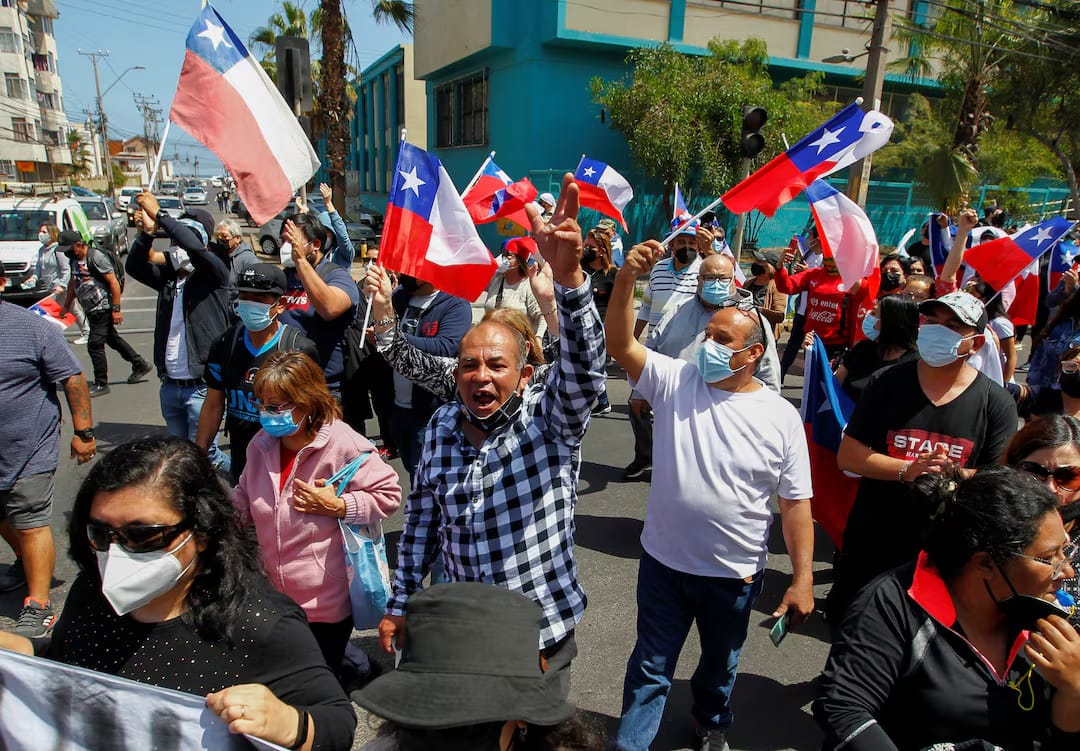
The remittance prohibition is particularly consequential. Venezuelan migrants in Chile send hundreds of millions of dollars annually to families in Venezuela — a financial lifeline for households surviving the island's economic collapse. A ban on those transfers would effectively sever the economic relationship that has made migration to Chile viable and would place enormous pressure on undocumented Venezuelans to either regularize their status or leave.
In January, Kast singled out Venezuelans specifically on Canal 5 Noticias, saying illegal Venezuelans’ “days were numbered” as he promised an unprecedented ramp-up of deportation orders.
The Humanitarian Corridor That isn’t
In the weeks following his election victory, Kast pursued what he described as a regional diplomatic solution. One of the most significant proposals raised by the incoming government was the creation of a “Regional Humanitarian Corridor” — a secure route allowing irregular Venezuelan migrants to leave Chile and transit through Peru and Ecuador without settling, either to return to Venezuela or continue to other destinations.
The proposal found partial receptivity in Argentina, where President Javier Milei shares Kast’s ideological orientation and political urgency on migration. It found considerably less in Peru.
Peru’s president dismissed the proposal outright, saying “the option of a humanitarian corridor has been ruled out.” When Kast was asked about Peru’s rejection at a press conference, he responded simply: “Everything will be fine.”
The regional cooperation Kast envisioned has not materialized in the form he promised, leaving the deportation agenda dependent primarily on bilateral arrangements with Venezuela’s transitional Rodríguez government, which has signaled willingness to accept returning citizens but has not committed to the logistical framework that would make mass returns workable.
The Venezuelan Paradox
The situation creates a painful paradox for Chile’s Venezuelan community. Kast enthusiastically welcomed the U.S. intervention in Venezuela, describing the capture of Maduro as “great news.” He has publicly aligned himself with the Venezuelan opposition’s democratic aspirations. Yet his government is simultaneously implementing policies that threaten the legal security and economic survival of the very Venezuelans whose political cause he claims to support.
María Corina Machado visited Santiago in mid-March, rallying 17,000 Venezuelans in the streets — the largest public demonstration she had attended since leaving Venezuela. “Santiago is overflowing with us, my Venezuelans,” she told the crowd as they chanted “María Presidente.”
But when asked whether she had discussed with Kast how Chile can support Venezuelans who have fled the country, she said she had not yet had that conversation.
The silence between Machado and Kast on the fate of the Venezuelan diaspora in Chile is notable. The two share ideological alignment on Maduro, on socialism, and on the desirability of a democratic Venezuela. On the question of what happens to 334,000 undocumented Venezuelans in Chile right now, they are operating on separate tracks without a common answer.
A Closer Look
An estimated 336,984 foreigners live in Chile without legal paperwork, according to government figures. The majority — some 252,591 — come from Venezuela. The influx has coincided with the expansion of transnational criminal networks like Venezuela’s Tren de Aragua inside Chilean territory, which has gained a foothold in the north.
But at the same time, according to Tomás Hirsch, a member of Chile’s Chamber of Deputies, “migrants have essentially been used as a scapegoat for the underlying issues that truly trouble the Chilean people, such as housing and the rising cost of living. The political rhetoric pushed by Kast and his party bears little resemblance to reality, as the vast majority of migrants commit no crimes,” Hirsch argued.
However, a recent 2025 study by Chile’s Center for the Study of Organized Crime documented a major increase in organized criminal activity across the country, with human trafficking concentrated in the north. Venezuela’s Tren de Aragua, along with local Peruvian gangs and Colombian smuggling and extortion networks, has taken a strong foothold.
Unfortunately, the genuine presence of criminal networks among migrant flows has provided political cover for policies that affect the overwhelming majority of Venezuelan migrants who came seeking work, safety, and a future for their children.
The Congressional Constraint
Kast’s agenda faces a structural obstacle that may limit how much of his rhetoric translates into policy. His coalition controls 76 of 155 seats in the lower house and 25 of 50 in the Senate — both short of majorities. The centrist Party of the People, with 14 pivotal votes in the lower house, will likely demand concessions before backing the border wall and deportation plans.
The physical construction of the border barrier — ordered by executive decree on his first day — does not require congressional approval. The broader legislative agenda, including criminalization of irregular entry, special prisons for migrant offenders, and the remittance ban, will require negotiation with a legislature that does not share the coalition’s majority.
What it Means for the Diaspora
For the hundreds of thousands of Venezuelans in Chile who are watching all of this unfold, the situation is one of profound uncertainty. Maduro is gone, but the Venezuela they fled has not yet become the Venezuela they hope to return to.
As one Venezuelan man in Santiago, who has worked at a burger restaurant since arriving years ago, put it: “Maduro’s gone, but I’ve come too far to go back. For now, regardless of the political situation in Chile, I must stay and try to provide for my family.”
That calculation — stay and endure, or leave for a Venezuela that is not yet stable enough to return to — is what approximately 334,000 undocumented Venezuelans in Chile are making right now, every day, under a government that has made their expulsion the centerpiece of its mandate.
President Kast’s Shield Frontier Plan is currently under construction. Sociedad Media will continue to monitor developments in Chilean migration policy and their impact on the Venezuelan diaspora in South America. Tips and firsthand accounts: info@sociedadmedia.com


