

BOGOTÁ — Sixty-nine Colombian soldiers were killed on Monday when a U.S.-donated military transport plane crashed moments after takeoff from a remote airstrip in the country’s southern Amazon, in one of the deadliest aviation disasters in the history of Colombia’s armed forces—and the political fallout landed almost as fast as the wreckage.
The C-130 Hercules aircraft broke into pieces on impact and caught fire after going down near Puerto Leguízamo, a town in the Putumayo region that borders Peru. Of the 126 people on board, 113 were members of the army, two were police officers, and 11 were crew members.
Burning wreckage spread across parts of the jungle. The post-crash fire detonated ammunition being carried on the plane, causing a series of explosions through the debris. Military vehicles and trucks eventually reached the area to support rescue efforts, while two aircraft equipped with 74 beds were dispatched to transport the injured to hospitals across the country.
The cause of the crash has not been determined. Defense Minister Pedro Sánchez said there was no indication of an attack by criminal groups, and that the plane was in airworthy condition with a duly qualified crew at the time of the accident.
Petro Blames the U.S.—and His Predecessor
Before investigators had reached a conclusion, President Gustavo Petro had already reached his own.
Petro blamed his predecessor, Iván Duque, for having accepted what he characterized as a “junk” plane from the United States, writing on X and questioning the logic of the arrangement: “Extremely expensive gifts. The maintenance costs more than a new plane—and how much are the lives lost worth?” Adding, “Question: Why did you buy a plane with 43 years of service?” He added that he had requested the replacement of the Hercules fleet a year ago.
Duque fired back, calling Petro “vile and unintelligent” and urging him to focus on the facts of the investigation rather than political point-scoring.
Aviation analysts pushed back on Petro’s framing. Colombian aviation expert and military analyst Erich Saumeth noted that the crashed aircraft had undergone a detailed overhaul three years after its 2020 donation, during which its engines were inspected and key components replaced. “I don’t think this plane crashed because of a lack of good parts,” Saumeth said, adding that investigators would need to determine why the engines failed so quickly after takeoff.
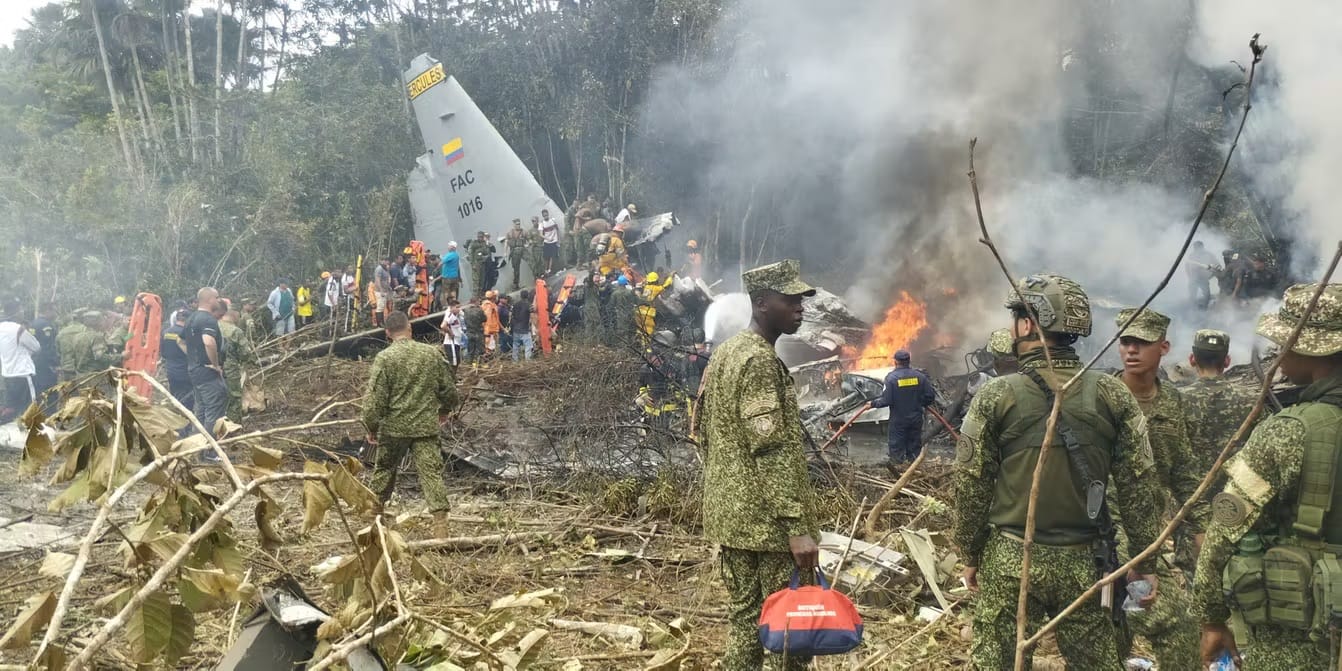
C-130 Hercules planes have been in Colombian service since the late 1960s, when the country acquired its first models. More recently, Colombia has updated parts of its aging fleet with used aircraft transferred from the United States under a provision that allows for the transfer of surplus military equipment.
The aircraft that crashed on Monday was the first of three planes delivered by the U.S. to Colombia in recent years under that framework.
A Long Partnership—Now Under Strain
The C-130 donation is not an isolated transaction. It sits within one of the most extensive military cooperation relationships in the Western Hemisphere—one that has been severely strained since Petro took office in 2022 and has lurched from crisis to crisis with his U.S. counterpart in Washington.
Colombia holds the designation of Major Non-NATO Ally of the United States—a status shared by only a handful of countries, including Australia, Japan, and Qatar. Washington has provided Bogotá with roughly $14 billion in military and security assistance over the past two decades, with Colombia serving as the cornerstone of the U.S. counternarcotics strategy in the region and the main source of intelligence used to interdict drugs in the Caribbean.
That partnership produced real results over decades. Plan Colombia—the landmark bilateral security program launched in the early 2000s—helped the Colombian military dismantle major drug trafficking networks, reduce homicide rates, and roll back the operational reach of FARC guerrillas. U.S. intelligence, training, and equipment were central to that effort. The C-130 fleet, used to transport troops across Colombia’s vast and roadless interior, has been an operational backbone of that mission.
The Trump-Petro Collision
What should be a straightforward military equipment story lands in 2026 in the middle of a diplomatic relationship that has never been more volatile.
The past year has seen the relationship between the two governments careen from crisis to crisis. In January 2025, Petro refused to accept deportees from the United States, only to back down after Trump threatened to levy crippling tariffs.
In September 2025, Petro made a speech at the United Nations General Assembly calling on U.S. troops to disobey Trump's orders—a moment that led Washington to revoke the Colombian president’s visa.
Following the U.S. military operation that captured Venezuela’s Nicolás Maduro in January, Trump called Colombia “very sick” and accused Petro of being “a sick man who likes making cocaine and selling it to the United States.” When a reporter asked whether a U.S. operation against Colombia was possible, Trump responded: “Sounds good to me.”
Colombian officials scrambled, making frantic calls to Republican members of Congress to help broker a phone call between the two leaders. The resulting 55-minute conversation produced a dramatic de-escalation, with both leaders praising each other and announcing plans for a White House meeting in February.
But the détente was fragile. Foreign Affairs assessed the situation plainly: conflicting ideologies and worldviews have created an unbridgeable gulf of mistrust and animus between the Petro and Trump administrations—with both sides appearing to welcome the confrontational dynamic.
Petro’s decision to direct Monday’s crash toward criticism of U.S. military equipment is consistent with that pattern. For a president in his final months in office—Colombia’s August elections will replace him with a successor—the crash offers one more opportunity to frame Washington as a source of harm rather than partnership.
What Comes Next
The investigation into the crash is underway, and its findings will determine whether Monday’s tragedy becomes a genuine reckoning with fleet modernization or a political flashpoint in an already combustible relationship. Colombia’s presidential candidates across the center and right have already stated their intention to repair the bilateral relationship and strengthen security cooperation with Washington after Petro’s term ends.
The crash—and how both governments handle its aftermath—will be an early test of whether that reset is possible.
For the families of 69 soldiers killed in a jungle clearing in Putumayo, the geopolitics are secondary. They lost someone on a transport flight that should have been routine—on a plane that has been flying these routes, in various forms, since the 1960s.
Sociedad Media will continue to monitor the investigation into the C-130 crash and developments in U.S.-Colombia relations. Have a tip or a story connected to the crash or Colombia’s security forces? Reach out at info@sociedadmedia.com


