

MIAMI — The story that began Friday morning with a New York Times report of two early-stage DOJ investigations into Colombian President Gustavo Petro escalated dramatically by Friday afternoon: the Associated Press confirmed, based on DEA documents reviewed directly by reporters, that Petro has been formally designated a “priority target” by the U.S. Drug Enforcement Administration—a legal classification that places the sitting president of one of Washington’s most important counter-narcotics partners in the same investigative category as cartel leaders.
Petro’s response was immediate, categorical, and defiant. Colombia’s Embassy in Washington called the reports baseless. And the political consequences—arriving 73 days before Colombia’s presidential first round—are only beginning to unfold.
What the AP Confirmed: DEA ‘Priority Target’
Colombian President Gustavo Petro has been designated a “priority target” by the U.S. Drug Enforcement Administration as federal prosecutors in New York probe his alleged ties to drug traffickers, according to people familiar with the matter and records seen by the Associated Press.
DEA records show Petro has surfaced in multiple investigations dating back to 2022, many based on interviews with confidential informants. The alleged crimes the DEA has investigated include his possible dealings with Mexico’s Sinaloa Cartel and a scheme to leverage his “Total Peace” plan to benefit prominent traffickers who contributed to his presidential campaign.
In recent months, prosecutors in Brooklyn and Manhattan have been questioning drug traffickers about their ties to Petro—specifically about allegations that the Colombian president’s representatives solicited bribes to block their extradition to the United States. The investigation is focusing at least in part on allegations that representatives of Petro solicited bribes from drug traffickers at the Colombian jail La Picota in exchange for a promise that they would not be extradited to the U.S., according to reports.
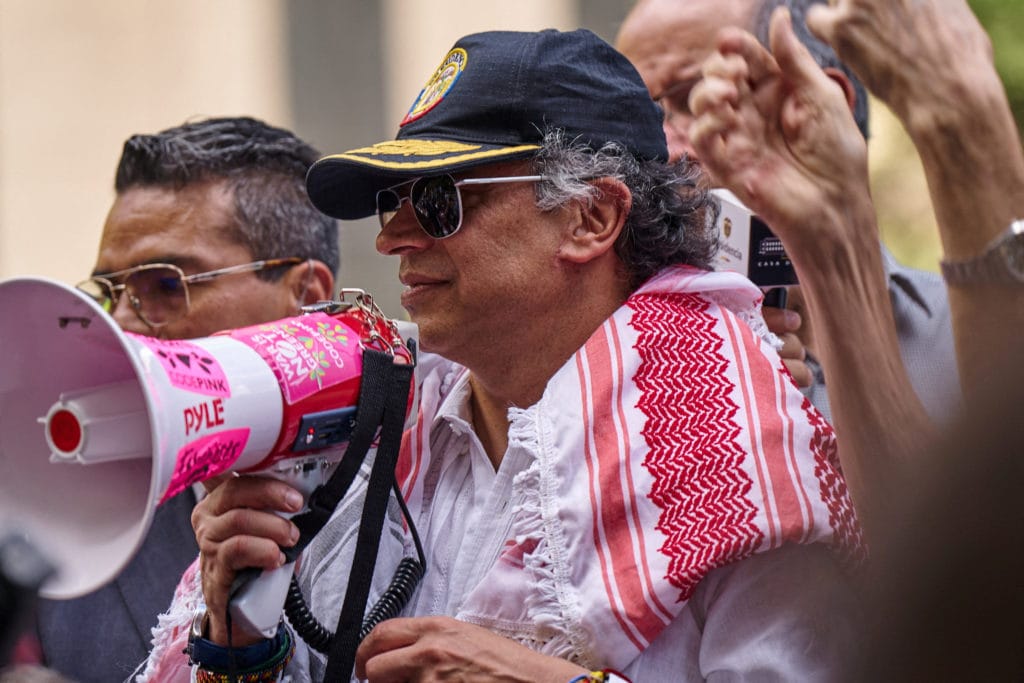
The DEA records also cite a 2024 interview with an unnamed source who claimed Petro is utilizing former campaign aides and officials from the state-run oil company Ecopetrol to launder presidential funds into foreign countries for Petro’s use upon completion of his presidency.
Ecopetrol President Ricardo Roa vehemently denied the allegations, saying they “lacked all reality or logic.”
The inquiries into Petro are in the early stages, and it is not clear whether they will result in charges. One person familiar with the matter added that the White House has had no role in the investigations.
The Sinaloa Connection and M-19 History
The DEA records reviewed by the AP point to Petro’s possible involvement with a range of criminal groups that have dominated the South American drug trade for years—including Mexico’s Sinaloa Cartel as well as the Cartel de los Soles, a term used to describe a loose network of corrupt, high-ranking military officers in neighboring Venezuela.
The now-defunct urban guerrilla group Petro belonged to, the 19th of April Movement—or M-19—has long been suspected of taking money from Pablo Escobar’s Medellín cartel as part of its deadly siege of the Supreme Court in 1985. Petro did not participate in the attack, which left several guerrillas and around half the high court’s magistrates dead. Leaders of the group have always denied any links to the cartel.
The historical connection—however unproven as it pertains to Petro personally—gives Washington’s investigators a documented institutional context for the current allegations that Petro’s defense will find difficult to entirely dismiss.
Petro’s Response: ‘Never In My Life’
Petro took to X Friday to issue his most direct denial of the allegations to date, writing in Spanish:
“As well known by El Espectador, in Colombia there is not a single investigation into my relationship with drug traffickers, for one reason: never in my life have I spoken to a drug trafficker. On the contrary, I dedicated ten years of my life, at the risk of my existence, and it caused my exile.”
He added, “As for my campaign, I’ve always told managers not to accept donations from bankers or narcos. The intensive and productive investigation on my presidential campaign did not discover a single peso from drug-traffickers because such is my principle as a political leader.”
He argued on X that U.S. legal proceedings would ultimately dismantle accusations from the Colombian far right—a group he claims is itself the one with actual cartel connections.
Colombia’s Embassy in Washington was equally categorical in its denial, issuing a formal statement describing the reports as “unverified” and based on anonymous sources. “The reported insinuations have no legal or factual basis,” the embassy said.
A spokesperson for the Colombian presidency declined to comment on the ongoing investigations directly.
The Timeline of U.S. Pressure on Petro
Friday’s revelations did not emerge from nowhere. They are the culmination of an escalating U.S. pressure campaign against Petro that began in earnest following Trump’s return to office in January 2025.
Trump labeled Petro an “illegal drug leader,” and the Treasury Department sanctioned him in late 2025 for alleged ties to the drug trade—without publicly offering evidence at the time.
Petro called the sanctions “a complete paradox,” writing: “Fighting drug trafficking effectively for decades has brought me this action from the government of the society we have worked so hard to protect from cocaine consumption. Not a single step back and never on our knees.”
Their feud came to a head in January 2026 after the U.S. struck Venezuela and captured its president, Nicolás Maduro. Shortly afterwards, a reporter asked if the U.S. would take military action against Colombia. Trump replied: “It sounds good to me.” A subsequent White House meeting in early February—attended by Secretary of Defense Hegseth, Secretary of State Rubio, and Republican Senator Bernie Moreno—produced an apparent diplomatic reset.
The Electoral Dimension—Colombia Votes in 73 Days
The timing of the DEA designation revelation—published simultaneously by the New York Times and confirmed by the Associated Press on the same Friday—is politically extraordinary.
Colombia’s presidential first round is on May 31. The congressional elections that took place on March 8—twelve days ago—already produced Paloma Valencia’s landslide right-wing primary victory. Friday's revelations land at the precise moment that Colombia’s presidential campaign is entering its most intensive phase.
Petro, Colombia’s first left-wing president, is limited to a single term. But the election is likely to be a referendum on his four years in office and a test for his Historic Pact coalition, whose candidate Iván Cepeda is currently leading in presidential polls.
A DEA “priority target” designation against the incumbent president—however legally preliminary—is a political weapon that every candidate running against the Petro movement will use in the 73 days remaining before voters decide.
Whether the investigations are driven by genuine law enforcement concerns or represent the weaponization of U.S. prosecutorial machinery for geopolitical ends—as Petro and his allies insist—is a question that Colombian voters will have to answer at the ballot box before any federal courtroom renders its own verdict.


