

MEXICO CITY — The crisis had been weighing on the hearts of hundreds of thousands of mothers and loved ones of the disappeared in Mexico for decades, and the pain had been silently blunted — concealed in the darkness of ignorance until last Thursday, in Geneva, when a United Nations treaty body did something it had never done before in its history.
The UN Committee on Enforced Disappearances requested that the UN Secretary-General urgently refer the situation of enforced disappearances in Mexico to the UN General Assembly for consideration of measures to support the state in preventing, investigating, punishing, and eradicating this crime.
The decision was not made hastily. The committee activated the Article 34 procedure in April 2025 — for the first time in its history — after years of monitoring, a 2022 visit to Mexico, numerous urgent action requests, and demands from dozens of Mexican victims’ collectives.
Then, in July 2025, the committee asked the Mexican state for additional information. Based on the information received, on April 2, 2026, the committee decided to bring the issue urgently before the General Assembly.
The finding at the heart of the decision is unambiguous. The CED concluded it had received well-founded indications that enforced disappearances in Mexico have been and continue to be committed as crimes against humanity.
President Claudia Sheinbaum’s government called the report biased and rejected its conclusions. The mothers, still searching for their children, called that response a condemnation.
The Scale of the Tragedy
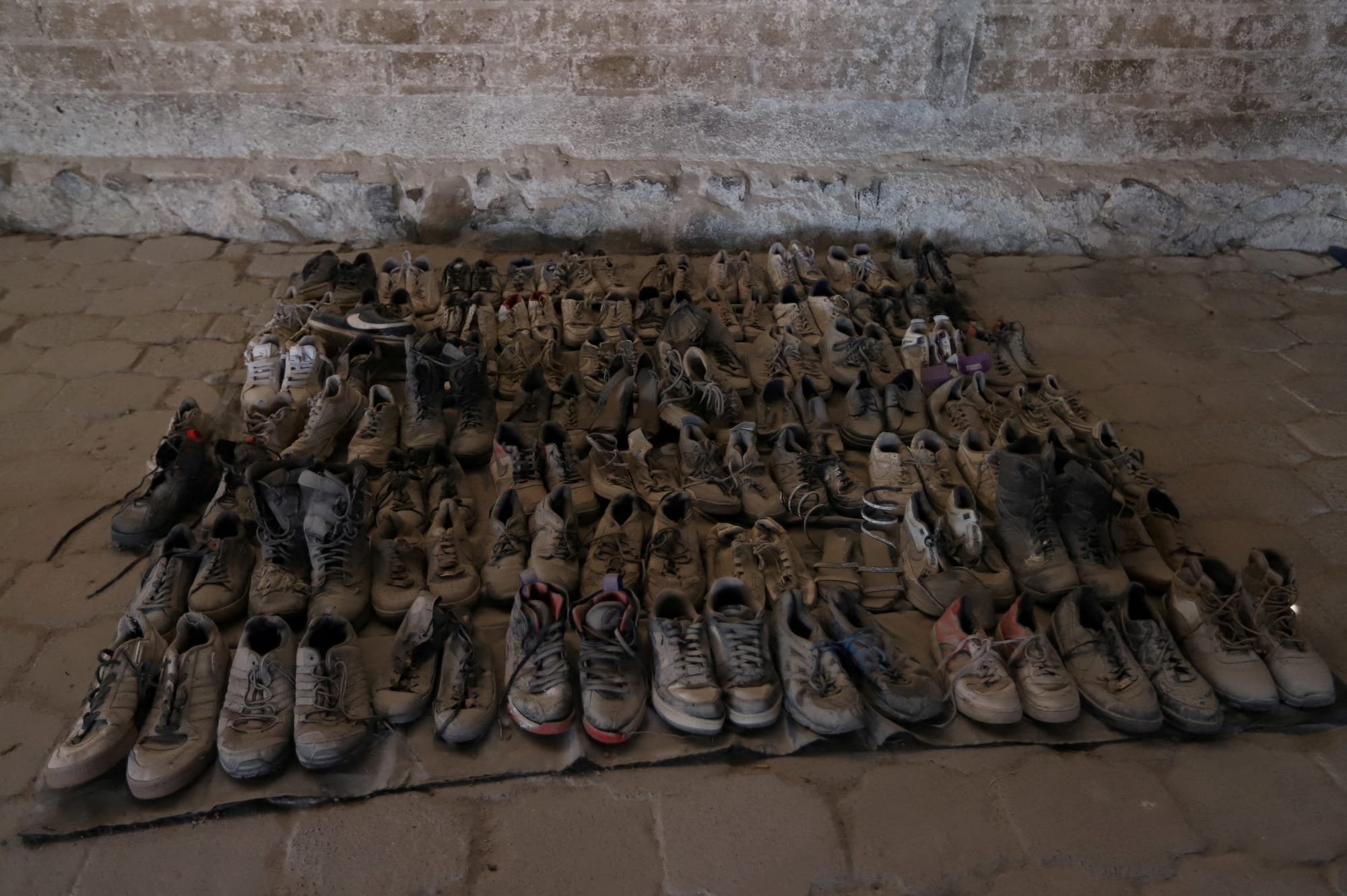
Prior reporting by Sociedad Media covered the discovery of an additional mass grave within a 10-mile radius of the Estadio Akron in Zapopan, Jalisco state, in late February — the eventually site hosting several matches of the 2026 FIFA World Cup.
Volunteer crews spent hours digging through the dirt with bare hands, pulling out plastic bags where amputated limbs were stored piled one on top of the other.
Between late 2025 and early 2026 alone, authorities have discovered the remains of 450+ bodies in clandestine grave sites around Akron Stadium.

The numbers are not in dispute — not even by the Mexican government itself.
At least 132,828 people are currently listed as missing on the Mexican government’s own national registry, though the CED notes this figure may be incomplete. The findings include the ongoing discovery of clandestine graves, with an estimated 4,500 graves found containing over 6,200 bodies and 4,600 sets of human remains.
There are approximately 72,000 unidentified human remains marked by Mexican authorities.
Under current conditions, according to experts, it would take 120 years to identify all the bodies of the disappeared. The broader context is one of near-total impunity: as of November 2021, between two and six percent of disappearance cases had been brought before the courts, and only 36 judgments had been issued at the national level.
The CED found that this figure has not improved meaningfully since its last assessment.
The impunity rate stands at almost 98% as recognized by the CED itself.
What the Committee Actually Found
Sheinbaum’s central counterargument — that most disappearances are carried out by criminal organizations rather than the state, and therefore cannot constitute enforced disappearances under international law — was directly anticipated and rejected by the committee.
The CED stressed that it did not find evidence of a federal policy to commit enforced disappearances. Even if many cases are committed by criminal groups, however, the committee found substantiated information suggesting direct participation or acquiescence of public officials in many cases.
CED Chair Juan Albán-Alencastro was explicit on the legal question.
“International law does not require crimes against humanity to occur nationwide or be orchestrated at the highest levels of government. What matters is the scale, the pattern of the attacks, and the targeting of civilians.”
The committee found that Mexico’s current method of investigating enforced disappearances does not allow for addressing the systematic nature of these crimes. In practice, disappearances are investigated in isolation on a case-by-case basis, using a methodology that does not allow authorities to identify broader patterns, connections between cases, or the chains of command behind them.
Sheinbaum’s Response
At her Monday morning press conference at the National Palace, Sheinbaum minimized the report on two fronts: first by arguing the CED is not a UN body but an independent committee of experts linked to the UN; and second by contending that the committee analyzed cases from only four states between 2009 and 2017 and extrapolated those results to 2025.
The four states were Coahuila, Veracruz, Jalisco, and Nayarit.
“Imagine that an analysis of four states from 2009 to 2017, and the laws that existed then and the attention paid to the issue of the disappeared, is extrapolated to 2025 — that alone is sufficient reason to say they are not very accurate in the analysis they are making,” she said.
President Sheinbaum argued that her government had sent documents to the committee detailing legislative changes, new search protocols, and work done with search collectives — and that those documents were not reflected in the findings.
She acknowledged the 132,000 figure but framed the crisis as a product of organized crime rather than state policy, and stated she would be willing to receive UN High Commissioner for Human Rights Volker Türk.
The technical argument about the CED’s status is factually narrow but misleading in practice. The Committee on Enforced Disappearances is indeed a treaty body — a panel of independent experts created under the International Convention for the Protection of All Persons from Enforced Disappearance, which Mexico signed and ratified.
Its findings carry direct legal and diplomatic weight precisely because Mexico is a state party to that convention. Describing it as merely “linked to” the UN obscures that Mexico voluntarily accepted the committee’s oversight when it ratified the treaty.
The Mothers Respond
The government’s framing did not go unchallenged by those impacted most by the disappeared.
More than 40 collectives and human rights organizations — including prominent mothers’ search groups such as Hasta Encontrarles and Buscando a Nuestras y Nuestros Desaparecidos — issued a direct response, warning that “while the Mexican state continues denying the disappeared, it condemns all Mexicans to having these crimes against humanity continue repeating.”
They expressed specific concern that Sheinbaum’s response “has not changed — denial of the crime remains its policy, but now they also deny international assistance.”
The collectives demanded that Sheinbaum convene all families of disappeared persons, accept the committee’s conclusions, and design a genuine national search strategy. They reminded the government that the disappeared “are proof that enforced disappearances exist in Mexico, even as the Mexican state continues denying it.”
Amnesty International, which has been tracking this crisis for years, urged Mexico to allow UN and foreign forensic experts to assist, noting the country has more than 72,000 unidentified bodies and has shown reluctance to cooperate fully with international forensic teams.
Why the Case Matters Beyond Mexico
The CED’s decision is historically significant independent of Sheinbaum’s response. This is the first time the Article 34 procedure has ever been activated in the committee’s history, meaning Mexico becomes the first country in the world to have its disappearance crisis referred to the UN General Assembly under this mechanism.
The procedure was designed as a last resort, reserved for situations where a state party has failed to take sufficient measures despite sustained engagement from the international body.
The next step depends on the UN Secretary-General, who must decide whether and how to transmit the referral to the General Assembly. If the General Assembly takes up the matter, it would open a multilateral diplomatic process that Mexico’s government — currently navigating a complex relationship with Washington and a series of domestic security pressures — will find difficult to manage.
For the families of Mexico’s 132,000 disappeared, the General Assembly is not a political abstraction. It is, at this point, one of the few remaining institutional levers they have not yet exhausted.
The UN Secretary-General has not yet announced a response to the CED’s referral request. Sociedad Media will continue to monitor developments. For questions, stories, or inquiries, please contact the outlet: info@sociedadmedia.com


