

MEXICO CITY — In the span of 72 hours, Mexico’s national football team lost its starting goalkeeper to a season-ending Achilles rupture, its most creative midfielder to a knee injury, and its country’s claim to a trouble-free World Cup to a wave of cartel violence that shook three host cities simultaneously.
The injuries are fixable. The security picture is considerably more complicated.
Malagón Is Done — and El Tri Feels It
Club América goalkeeper Luis Ángel Malagón ruptured his Achilles tendon in the first half of a CONCACAF Champions Cup round-of-16 victory over the Philadelphia Union on Tuesday, collapsing to the pitch in tears before being carried off on a stretcher.
Club América confirmed the injury on Wednesday, announcing that the 29-year-old requires surgery and faces a recovery period of between six and nine months—a timeline that eliminates any possibility of his participation in this summer’s World Cup.
The loss is significant beyond the individual. No goalkeeper has featured more for Mexico since manager Javier Aguirre took charge in the summer of 2024. Malagón was the starter when El Tri lifted both the Nations League and Gold Cup in 2025, winning the Golden Glove award in the latter tournament.
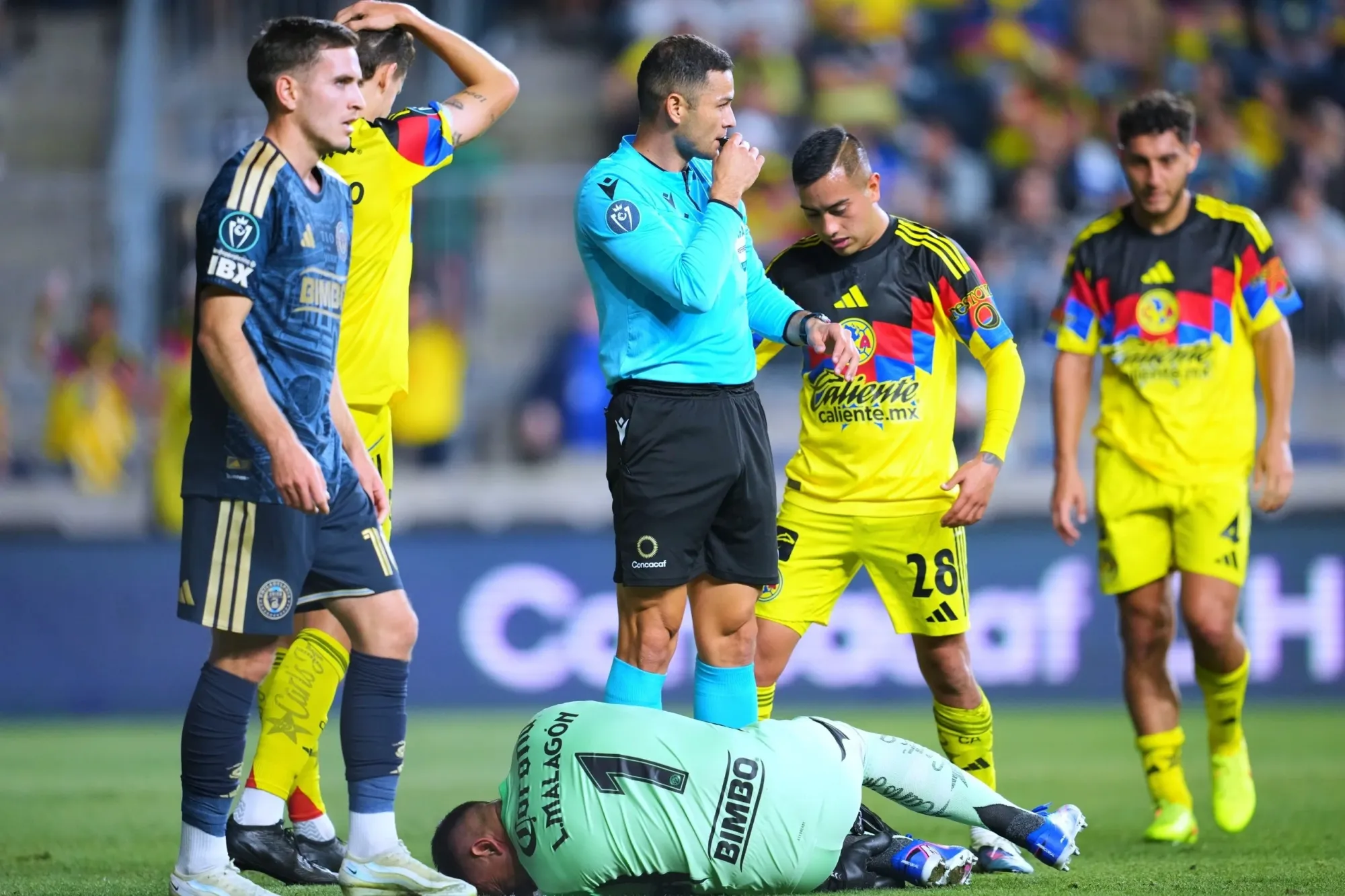
Malagón posted an emotional message on Instagram following the injury: “Hurt and sad, my soul shattered. Trying to understand the situation and asking why? The dream seems to be fading away, but I know that God will one day give me an answer.”
The compounding dilemma of Mexico’s injury crisis was not lost on Aguirre. “Injuries affect everyone in the world of futbol, but as the coach of Mexico, I am concerned about the significant number of injured players we have and how long it may take for them to recover,” Aguirre had said last month—before Malagón’s injury added the most painful name to an already growing list that includes right back Rodrigo Huescas with a torn ACL and midfielder Edson Álvarez recovering from ankle surgery.
Marcel Ruiz Adds to the Injury Toll
The damage extended further this week when Marcel Ruiz—one of Aguirre’s most valuable midfielders and a key part of El Tri’s creative engine heading into the tournament—suffered a knee injury during Toluca’s 3-2 first-leg CONCACAF Champions League loss to San Diego FC. The extent of the injury is still being assessed, but the timing compounds what was already a deeply concerning injury picture for the Mexican Football Federation.
With Malagón, Huescas, Álvarez, and now Ruiz all sidelined or doubtful, Mexico is heading into its two critical March warm-up friendlies—against Portugal on March 28 at the Azteca and Belgium on March 31 at Soldier Field in Chicago—with a squad that looks materially different from the one that won back-to-back trophies in 2025.
The Ochoa Question
Malagón’s absence has reopened the door for one of Mexican football’s most beloved figures. Guillermo “Memo” Ochoa—40 years old, currently playing for AEL Limassol in Cyprus—has long expressed his desire to compete in a sixth World Cup, which would place him alongside Lionel Messi and Cristiano Ronaldo as the only players in history to achieve that milestone.
According to Mexican national team insider David Medrano, the Mexican Football Federation has already established contact with AEL Limassol to manage Ochoa’s availability for the upcoming FIFA international window.
With Malagón out, Raúl “Tala” Rangel of Chivas Guadalajara—who has started five out of Mexico’s last eight matches—is now the overwhelming favorite to be Mexico’s World Cup starter. The legendary Ochoa enters serious contention for the backup role, with Carlos Acevedo of Santos Laguna and Andrés Gudiño also in the picture.
Ochoa’s World Cup legacy is extraordinary. He became Mexico’s starting goalkeeper in 2014 and delivered one of the most famous individual performances in tournament history against Brazil—producing a series of crucial saves in a 0-0 draw that Mexico held despite facing enormous pressure throughout.
He continued as Mexico’s starter in both 2018 and 2022. A sixth appearance would cement a historical legacy that transcends club football entirely.
Mexico’s Security Operation: Plan Kukulkán
The goalkeeper situation—significant as it is—has been overshadowed by a security challenge that directly threatens Mexico’s ability to deliver the tournament it promised the world.
The Mexican government unveiled its comprehensive World Cup security strategy—branded Plan Kukulkán, after the serpent deity of the Mayan civilization—deploying nearly 100,000 law enforcement personnel, including 20,000 military and National Guard troops, 55,000 police officers, members of private security companies, more than 2,000 military vehicles, 24 aircraft, 33 surveillance drones, anti-drone systems, and robot dogs. Three joint task forces were stationed in the three host cities: Guadalajara, Mexico City, and Monterrey.
President Claudia Sheinbaum announced the plan during a visit to a suburb of Guadalajara—the city hit hardest by retaliatory cartel violence following the February 22 military operation that killed CJNG leader Nemesio “El Mencho” Oseguera.
“We are here to tell everyone in Jalisco, all the people of Jalisco, that we are together, that we are working for peace, security, and the well-being of the inhabitants of this beautiful state,” Sheinbaum said alongside members of her security cabinet.
Despite Sheinbaum’s assurances, security analysts have expressed concern about the CJNG succession dynamic that El Mencho’s death has set in motion. Security Secretary Omar García Harfuch acknowledged his team would be “very attentive” to “any type of reaction or restructuring within the cartel,” confirming that authorities were engaged in “particular monitoring of several leaders.”
Victoria Dittmar, a researcher at InSight Crime in Mexico City, said that guaranteeing security in the region had always been a challenge, and that following El Mencho’s removal, the task had become one of “pacifying the country and the cities, especially those that will receive so many tourists.”
The Portuguese Football Federation said it was “closely monitoring the delicate situation” in Mexico ahead of its scheduled March 28 friendly against El Tri at the Azteca—the same stadium set to host the World Cup’s opening match on June 11—adding that the safety of players, coaches, and supporters would be “the deciding factor” in whether the game proceeds.
FIFA's Position
FIFA President Gianni Infantino has stated he has “total confidence” in Mexico, in President Sheinbaum, and in the authorities—expressing that he is “convinced that everything will turn out in the best possible way.”
Jalisco governor Pablo Lemus ruled out the prospect of Guadalajara being dropped from the tournament, saying there was “absolutely no risk” of a change in the line-up.
For Mexico and the broader Latin American diaspora in the United States, the 2026 World Cup is more than sport. It is an economic opportunity, cultural pride, and global visibility. Guadalajara alone expects hundreds of thousands of visitors, injecting significant revenue into local businesses, hospitality, and tourism.
The stakes for getting the security right—on and off the pitch—have never been higher.
Mexico’s World Cup opener is 90 days away. Ochoa may be coming back. The cartels are being watched. And 100,000 security personnel are being deployed to make sure the beautiful game gets its moment—regardless of what surrounds it.


