

For the first time in the history of the modern FIFA World Cup, a qualified nation has withdrawn from the tournament due to active military conflict directly involving one of the host countries.
Iran’s exit from the 2026 World Cup—confirmed Wednesday by Sports Minister Ahmad Donyamali—leaves FIFA with 89 days to resolve a vacancy that no regulation was ever designed to fill, and a tournament already under pressure from security concerns, hotel cancellations, and cartel violence now confronting its most consequential geopolitical rupture yet.
The Announcement
Speaking on state television Wednesday, Donyamali said: “Considering that this corrupt regime has assassinated our leader, under no circumstances can we participate in the World Cup.” He added:
“Our children are not safe and, fundamentally, such conditions for participation do not exist. Given the malicious actions they have carried out against Iran, they have forced two wars on us over eight or nine months and have killed and martyred thousands of our people. Therefore, we certainly cannot have such a presence.”
The announcement came after a joint U.S.-Israel strike on Tehran—Operation Epic Fury, launched February 28—reportedly killed Iran’s Supreme Leader Ayatollah Ali Khamenei, triggering intense military exchanges across the region, including missile and drone attacks on Israel and U.S. military bases in the Gulf.
Iran was one of the first non-host nations to qualify for the 2026 tournament, earning its place in Group G alongside Belgium, Egypt, and New Zealand. All of its scheduled group matches were set to be played on U.S. soil—in Los Angeles and Seattle—making participation in a tournament co-hosted by a country in an active war with Iran a practical and political impossibility, regardless of any diplomatic assurances offered, according to Iranian sports officials.
Trump’s Response: Mixed Signals
The Trump administration’s public position on Iran’s World Cup participation has shifted notably in the days surrounding the withdrawal. Following a meeting between FIFA President Gianni Infantino and Trump, Infantino stated: “During the discussions, President Trump reiterated that the Iranian team is, of course, welcome to compete in the tournament in the United States.”
But Trump’s own subsequent remarks were considerably less welcoming. On Thursday, Trump discouraged Iran’s national team from traveling to the U.S. for the World Cup—his most recent comments coming a week after he told POLITICO that he “really does not care” if Iran plays at the global competition. “The Iran National Soccer Team is welcome to The World Cup,” Trump said in a brief social media statement, “but I really don’t believe it is appropriate that they be there, for their own li[ves].”
The statement—which appeared to warn Iranian players of potential safety risks on U.S. soil—reflected a tension between FIFA’s desire to keep the full 48-team field intact and the geopolitical realities of hosting a team from a country at active war with the United States.
Tehran officially rejected Trump’s earlier assurances of welcome. Iran’s withdrawal stands regardless of any diplomatic overtures from Washington or FIFA.
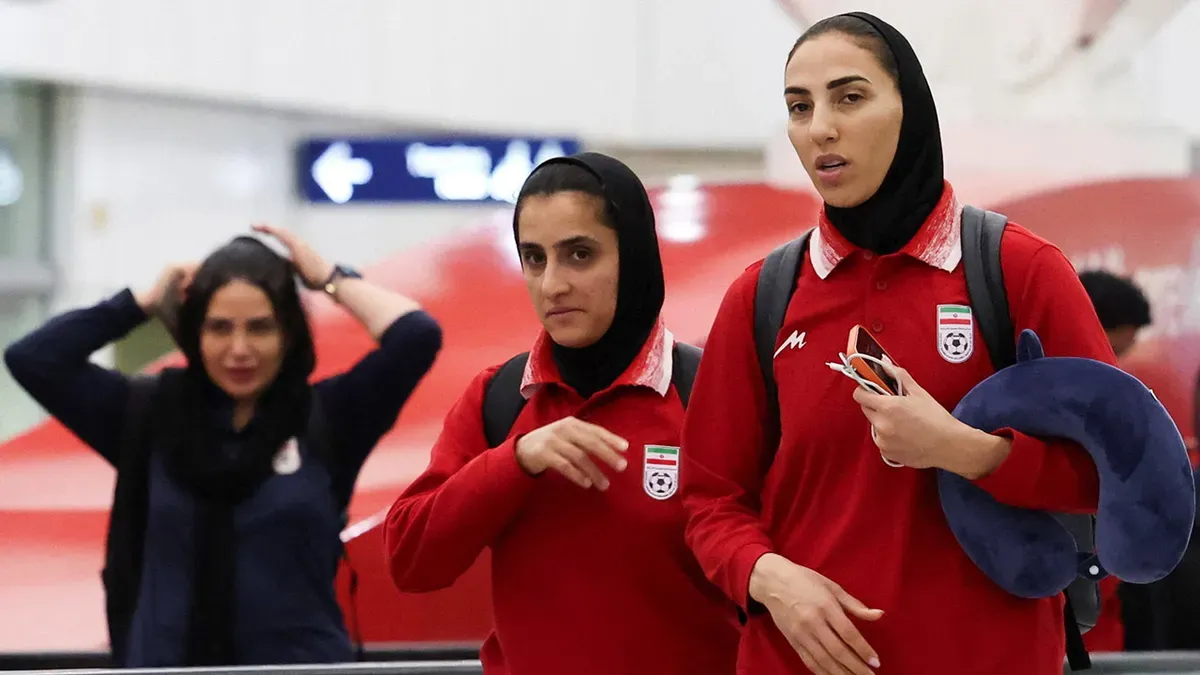
What Happens to Iran’s Spot
FIFA now faces a decision with no modern precedent to draw from. This marks the first time in the history of modern World Cups that a participating team has withdrawn from the tournament directly due to an active phase of military conflict affecting the host country.
FIFA’s regulations provide two options under Article 6, Regulation 6.7: reduce Group G to three teams—decreasing the number of matches the remaining teams would play and complicating the knockout bracket—or replace Iran with another association at FIFA’s sole discretion.
Sources told ESPN that Iran’s replacement would almost certainly come from the Asian Football Confederation. The nation that came closest to qualifying from Asia is Iraq—but Iraq’s path is complicated by its own ongoing intercontinental playoff against either Bolivia or Suriname, currently scheduled for March 31 in Monterrey, Mexico.
Iraq’s head coach Graham Arnold has already asked FIFA to reschedule that match due to the closed regional airspace. Should Iraq win the playoff and qualify independently, the next Asian team in line would be the United Arab Emirates—though UAE airspace is also partially restricted due to the regional conflict.
Sources told ESPN that FIFA is prepared to wait for the situation to resolve itself before making a final decision, and that firm decisions are unlikely before the FIFA Congress on April 30—just six weeks before the tournament begins on June 11 in Mexico City.
The Ripple Effects: Women's Football and Humanitarian Asylum
Iran’s withdrawal extends beyond the men’s tournament. Australia granted humanitarian asylum to five Iranian women’s national team players who staged a silent protest by refusing to sing Iran’s national anthem before an AFC Women’s Asian Cup match against South Korea.
The five players—Fatemeh Pasandideh, Zahra Ghanbari, Zahra Sarbali, Atefeh Ramazanzadeh, and Mona Hamoudi—sought protection amid growing political turmoil in Iran following reports of Khamenei’s death and the escalating conflict.
Iran’s Foreign Ministry accused Australian authorities of taking athletes “hostage” under the guise of asylum, referencing a Tomahawk strike on a school in Minab that reportedly killed 165 schoolgirls as context for what it characterized as Western hypocrisy on humanitarian grounds.
The competing claims reflect the degree to which the Iran conflict has permeated every dimension of international sport—not merely the men’s World Cup fixture list.
What It Means for the Tournament
Iran’s exit is the most significant off-field development in a World Cup preparations story that has accumulated complications at an accelerating pace.
The tournament already faces concerns over cartel violence in Mexican host cities following the death of CJNG leader El Mencho, significant hotel cancellations in Mexico City, and the logistical challenges of a 48-team expanded format being staged across three countries simultaneously.
New Zealand’s opening match—scheduled against Iran—is now in direct jeopardy pending FIFA’s replacement decision. Belgium and Egypt, the other members of Group G, face similar uncertainty about their opening-round schedule as FIFA works through its options.
The Denmark precedent—invoked by analysts in the days since Iran’s announcement—is instructive but imperfect.
In 1992, Denmark was handed a place at Euro ’92 by UEFA just ten days before the start of the tournament after Yugoslavia was excluded due to United Nations sanctions.
Denmark went on to win the tournament. But that replacement involved a single-country European championship with far simpler logistical requirements than a 48-team, three-country World Cup with travel, visa, and airspace complications already affecting multiple AFC nations.
FIFA has not publicly commented on a timeline for its decision. With the tournament opening in 90 days, that timeline is compressing rapidly—and the organization that promised the world’s most inclusive World Cup is now managing its most politically complicated one.
🚨⚽🇮🇷 | BREAKING/2026 FIFA WORLD CUP: Iran confirms its national team will NOT participate in the 2026 FIFA World Cup—citing the country’s active war with tournament co-host, the United States.
— Sociedad Media (@sociedadmedia) March 12, 2026
The geopolitics of this summer just got a lot more complicated.
100 days out. The… pic.twitter.com/PglB5h6dbP


