

MIAMI – Guatemala announced this week that the Central American nation intends to wind down its participation in Havana’s controversial Cuban Doctors program, which provides Cuban medical assistance to partner nations, offering a lucrative outlet by which the regime in Havana has been able to generate much-needed income for decades.
Guatemala’s Health Ministry confirmed that over 400 Cuban health workers, including 333 doctors, are currently working in the Central American country by providing expert medical care to Guatemalans as part of the program.
The ministry also added, however, that it intends to reduce its use of Cuban doctors, a decision based on a “technical analysis” to help bolster the nation’s self-reliance on its own national medical workforce.
The United States Trump administration has not been coy about pressuring members of Latin America’s socialist bloc, namely Venezuela, Cuba, and Nicaragua, to begin to reopen their countries to more democratic norms, even using the threat of military force or economic means to tighten the squeeze on, for instance, Cuba, by restricting the flow of oil supplies from third-party nations.
The White House has issued a warning to any country seeking to aid the regime in Cuba by providing desperately needed oil products, threatening to impose tariffs if the U.S. blockade is violated.
🚨🇲🇽🇨🇺 | AHORA/MEXICO-CUBA: Mexican President Claudia Sheinbaum, during her daily presser, announced that her government is planning a humanitarian “air bridge” to provide aid and support to Cuba amid a tightening U.S. blockade around the island.
— Sociedad Media (@sociedadmedia) February 13, 2026
The White House recently… pic.twitter.com/56CPdsTu1r
On Thursday, two Mexican naval vessels docked in Cuba carrying 800 tons of humanitarian aid for the Cuban people. President Claudia Sheinbaum of Mexico has warned that U.S. actions in Cuba will risk worsening the economic conditions of the Cuban people, and may cause a “humanitarian disaster.”
The United States government has also confirmed that vital humanitarian food sources like beans, canned fish, and other food items have been supplied to the Cuban people, but has warned that these supplies often do not reach their intended recipients due to corruption on the part of the Cuban government.
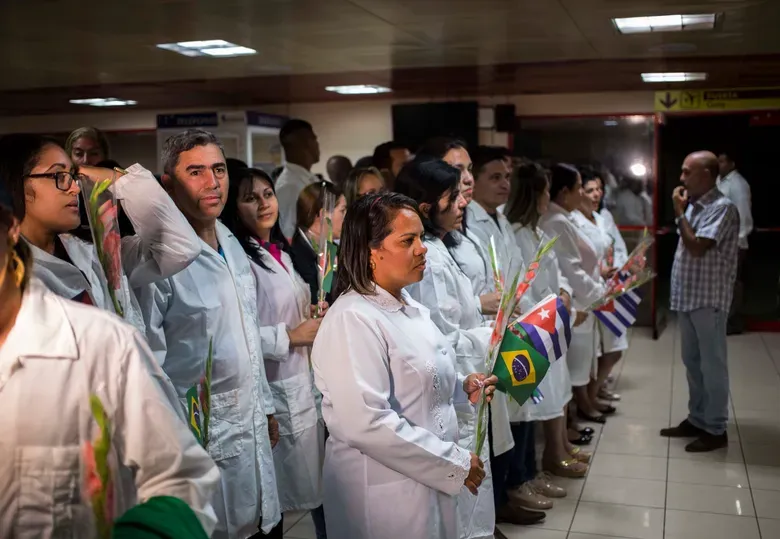
The Trump administration is also pressuring neighboring countries in the region to sever their ties with the Cuban government and end participation in the Doctors-for-Hire program.
Guatemala’s announcement on Tuesday comes in the wake of several other countries in Latin America and the Caribbean cutting relations with Havana’s controversial program.
The Bahamas also cut links with the Cuban program, with Paraguay, and Guayana ending their participation in 2025.
According to estimates, the program provides the Cuban government with approximately $11 billion in annual revenue, with critics and various international human rights organizations arguing that the program amounts to modern-day slavery, claiming that the Cuban government absorbs the majority of revenues from the program while paying Cuban professionals only a small fraction for their service.
The U.S. government also claims that many Cuban doctors are often coerced into the program, essentially forced by bureaucratic officials to live overseas for extended periods of time and not adequately or fairly compensated for their sacrifice.
In March of last year, the prime minister of St. Vincent and the Grenadines (SVG) stated that his Caribbean government provided evidence to the U.S. government that Cuban health workers in his country are not the victims of human trafficking or “forced labor,” refuting recent claims by the Trump administration.
U.S. Secretary of State Marco Rubio, a son of Cuban immigrants, announced in February 2025 that the United States is embarking on a policy to target “forced labor” and “abusive and coercive labor practices,” which Rubio claims applies to Cuba’s international medical missions.


