

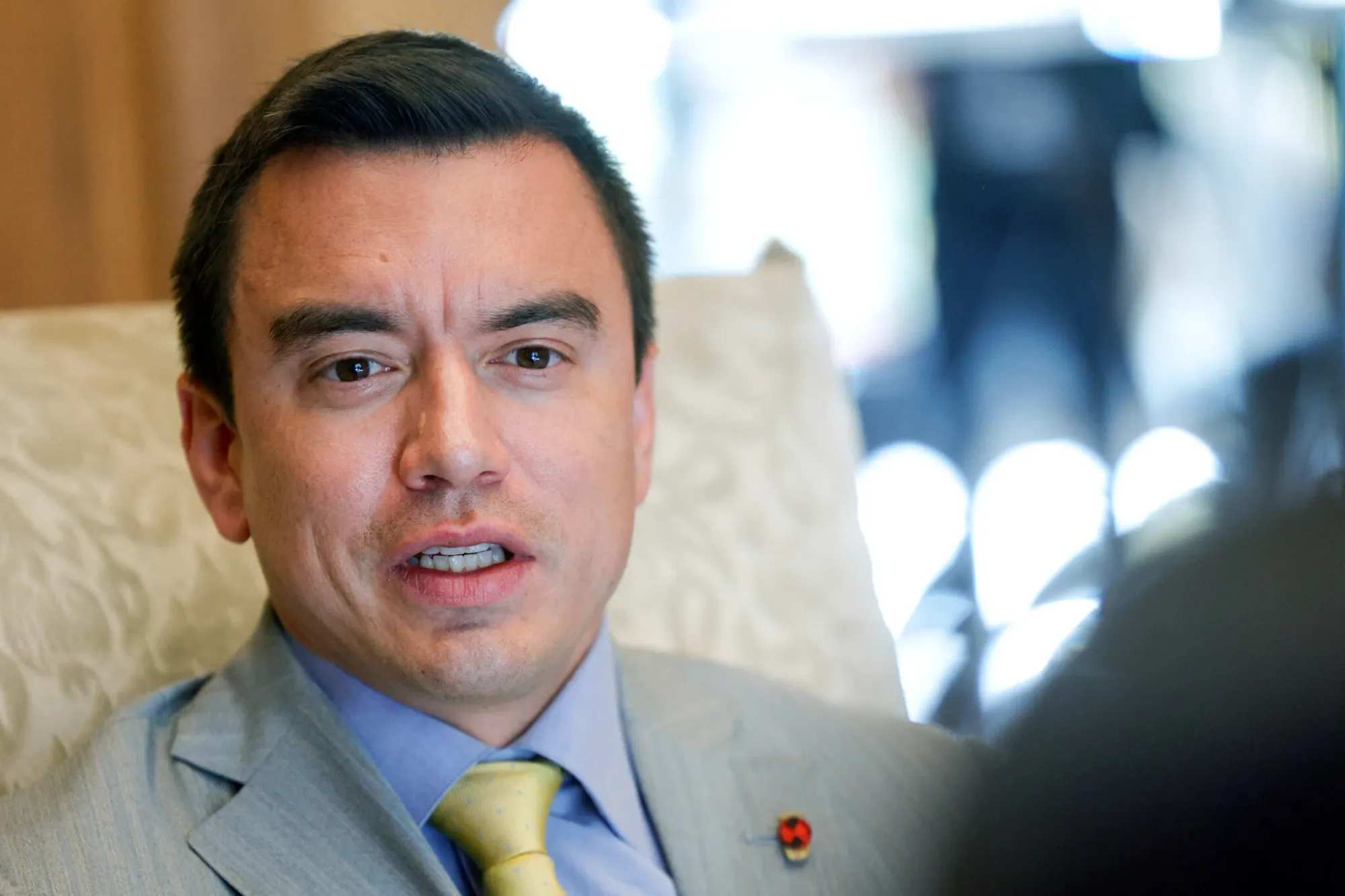
MIAMI – Ecuador’s President Daniel Noboa delivered one of his most alarming public assessments yet of the forces driving his country’s security crisis this week, telling Univision in a nationally televised interview that international terrorist organizations—including Hezbollah, Hamas, and Iran’s Islamic Revolutionary Guard Corps (IRGC)—are actively training the criminal gangs tearing Ecuador apart.
“The cartels work with narco-terrorist groups trained by Hezbollah, Hamas, and by Iran’s Revolutionary Guard,” Noboa said in the interview, describing a transnational criminal architecture that extends far beyond the local gang networks Ecuador has been battling since declaring an internal armed conflict in January 2024.
The remarks were not made in a vacuum. In September 2025, Noboa signed Executive Decree No. 128, officially designating Hamas, Hezbollah, and the IRGC as terrorist organizations—the first South American country to do so—after Ecuador’s National Intelligence Center warned of the strong presence of these organizations in Latin America and their possible ties to Ecuadorian criminal networks.
The decree asserted that the three groups pose a direct threat to the sovereignty, public safety, and integrity of Ecuador, instructing the CNI to examine the groups’ links to Ecuadorian criminal gangs and coordinate with regional intelligence agencies.
The decree drew immediate praise from Israel’s Foreign Minister Gideon Sa’ar, who wrote on X that “Ecuador’s courageous step sends a clear message against Iran’s terror network and strengthens global security,’ calling on more countries in Latin America and around the world to follow suit.
Iran’s General Staff of the Armed Forces responded by denouncing Ecuador’s decree as an “unreasonable and unlawful” act, calling it submission to “the hegemonic system led by terrorism-breeding America.”
Noboa’s latest statements go a step further than the September decree—moving from institutional designation to direct public accusation of active training operations on Ecuadorian soil.
The Ecuadorian president stated that some criminal organizations operating locally had received training or support from structures linked to those groups, which he described as part of a transnational network that fuels violence and drug trafficking in Ecuador.
The context for the allegations is a country in genuine crisis. Gang violence resulted in the death of over 3,600 people in Ecuador in 2025—42% more reported fatalities than in the first eleven months of 2024—with 71% of the population exposed to violence.
Ecuador recorded the highest homicide rate in all of Latin America for the third consecutive year.
The primary criminal organizations driving that violence—Los Choneros, Los Lobos, and Los Tiguerones—have established operational links to Mexican cartels, including the Sinaloa Cartel and CJNG, and now, according to Noboa, to Middle Eastern terrorist networks as well.
Noboa also used the Univision interview to defend Ecuador’s deepening security cooperation with Washington, confirming that Ecuador recently carried out a joint military operation with U.S. forces near the border with Colombia. “We are open to collaboration and joint operations,” he said, while insisting that any foreign military action in the country must be conducted alongside Ecuadorian forces.
The IRGC-Ecuador connection is not without precedent in the region. Argentina has long documented Hezbollah’s financial and operational networks within its borders—most notably in the tri-border area where Argentina, Brazil, and Paraguay converge—and the 1994 AMIA bombing in Buenos Aires, attributed to Hezbollah with Iranian state backing, remains the deadliest terrorist attack in Latin American history.
Ecuador’s National Intelligence Center reports warned specifically of the possible presence or influence of these organizations in Latin America and their connections with regional criminal networks—intelligence that formed the evidentiary basis for Noboa’s September decree and his more recent public statements.
Whether Noboa’s claims about active IRGC and Hezbollah training operations can be independently verified remains an open question. No corroborating intelligence has been made public. But in the context of an ongoing joint U.S.-Ecuador military campaign against designated terrorist organizations, the political and strategic implications of the accusation are already reshaping the region’s security landscape—regardless of what independent verification ultimately confirms.


