

MIAMI — Colombia has held democratic elections for more than two centuries. It has also buried a presidential candidate in the middle of a campaign, seen senators kidnapped, watched armed groups extend their grip over entire regional departments, and entered this electoral season with more than 400 documented incidents of political violence already on the books. The 2026 presidential election is, by nearly every measure, the most consequential vote the country will hold since Gustavo Petro became its first left-wing president in 2022—and the most dangerous campaign environment in a generation.
On May 31, more than 41 million registered Colombian voters will choose the country’s next leader. If no candidate clears 50% of the vote in the first round—which the polls suggest is virtually certain—a runoff between the top two finishers will follow on June 21. The winner takes office on July 28 and inherits a country grappling with surging violence, strained relations with Washington, a struggling economy, and a peace process that has largely unraveled.
The race now has a clear shape. The official ballot was finalized on March 25, when Colombia’s electoral authority conducted a lottery to determine candidate order—a detail that matters more than it sounds in a country where name placement on a crowded ballot can measurably affect results.
Fourteen candidates will appear, the largest field since 1994. Three of them have a realistic path to the presidency.
The Three Names that Matter
Iván Cepeda — The Left’s Standard-Bearer
Iván Cepeda is the candidate of the Pacto Histórico—the same coalition that carried Gustavo Petro to the presidency in 2022, and he enters the final stretch as the clear frontrunner. The most recent Guarumo and Ecoanalítica poll, conducted March 19–25 across 69 municipalities and published by Colombian outlet El Tiempo, puts Cepeda at 37.5% voting intention, a lead of roughly 17 points over his nearest rivals.
A longtime senator known nationally for his human rights activism and his legal confrontations with former President Álvaro Uribe over alleged ties to paramilitary groups, Cepeda is running as the continuity candidate of the Colombian left.
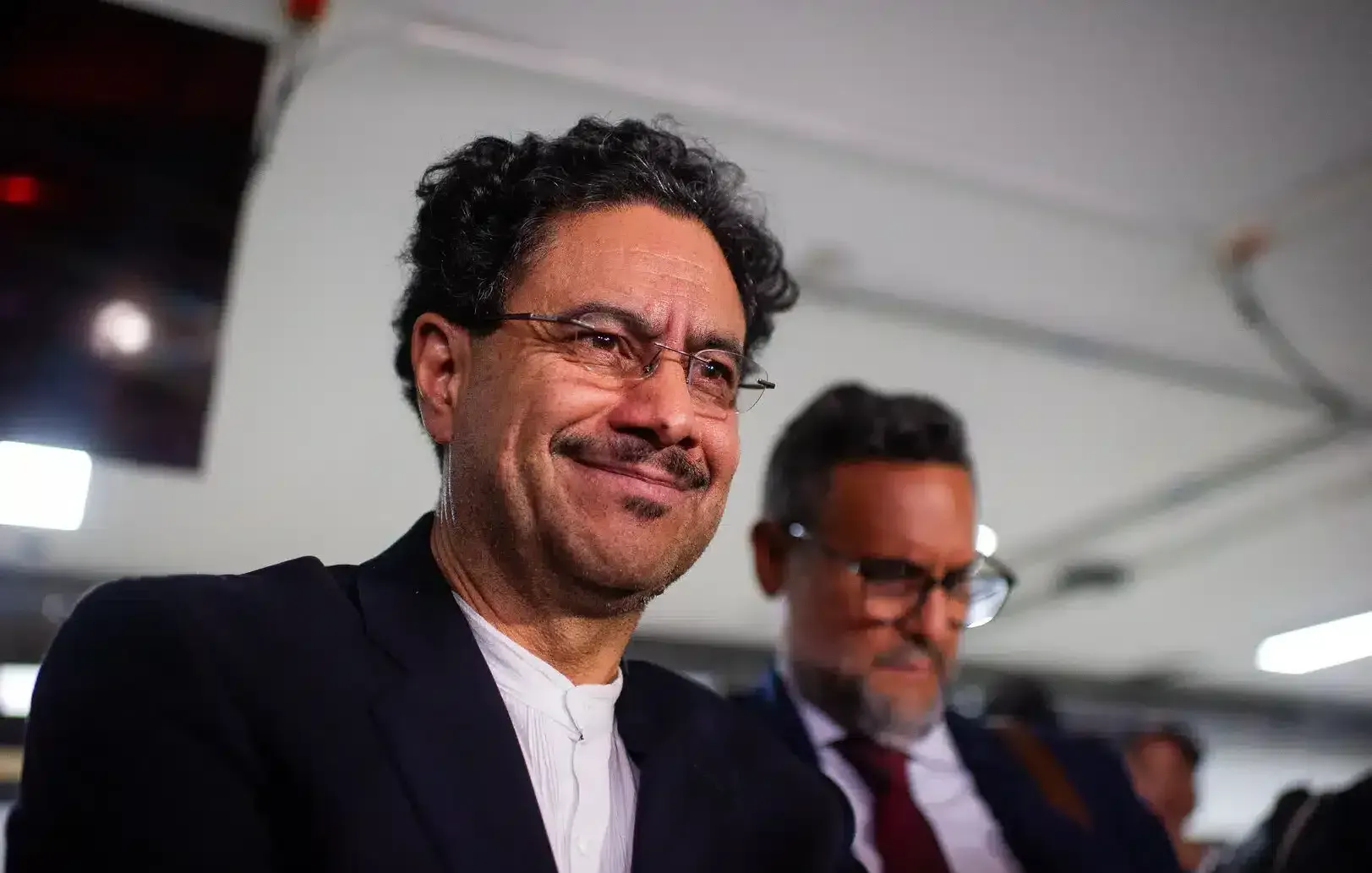
He has promised to deepen Petro’s negotiation-based approach to armed conflict—a policy known as “total peace”— despite its mixed results. He has also named Indigenous senator Aida Quilcué as his running mate, a choice that reinforces his appeal to marginalized and rural Indigenous communities.
Cepeda’s challenge is not the first round. It is the runoff. The same poll that shows him leading overall also reveals that 37.2% of respondents said they would never vote for him under any circumstances—the highest “never vote” figure of any candidate.
In a hypothetical runoff against Paloma Valencia, the Guarumo survey shows the race within the margin of error: 43.3% for Cepeda to 40% for Valencia. A separate Centro Nacional de Consultoría poll published March 22 found an even tighter picture, with Cepeda at 34.5% and Valencia pulling to 22.2% and rapidly closing.
Winning the first round and winning the presidency may require very different campaigns.
Abelardo de la Espriella — The Outsider on the Right
Abelardo de la Espriella is the most unusual figure in the race. A criminal defense lawyer from Montería who has represented controversial clients, including figures accused of ties to organized crime—allegations he denies—De la Espriella has constructed a campaign around the image of the disruptive outsider, drawing explicit comparisons to Argentina’s Javier Milei. His base is anti-Petro, security-focused, and deeply skeptical of Colombia’s political establishment.
De la Espriella’s platform is unambiguous on security: in his first 90 days, he has said he would launch aerial bombardment and fumigation campaigns against drug traffickers and armed groups, pursue close military and police ties with Washington, and seek the extradition of cartel leaders demanded by the Trump administration.
That last position is particularly significant given that U.S. pressure on Colombia to extradite key narco figures has itself become a destabilizing factor in the current campaign, with Bloomberg reporting in February that the manhunt for cartel leaders wanted by Trump risks triggering further violence ahead of the vote.
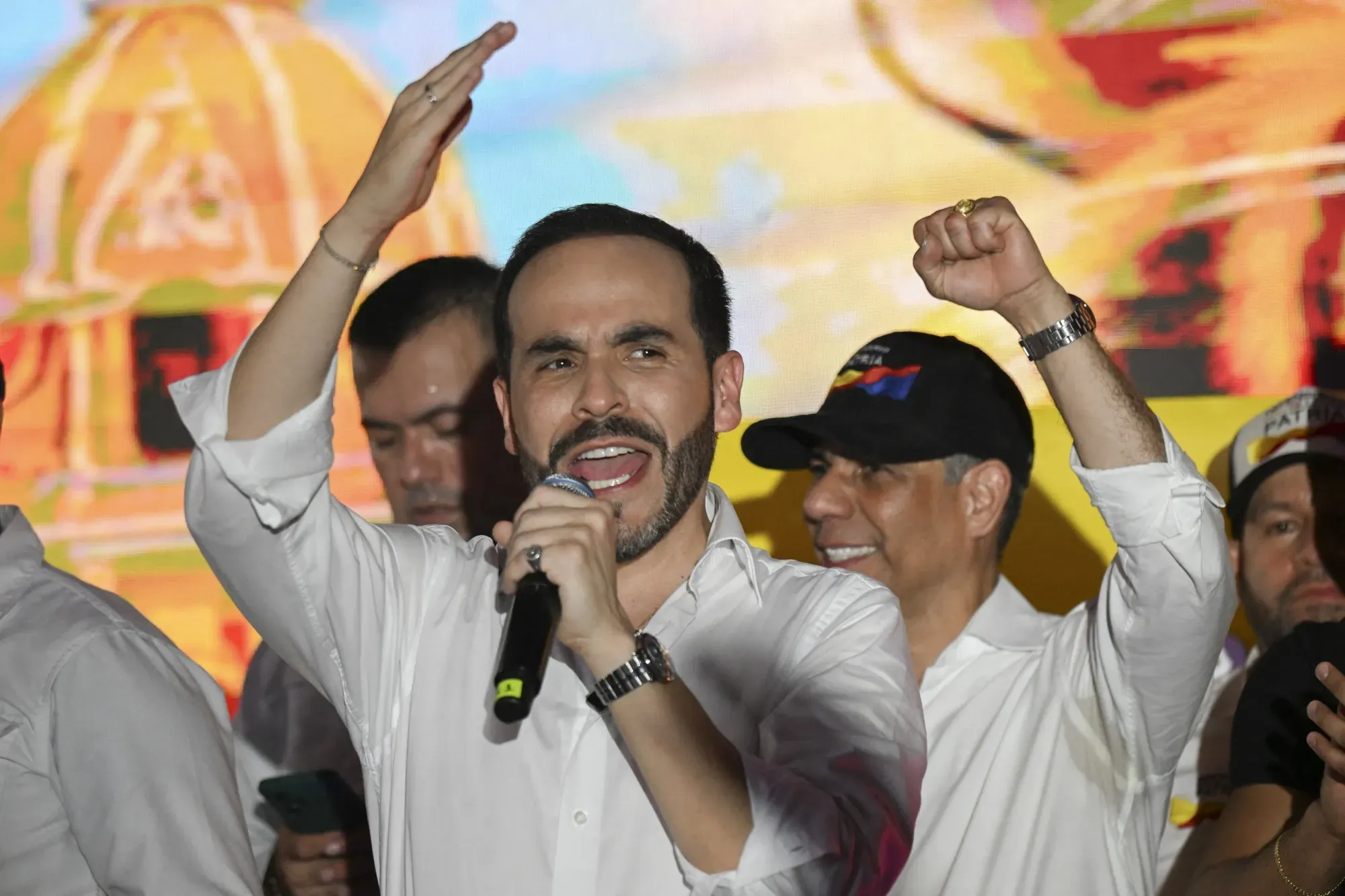
The most recent polls show De la Espriella under moderate pressure. After peaking at 22.6% in February, he has slipped to 20.2% in the March Guarumo survey, while the CNC poll puts him lower still at 15.4%. The emergence of Paloma Valencia as a credible center-right force has directly cost him support. Both he and Valencia have publicly pledged to support each other in a potential runoff—a recognition that whichever of them makes it to June 21, consolidating the non-left vote will be essential.
De la Espriella has also made the point more colorfully, saying he would not negotiate with what he called the devil—suggesting he views coalition politics with suspicion even as the math demands it.
Paloma Valencia — The Surge Candidate
The most dramatic shift in the Colombian race over the past three months belongs to Paloma Valencia, the Democratic Center senator and protégée of former President Álvaro Uribe. In January, Valencia registered just 6.9% in polling. By late March, she stood at 19.9% in the Guarumo survey and 22.2% in the CNC poll—a rise of more than 13 points driven almost entirely by her dominant performance in the Gran Consulta por Colombia, the right-wing primary held alongside the March 8 congressional elections, where she secured 3.2 million of the 5.8 million votes cast.
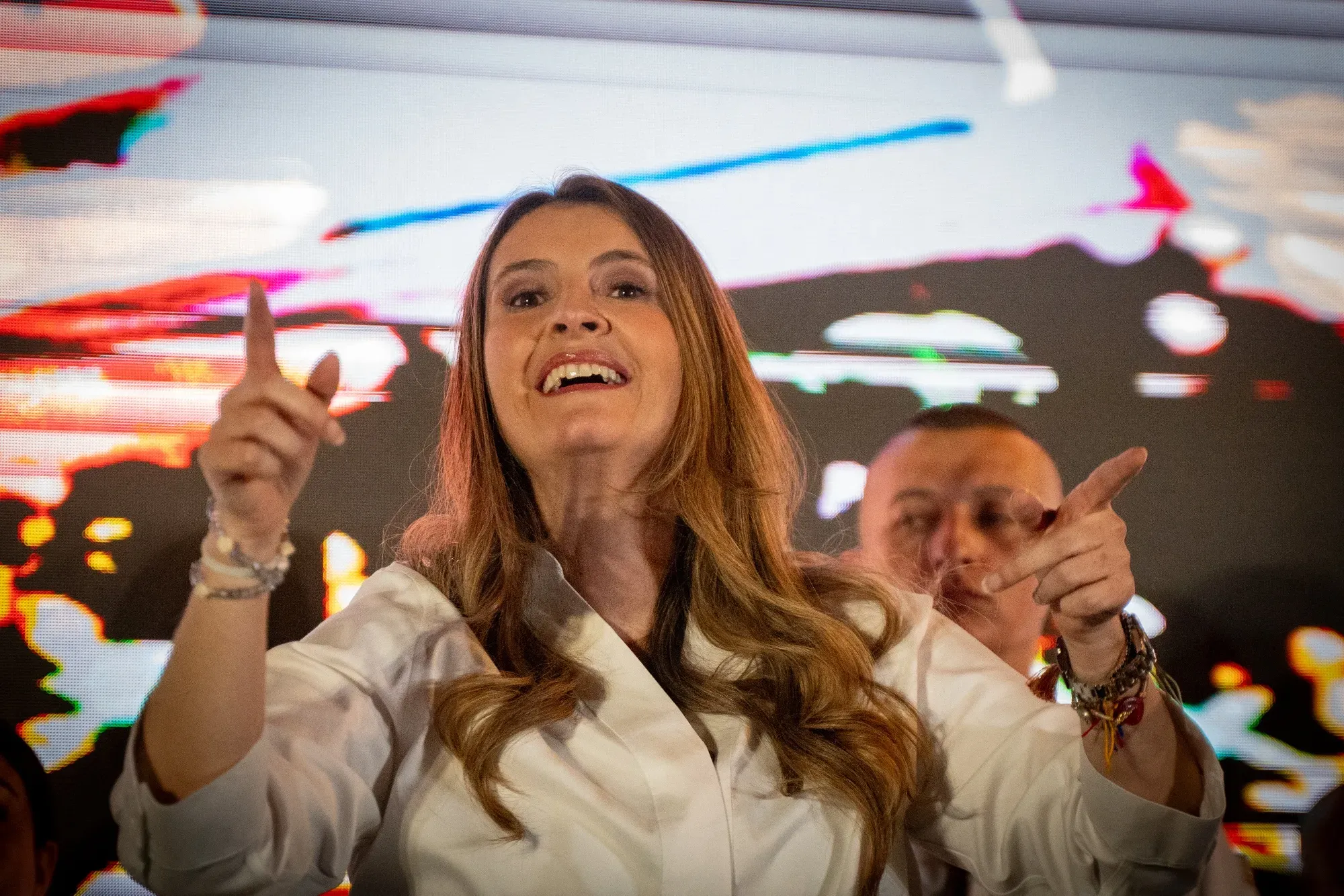
Her vice-presidential selection has also added momentum. Juan Daniel Oviedo, a well-regarded former director of Colombia’s national statistics agency, has proven to be a significant electoral asset: a CNC poll found that 52.1% of respondents said vice-presidential choices influenced their candidate preference, and Oviedo ranked as the second most popular running mate in the country.
Valencia’s policy agenda is the most pro-Washington of the three frontrunners. She has called for a “new Plan Colombia”—reviving the model of deep U.S.-Colombian security cooperation that defined the Uribe era—promised to lower taxes, expand private investment, and take a hard line against drug trafficking and illegal mining groups.
Her 12th-place position on the physical ballot, determined by the March 25 lottery, is considered a disadvantage in a 14-candidate field. Whether that matters in practice will depend on how effectively her campaign mobilizes the primary coalition that already voted for her.
The Issues Defining the Race
Security — and the Shadow of Political Violence
No issue dominates the 2026 race more than security, and no issue is more charged by recent events. In June 2025, presidential pre-candidate Miguel Uribe Turbay was assassinated during a campaign rally in Bogotá—the first killing of a Colombian presidential candidate in more than 30 years, allegedly carried out by a 14-year-old with alleged links to the Segunda Marquetalia guerrilla group.
The assassination reshaped the race and, according to analysts at the International Crisis Group, pushed campaigns away from public events and toward social media, creating new vulnerabilities to disinformation and foreign interference.
The violence has not stopped. Colombia’s Election Observation Mission has flagged 185 of the country’s 1,122 municipalities as at elevated risk of electoral violence ahead of May 31. A senator was kidnapped in the southwestern department of Cauca. Three politicians—a senator, a mayor, and a legislative candidate—were abducted in the months surrounding the March 8 congressional vote. Petro’s “total peace” initiative, which sought simultaneous negotiations with all remaining armed groups, has largely collapsed, and virtually every indicator of violence—kidnappings, massacres, forced displacement—has risen since his administration began.
All three leading candidates are competing to own the security issue, but with starkly different prescriptions. Cepeda promises to continue negotiating. De la Espriella promises to bomb and fumigate. Valencia promises to partner with Washington and deploy security forces aggressively. Colombians, polling on their top concerns, have consistently ranked security, corruption, and crime above all other issues.
The U.S. Relationship—A Bilateral Reset on the Horizon
Colombia’s relationship with the United States has been turbulent under Petro, whose confrontational style and anti-Washington rhetoric produced several diplomatic flashpoints, including a February 2026 standoff over the deportation of Colombian nationals that temporarily threatened tariffs before the two presidents met to lower the temperature.
The Council on Foreign Relations, in a February 2026 report, described the upcoming Colombian presidential transition as a potential window for Washington to engineer a bilateral reset—and noted that the Trump administration’s approach to whichever candidate wins will significantly shape regional stability.
The stakes are high. Colombia produces more cocaine than any other country in the world, according to the United Nations. Coca cultivation nearly tripled over the past decade to a record 253,000 hectares. That reality means the next Colombian president will immediately face pressure from Washington on drug policy, extradition, and cartel enforcement—regardless of their political orientation.
For Miami’s Colombian diaspora community—one of the largest in the United States—the bilateral relationship is not an abstraction. It shapes remittances, family safety, and the stability of the country in which many still have deeply seated roots.
What the Ballot Lottery Means and What Comes Next
On March 26, the day after the ballot order was confirmed by lottery, Cepeda drew first position—appearing at the very top of a 14-candidate field.
De la Espriella drew the first spot in the second row. Valencia landed 12th.
In Colombian electoral research, ballot placement is a documented factor in candidate performance, particularly among less-informed or undecided voters making snap decisions in the booth. Cepeda’s placement is an additional structural advantage atop his polling lead.
What now determines the outcome is the runoff arithmetic. Cepeda’s path to victory on June 21 runs through his ability to win over centrist voters who did not support him in the first round—a task made harder by the 37% of the electorate that says they will never vote for him. Valencia’s path requires consolidating the right behind her, attracting the moderate voters currently behind Claudia López and Sergio Fajardo, and making the runoff case that Cepeda’s continuation of Petro’s policies is a choice Colombia cannot afford.
Neither outcome is predetermined. At this stage in past Colombian races, the gap between first and second round results has shifted significantly, and 16.7%of voters remain undecided.
The next eight weeks will determine whether Colombia continues left, turns hard right, or finds a center-right course for the first time since Petro’s historic 2022 victory.
Colombia’s 2026 presidential election—and its implications for U.S.–Latin America relations, regional security, and Miami’s Colombian diaspora community—is a core focus of Sociedad Media’s coverage. We will continue tracking the race through the May 31 first round and the June 21 runoff. Write to us with questions, tips, or general inquiries at info@sociedadmedia.com


