

BOGOTÁ – When the polls closed on Sunday across Colombia, two things were immediately clear: the country has a new Congress it will spend the rest of the week counting, and it has a new presidential frontrunner on the right that almost nobody fully anticipated. In a single evening, Senator Paloma Valencia went from a credible conservative candidate to the dominant force in the race to succeed Gustavo Petro—and the May 31 presidential election has never looked more uncertain.
Valencia’s Landslide Rewrites the Race
The headline number of the night belongs to Valencia. With nearly all ballots tallied, Valencia secured 55% of votes in the right-wing Gran Consulta, trouncing eight other presidential hopefuls in a result boosted by unexpectedly high turnout.
With more than 98% of voting tables reporting, Valencia surpassed three million votes—finishing well ahead of second-place Juan Daniel Oviedo, who drew just over one million, followed by Juan Manuel Galán in third, Juan Carlos Pinzón in fourth, and Vicky Dávila in fifth.
The scale of the victory matters as much as the victory itself. The right-wing consultation proved the most popular of the three held Sunday, outperforming center and left-wing consultations in total turnout—a signal of real organizational energy behind the conservative bloc heading into May’s presidential election.
Valencia’s result was interpreted by analysts and political leaders as a direct show of strength against far-right outsider Abelardo de la Espriella, who until Sunday had been considered the favorite within the conservative political space. De la Espriella declined to participate in the primary—a calculation that now looks like a miscalculation.
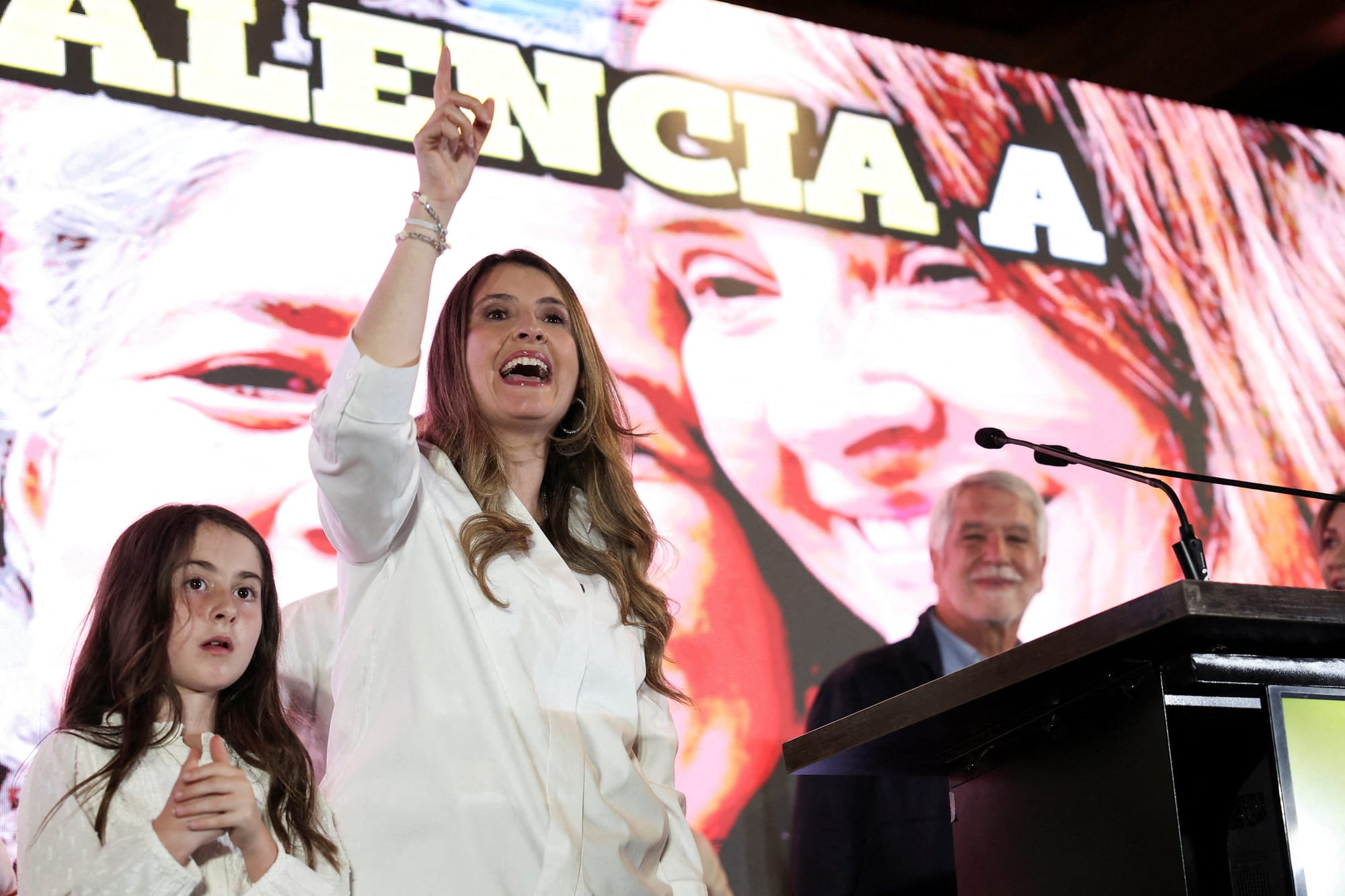
The reaction from within the right was immediate and unifying. Juan Carlos Pinzón publicly acknowledged defeat and announced his retirement from public life, asking all his voters to support Valencia. David Luna pledged to work for Valencia’s victory, and Vicky Dávila personally embraced Valencia, telling her: “You have a very great responsibility—to defend Colombia and protect our democracy and our freedom.”
Former President Álvaro Uribe's Democratic Center party framed the result as a tribute to slain senator Miguel Uribe Turbay, whose assassination last year had thrown the party’s presidential plans into disarray.
A Fragmented Congress With No Clear Majority
While the presidential primary results arrived quickly, the congressional picture will take days to fully resolve. The Historic Pact and Democratic Center remain locked in a very close contest for seats in both chambers, with neither achieving a clear advantage—a result that foreshadows a fragmented Parliament and intense political negotiation for the 2026–2030 term.
Partial tally data show the Historic Pact emerging as the most-voted force in the Senate, consolidating an expansion of its parliamentary presence. Behind it, the Democratic Center registered growth compared to its current representation, moving from 13 seats to an estimated 16 or 17—a recovery that consolidates it as the primary opposition force.
Behind the two main forces, traditional parties maintained a significant presence: the Colombian Liberal Party ranked third with approximately 13 seats, the Green Alliance secured around 11, and the Conservative Party held roughly 10.
Other parties winning representation include the Party of the U with 8 seats, Radical Change/Alma with 7, MIRA/New Liberalism with 5, and National Salvation—the small far-right party aligned with de la Espriella—with 4, having surpassed the 3 percent threshold at the last minute.
Several parties failed to cross the threshold entirely, including the Broad Unitary Front led by Roy Barreras, We Believe—the party of Medellín mayor Federico Gutiérrez—the Citizen Power coalition, and All for Colombia, the political vehicle of Juan Daniel Oviedo.
The elimination of Oviedo’s congressional vehicle is particularly significant: without a party in Congress, his leverage as a potential Valencia coalition partner is limited to his personal vote bank.
A Day Under Siege: Cyberattacks and Border Chaos
Sunday’s elections were not only a political contest—they were a stress test of Colombian institutional resilience, and the results there were considerably more troubled.
National Registrar Hernán Penagos reported that the electoral authority’s digital infrastructure faced sustained cyberattacks peaking at between 100 million and 300 million IP addresses attempting simultaneous access throughout the day.
Alongside the volumetric attacks, authorities identified at least 30 attempts to impersonate the official electoral website and 60 internet profiles actively working to distort or replace official results information on social media.
Penagos urged citizens to consult only official channels and insisted that technical conditions were guaranteed to publish and consolidate pre-count results—but the scale of the assault was unlike anything previously reported in a Colombian election.
The electoral authority said its platforms faced a wave of website impersonation attempts, with officials urging voters to rely on official channels only and calling for rapid hardening of systems. Analysts noted that the attack profile appeared designed not necessarily to alter vote counts directly, but to sow confusion, generate parallel information ecosystems, and undermine public confidence in whatever results emerged.
On the ground, the picture was equally unsettling. Defense Minister Pedro Sánchez announced that a group of at least 2,400 people allegedly heading to vote were detected trying to enter Colombia via an illegal border crossing with Venezuela in Norte de Santander, despite announced border closures during the election process.
“They are doing so illegally,” said Sánchez, adding that “this is a clear case of a crime being committed.”
President Petro described the incident as “large-scale fraud” and an “avalanche of illegal voting,” calling on the mayor of Cúcuta to take action and writing on X that sixty buses had been detained and demanding investigations into the transportation company responsible.
Armed groups separately harassed a rural polling post in Puerto Lozada, in the municipality of La Macarena in Meta department. A video circulating on social media showed election jurors on the floor taking cover during an armed confrontation. The electoral authority confirmed that half an hour after polls closed, the pre-count had not been able to begin at that location.
The Ministry of Defense documented 38 cases of money seizure tied to electoral operations, with 41 people captured in those actions, while authorities registered 24 detentions for electoral crimes and 71 additional detentions for money laundering and related offenses.
Law enforcement seized more than 3.6 billion Colombian pesos—approximately $572,000—allegedly intended for vote buying. Among those detained was Víctor Hugo Moreno, a former governor of Amazonas and Democratic Center candidate for the Chamber, who was accused of attempting to bribe officers before being released hours later. The party expelled him before polls closed.
Center and Left: Winners With Asterisks
In the centrist primary, former Bogotá mayor Claudia López achieved a clear victory, positioning herself as the center’s candidate for May 31. But her consultation drew a fraction of the votes Valencia’s generated—accounting for just 6.77% of total primary votes cast Sunday, compared to the right-wing consultation’s commanding majority share.
The enthusiasm gap is real and will be difficult to close.
On the left, Roy Barreras secured the nomination within the Front for Life coalition after defeating Daniel Quintero—despite polls that showed Quintero leading heading into election day. But with the Historic Pact having instructed its base not to participate in Barreras' primary, and with Iván Cepeda remaining the undisputed choice of Colombia’s left, Barreras enters May 31 as a secondary figure rather than a genuine contender.
What Happens Next
Colombia’s presidential election is scheduled for May 31, with a runoff between the top two vote-getters on June 21 if—as is near-certain in a crowded field—no candidate secures an outright majority.
The field heading into that first round now features Iván Cepeda backed by the Historic Pact; Paloma Valencia as the energized institutional right; Abelardo de la Espriella as the far-right outsider; Claudia López representing a center struggling to generate momentum; and Roy Barreras with limited reach beyond his political machine.
The new Congress—fragmented, polarized, and dominated by two blocs that cannot govern alone—will complicate the next president’s agenda from day one, regardless of who wins. And the integrity questions raised by Sunday’s cyberattacks, border incident, and armed intimidation could shadow the process between now and May 31, giving both Petro and opposition figures ammunition to question results if the outcome doesn’t go their way.
Colombia has voted. The real campaign—and the real battle over what Sunday meant—begins now.


