


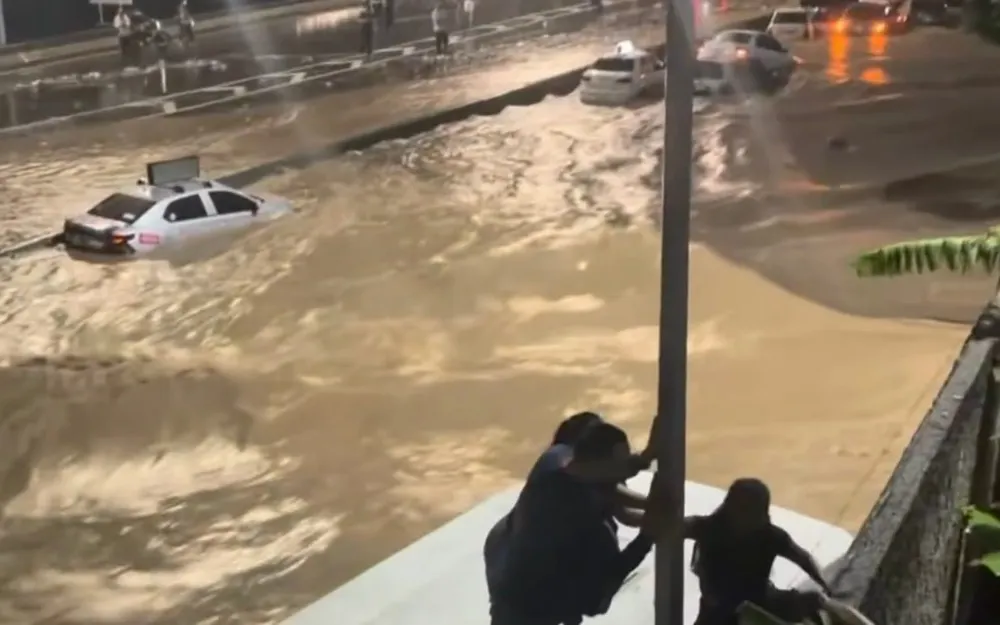
CARACAS — Caracas experienced fresh, severe flooding on Saturday, August 22, as intense afternoon rainfall overwhelmed the city’s drainage infrastructure once more, striking several of the same vulnerable sectors that have flooded repeatedly throughout the month.
What Happened
Venezuela’s National Institute of Meteorology and Hydrology (Inameh) had forecast the storm system in its atmospheric bulletins ahead of Saturday afternoon, and the rainfall arrived as predicted, triggering widespread street flooding (anegaciones) across multiple points in Greater Caracas.
Among the most significant impacts was the collapse of the drainage system at the Mercado de Coche station on the Caracas Metro, where the volume of water made pedestrian and vehicle access to the subway entrance difficult. Residents and traffic monitors shared video on social media showing strong currents of water overtaking major avenues across the city.
Two areas saw particularly heavy reporting of emergencies: the Ojo de Agua sector in Baruta municipality, and the entrance to the Santa Ana sector along the Carapita-Antímano corridor in western Caracas — a stretch of the city that has flooded repeatedly throughout August, including a partial home collapse and additional flooding reported there just days earlier, on August 17-18.
Part of a Month of Repeated Flooding
Saturday’s flooding extends what has become a torrential pattern for Caracas throughout August. The most severe single episode came the weekend before, when Tropical Wave #37 brought torrential overnight rain on August 15-16, killing three people — including two teenage girls swept away by rising water in La Vega parish — and causing flooding across all 22 parishes of the Libertador municipality, Caracas’s core urban district.
Guaire River in Caracas, Venezuela, overflowing onto the Valle Coche highway near Santa Mónica. Source: X
Mayor Carmen Meléndez deployed emergency crews alongside Ministry of Public Works teams and support from La Guaira’s regional government in response to that earlier storm.
A City Whose Vulnerabilities Keep Repeating
The recurrence of flooding in the same specific sectors — Antímano, Carapita, and the broader western Caracas hillside corridor in particular — points to a consistent underlying vulnerability rather than a series of unrelated incidents.
Caracas’s hillside topography channels heavy rainfall rapidly downhill through informal settlements built into these slopes, while the city’s drainage infrastructure, as demonstrated by Saturday’s failure at the Coche metro station, has repeatedly proven unable to absorb the volume of water these storms produce.
Authorities’ Response
Following Saturday’s flooding, authorities urged residents to take precautions and avoid areas showing significant water accumulation, and issued a broader warning to exercise caution given ongoing storm activity across a wide swath of the country, including the Capital District, Miranda, La Guaira, Bolívar, Amazonas, Anzoátegui, Yaracuy, Lara, Zulia, the Llanos region, and the Andes.
With Venezuela still within its peak rainy season and Inameh’s forecasts indicating continued storm activity across the same affected regions, further flooding in Caracas’s most vulnerable sectors remains a real possibility in the days ahead.
Whether the city’s drainage infrastructure — already shown to be a point of failure at Coche station — can withstand additional storms without further damage, and whether repeated flooding events like Saturday’s prompt any structural response from authorities, remain open questions as the season continues.
Fuertes lluvias en Caracas generan desbordamiento del río Guaire.
— Victor Ugas (@VictorUgas58) August 23, 2026
Varias zonas afectadas. pic.twitter.com/W7auXKkD8I